




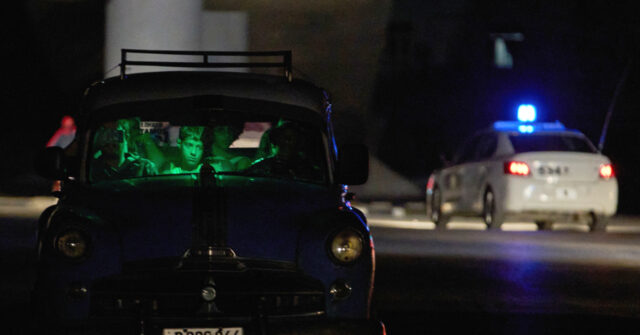
The Madrid-based outlet Diario de Cuba published harrowing testimonies Monday from residents of Havana denouncing arrests and beatings by communist thugs intended to keep them from protesting during the routine nighttime blackouts in the country.
Cuba’s decades-old inhumane situation has worsened in the past months after the Castro regime, which has brutally repressed Cubans for over 67 years, found itself abruptly deprived of access to Venezuelan oil following the United States’s arrest of socialist dictator Nicolás Maduro in Caracas. For over two decades, the rogue communists relied on virtually free shipments of Venezuelan oil to keep their ailing regime afloat while helping their Venezuelan ideological protégés prop up their regime and providing security to Maduro in return.
The lack of Venezuelan support has led to a noticeable surge in daily anti-communist protests across Cuba. Protesters have availed themselves of anonymity granted by the dark during nighttime blackouts to take to the streets, start fires, and bang pots and pans in protest against communism.
Diario de Cuba reported that, in the face of growing disrespect for the Castro regime, the Cuban people’s weariness, and a shift in the geopolitical landscape that has left the Cuban Communist Party in unprecedented isolation, “a new order of battle has been issued” to silence the population through police repression “calculated down to the last detail.”
The outlet explained that police repression and the fear of being taken to a police station and tortured have imposed a de facto curfew on the people of Havana.
Diario de Cuba spoke with “El Chino,” a man who wished to be identified under the pseudonym out of fear of repercussions. He recounted that he was brutally beaten by police officers patrolling the streets of Havana. He was allegedly identified as “prone to protest” after he explained to the officers that he was going to buy cigarettes and refused to be searched for drugs. El Chino detailed that he was taken to a police station in central Havana, where he was charged with “resisting arrest” and released after posting a bail of 7,000 Cuban pesos (roughly $291.59).
“No drugs or any other evidence were found on El Chino that would justify the search, the beating, the arrest, or the charges. They took him to a hospital solely to perform a blood test, even though he was bleeding from his head and nostrils,” Diario de Cuba wrote.
The man’s family reportedly found him with a swollen face and bloodstained clothes when they arrived at the police station after being alerted by a neighbor who witnessed the incident.
Damián Conesa, a Havana resident, explained to Diario de Cuba that he was beaten by half a dozen police officers while walking through an area in Havana’s Príncipe People’s Council district when it experienced a power outage for “simply smelling of alcohol.” He stressed to the outlet, “This isn’t an isolated incident, but rather the police’s new practice once night falls, forcing people to impose a ‘curfew’ on themselves.”
“It is fear that keeps you from setting foot on the street at night or in the early morning. The government claims that the protests against the blackouts and the country’s situation are led by people who are drunk or under the influence of drugs,” Conesa said. “That is the ordinance; therefore, if the police stops you in a certain neighborhood and you have alcohol on your breath or are behaving erratically, you are suspected of disturbing the peace or prone to protesting.”
Conesa emphasized that the Cuban regime, instead of addressing the use of narcotics and alcohol as a public health issue, exploits it as an argument to justify repression and discredit the protests.
“The argument is that those who use these substances are prone to engaging in demonstrations that ‘disrupt public order’ or ‘commit crimes against State Security,’” he said.
“It’s nothing new that they want to twist the reasons behind the pot-banging protests,” Yanisey Travieso, a neighbor from Dolores, told Diario de Cuba. “They no longer know how to label those of us who are protesting against the prolonged blackouts and the country’s overall situation. They’ve called us everything from drunks to rabble.”
Travieso explained that her husband was beaten and accused of “disturbing the peace” after he went out on an urgent errand at midnight. She further detailed that whenever the Cuban regime has to cover the protests on its news broadcasts, it always shows “drunks, drug addicts, and criminals with extensive criminal records — or citizens ‘misled by the enemy’ and by the independent press,” used as a pretext to send the police to patrol at night and crack down on the protests.
Travieso stressed that anyone who, for whatever reason, is out at night or in the early morning hours during blackouts is subject to being approached by Cuban law enforcement and potentially branded a “public order offender.”
“These are not isolated incidents. It is a new form of police repression that leaves you with no options: on the one hand, crime and social violence, and on the other, unscrupulous police repression that resorts to brute force and lies,” Travieso denounced.
“People are too scared to even go out and take out the trash, because they might accuse you of trying to set fire to the mountains of trash in your neighborhood,” Alexander Vizcaíno, a resident of the Belén People’s Council, said, detailing that he was accused of trying to burn trash and damage an underground cable line.
“I went out to take out the trash and ended up at the police station, badly beaten and accused of I don’t know how many crimes. The fact that I wasn’t carrying my ID card set everything off, even though two neighbors told the officers that I was from the neighborhood,” Vizcaino recounted.
“They turned a deaf ear, threatened the two neighbors, and when I protested, the beating began — and with great viciousness,” he continued. “I took it personally, very personally. I’ve never been involved in anything political, but since that day I haven’t stopped banging pots and sharing every protest and every demonstration in Cuba on my social media.”
“There are those who claim that the end of the government is near, and I believe it, because this sort of ‘curfew’ seems, as the saying goes, like one of the last death throes of a hanged man,” Vizcaíno concluded.
Christian K. Caruzo is a Venezuelan writer and documents life under socialism. You can follow him on Twitter here.
Read the full article here


