


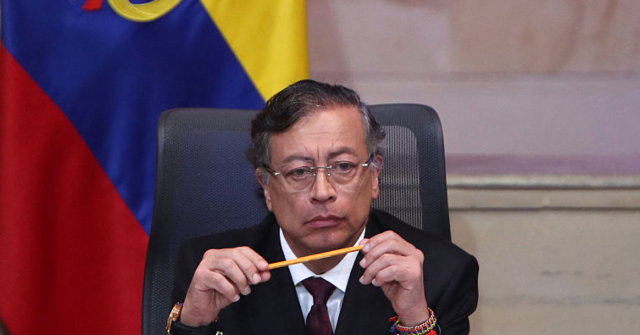
Colombian narco-terrorist groups experienced a staggering 90 percent growth in their ranks during the four-year, far-left presidency of Gustavo Petro, the Colombian newspaper El Tiempo reported on Monday.

El Tiempo, citing data documented by the Colombian think tank Ideas for Peace Foundation (FIP), explained that all armed terrorist groups in Colombia collectively amounted to 15,120 members by the end of 2022. The numbers nearly doubled in the following years, reaching 28,802 members by the end of July 2026 — an increase of 13,682 members representing a 90 percent growth.

According to the data, the narco-terrorist group Clan del Golfo reportedly experienced the largest growth over the past years, going from 4,061 known members to 12,268, more than doubling its ranks between December 2022 and July 2026. U.S. Secretary of State Marco Rubio designated the Clan del Golfo as a Foreign Terrorist Organization (FTO) and a Specially Designated Global Terrorist (SDGT) group in December for its extensive cocaine trafficking operations and multiple terrorist attacks against Colombian society.

The National Liberation Army (ELN) Marxist terrorist group experienced a 22 percent growth within the same time period, going from 5,851 to 7,123 members. Similarly, the Revolutionary Armed Forces of Colombia (FARC), a Marxist terrorist group that supposedly “disbanded” in 2016 after it signed a “peace deal,” experienced significant growth among its different decentralized branches, with 10,424 known members spread across its four main factions.

“Added to these are structures that were not classified as organized armed groups (GAO) in 2022, such as the ‘Conquering Self-Defense Forces of the Sierra Nevada,’ with 737 members, and ‘Comuneros del Sur,’ with 250 (an organization that was part of the ELN at the time),” El Tiempo reported.

“The growth of these structures occurred progressively over the four-year period and coincided with the consolidation of 14 scenarios of simultaneous confrontation between illegal groups,” the newspaper continued.

El Tiempo also noted that conflicts over the control of strategic corridors, drug trafficking routes, illegal mining, and other illicit economies also led to a significant rise in cases of forced displacement inside Colombian territory over the past years.

The shocking increase in the ranks of Colombian narco-terrorist groups documented by FIP occurred throughout the years that the now-outgoing administration of Marxist President Gustavo Petro enacted its “Total Peace” plan, an initiative that prioritized engaging in multiple “negotiations” with Clan del Golfo, ELN, FARC, and other criminal groups towards ending the corresponding armed conflicts.

The Total Peace plan has been widely described as a failure, as many of the negotiation attempts ended up either suspended or with no meaningful results. Some of the negotiation rounds reportedly occurred while the corresponding terrorist groups continued to engage in violent actions throughout Colombia. Ultimately, Total Peace did not result in the dismantlement of the nation’s terrorist groups, nor did it led to any tangible progress towards ending any of the group’s conflicts with the Colombian state.

Petro appeared to downplay his role in leading the Total Peace plan this year, claiming to the Spanish public broadcaster RTVE that it was a “national” failure and not a “personal” one.

At press time, Petro is in the final 72 hours of his administration. Petro’s four-year presidential term will end on Friday, August 7. On that day, he will be succeeded by incoming conservative President-elect Abelardo de la Espriella, who Petro has repeatedly failed to recognize as the winner of June’s presidential election runoff.

Unlike Petro and his Total Peace plan, President-elect de la Espriella has repeatedly vowed that his administration will enact a hardline stance against Colombia’s terrorist groups, insisting on the need to “bomb narco-guerrilla camps.” De la Espriella has also promised that he will immediately repeal the Total Peace-related mechanisms and reactivate all arrest warrants against terrorist group members that had been suspended through the “negotiation” processes.

Last month, the conservative president-elect issued a “30-day ultimatum” to ELN leaders hiding in the Department (state) of Santander to surrender, and declared, “any bandit who does not submit will be taken out.” De la Espriella has issued similar “ultimatums” to other armed groups in other areas of Colombia over the past weeks.

El Tiempo‘s report comes just hours after the Colombian newspaper El Colombiano published a separate but equally worrisome report indicating that Colombian terrorist groups are utilizing social media platforms — predominantly TikTok — to recruit young Colombian children and teenagers into their ranks.

Christian K. Caruzo is a Venezuelan writer and documents life under socialism. You can follow him on Twitter here.


Read the full article here

Share.
Leave A Reply

Exit mobile version