




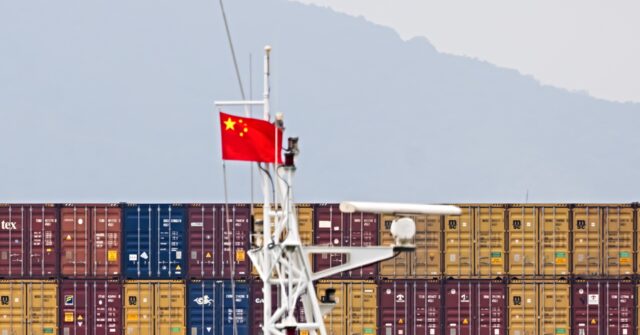
China dethroned Germany as Spain’s top supplier of goods during the first quarter of 2026, fresh data from the Spanish government reveals.
The data, cited by the Spanish newspaper El País on Thursday morning, showed Chinese goods accounted for 11.6 percent of all of Spain’s imports during the first four years of 2026 — an amount slightly higher than the 11.4 percent of goods imported in that same period from Germany, Spain’s historically top supplier. Chinese exports to Spain during Q1 2026 reportedly amounted to over 12.5 billion euros.
El País explained that the only time in which China had overtaken Germany as top supplier of goods to Spain in the past was in 2022, when microchip shortages brought the German car making sector to a standstill. Such circumstances, however, were temporary, with Germany reclaiming the title of Spain’s top supplier by 2023 — returning to its relatively unchanging 11 percent baseline.
Unlike four years ago, the data cited by El País indicates a continued “structural” upward trend for Chinese exports to Spain from 2023 onwards leading to Q1 2026’s results rather than it being caused by isolated problems such as the scenario faced by Germany in 2022. Additionally, El País suggested, China’s export boom to Spain is also sustained by a shift to low-cost Chinese products sold through online platforms such as Temu and Shein.

While Chinese exports have been steadily securing a greater foothold in Spain over the past years, data indicates that Spain’s exports to China have instead stagnated at around two percent per year, which makes China the eleventh-largest destination for Spanish goods. China sold roughly 50.25 billion euros’ worth of goods to Spain during 2025, ranging from machinery, technology, office supplies, textiles, chemical products, vehicles, toes, and shoes.
In contrast, the Asian nation spent 7.97 billion euros importing Spanish goods during the same year — which translates to a notably significant 42 billion trade deficit for Spain. Minerals, pork and other meat products, and other types of chemicals were among Spain’s top exports to China in 2025.
Raymond Torres, Director of Economic Trends and Analysis at the Spanish private firm Funcas, explained to El País that while Spain’s two-way exchange with Germany sees Spain export slightly less than what it imports to Germany, the trade relationship between both European nations is more balanced than Spain’s trade with China.
“In the case of automobiles, the Spanish components sector has benefited from trade with Germany, just as in the aircraft sector, where we produce certain parts and they produce others, which has a knock-on effect on the Spanish production system,” Torres detailed.
“This is not the case with China. These are substitute imports, whether from other suppliers, such as Germany, or from Spanish production,” he detailed.
Alicia García Herrero, a Spanish researcher and economist at the financial firm Natixis, warned to El País of the dangers of China’s growing penetration into the Spanish economy — as this, in turn, can leave Spain “hyper-dependent” on China and forcing the country to follow its trail.
“That’s why it’s dangerous. Also because it’s not reciprocal. China competes with us in third-party markets, entering them just as it does in Spain,” García Herrero said. “And even though the country is innovating aggressively, it provides a lot of subsidies, especially to automakers, which helps them gain market share.”
Socialist Prime Minister Pedro Sánchez strongly praised the Chinese communist regime led by dictator Xi Jingping during his official April visit to Beijing — and called upon the European Union to embrace his vision of China as a “partner” of the EU. At the time, Sánchez affirmed to Xi that Spain would always work for “mutually beneficial” EU-China relations in which “dialogue, reciprocity and harmony prevail.”
Read the full article here


