

Close Menu
The Politic ReviewThe Politic Review
  • News
  • U.S.
  • World
  • Politics
  • Congress
  • Business
  • Economy
  • Money
  • Tech
  • More Articles
Trending

FIFA Officially Charges Argentina for Waving Falklands Banner at World Cup

July 30, 2026

Sen. Rick Scott to Anthony Fauci: You’re Hiding Behind ‘Fraudulent’ Autopen Pardon

July 30, 2026

First, the Loss – Now, the Judicial Costs: Prince Harry May Have an 8-Figure Bill To Settle After Losing Privacy Suit in the UK Against Daily Mail

July 30, 2026
Facebook X (Twitter) Instagram
  • Donald Trump
  • Kamala Harris
  • Elections 2024
  • Elon Musk
  • Israel War
  • Ukraine War
  • Policy
  • Immigration
Facebook X (Twitter) Instagram
The Politic ReviewThe Politic Review
Newsletter
Thursday, July 30
  • News
  • U.S.
  • World
  • Politics
  • Congress
  • Business
  • Economy
  • Money
  • Tech
  • More Articles
The Politic ReviewThe Politic Review
  • United States
  • World
  • Politics
  • Elections
  • Congress
  • Business
  • Economy
  • Money
  • Tech
Home»Economy»Rearmament: UK Govt Pushes For New Generation of Explosives Factories to Fix Post-Cold War Deindustrialisation
Economy

Rearmament: UK Govt Pushes For New Generation of Explosives Factories to Fix Post-Cold War Deindustrialisation

Press RoomBy Press RoomJuly 30, 2026No Comments7 Mins Read
Share Facebook Twitter Pinterest Copy Link LinkedIn Tumblr Email VKontakte Telegram

The British government is seeking to build “at least six new munitions and energetics factories” after the Ukraine War experience showed how fast ammunition is used in a near-peer conflict, and how long it takes to make more when the industrial base no longer exists.

The Ministry of Defence has announced a funding package to support 22 unnamed companies to underwrite their costs in building “at least six” new factories to produce what the industry calls energetics, which might better be known as explosives, propellants, and pyrotechnics. The selected businesses will receive up to £300,000 each to “develop proposals for the creation of new factories producing energetic materials used in munitions”, and the winners in the competition will receive contracts “worth up to £5 million each” to get the ground broken on building the new facilities.

According to the government’s statement, the project is intended to move — at least by Whitehall standards — at a very brisk pace. The proposals are due to be made by the end of the summer, and construction of new munitions factories should begin before the end of 2026. The rush to build is part of a century-long story of corporate amnesia in which London has repeatedly destroyed its own armaments factories to save money in peacetime, only to be surprised, yet again, when war returns.

The Ministry of Defence also said that sourcing explosives domestically would “help bring high-skilled manufacturing back to industrial communities across the UK” and noted: “The war in Ukraine shows the importance of the fast resupply of munitions by industry, and the studies are advancing… the UK’s ability to deter threats while providing skilled manufacturing jobs”.

The United States is also working on this problem, and in 2023, the then-Department of Defence launched a National Energetics Plan to overcome America’s ability to scale weapons production. NATO has for years expressed concerns that the parlous state of Western industry is undermining the alliance’s deterrence, as enemies understand that while the West may have the best weapons, it has few of them and they can’t be replaced quickly enough in a protracted fight.

Indeed, the Ukraine War has been characterised by prolonged weapons shortages for Ukrainian forces, from the very basics like the humble artillery shell, all the way up the scale to highly sophisticated surface-to-air missiles like the Patriot system. Western allies of Ukraine have all but emptied their own national stockpiles of a wide range of weapons to keep Kyiv in the fight, and in many cases discovered with surprise that the industrial capacity to simply order more no longer exists.

An early decisive moment for Ukraine after the initial Russian invasion was the success of the Anglo-Swedish NLAW anti-tank missile in stopping Russian armour in the rush to capture Kyiv, and the British government responded to this impressive performance by resolving to send more missiles. Yet despite being a nearly new and barely proven weapon system, the fickle post-Cold War procurement system of Western militaries meant the production lines had already vanished, with the expertise acquired scattered. In some cases, the very companies that had made the components for the sophisticated missiles had already shut down.

As stated then, on how this came to be, Breitbart News reported:

[the finger was pointed at] a series of previous governments going back to the 1990s changing the way defence procurement worked from the end of the Cold War from a situation where weapons were in constant production and stockpiled, to one where occasional orders anticipating future demand became the norm.

The old Cold War way was “highly resilient [with] enormous stockpiles”, [James Heappey, the then-British junior minister for Defence Procurement] said, but such a system comes at a financial cost. The war against terror era brought predictable cycles of military deployments with comparatively low-intensity use of munitions and defence acquisition run on “just-in-time” delivery principles used by civilian industry.

Efficient as that may be, Heappey said it “does not work when you need to be ready for a fight tomorrow and crucially your capacity to fight that fight tomorrow is part of the deterrence.”

Defence procurement before Ukraine, Heappey told the conference, was essentially on feast-to-famine lines, where the state would occasionally buy “5,000 of those highly advanced missiles that should be enough to see us through… 30,000 rounds of artillery ammunition in a bunker, that will see us through”. The aggregate impact of that, he said, was the government had suddenly discovered in a time of unexpected crisis, industry was unable to respond quickly and scale to meet demand.

… [then-NATO boss] Admiral Bauer said the weapons gifted to Ukraine were coming “not from full warehouses, we started to give away from half full or lower warehouses in Europe. Therefore the bottom of the barrel is now visible”. Just-in-time economics were no longer suitable for Western defence, he said, because “we need the industry to ramp up the production at a much higher tempo. We need large volumes.

“The just-in-time, just-enough economy that we built together in our liberal economies for 30 years is fine for a lot of things, but not for the armed forces when there is a war ongoing.”

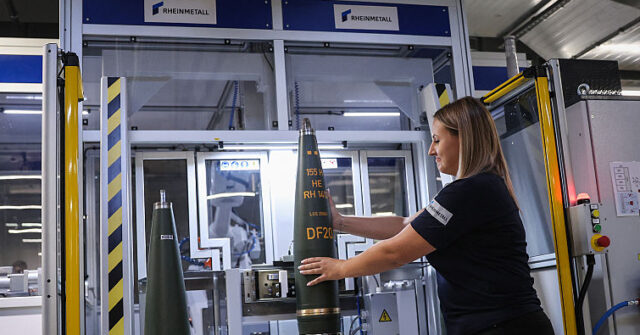
While explosives and propellants, as targeted in the new Ministry of Defence drive to build energetics factories, are not the only bottleneck in Western defence procurement, they are a considerable one. With 155mm artillery shells, the process of precision forging and machining the bursting cases requires heavy industrial capacity and sovereign steel in wartime, but the actual production of explosives is now so exceptionally offshored since the end of the Cold War, and it is stated by The Daily Telegraph that there is now only one factory in Europe producing the TNT needed for the shells.

The enormous demand for shells in the war led to prices surging on the global market as stockpiles were quickly depleted, and a handful of factories in friendly nations that were still making them saw their order books fill up. As reported, 155mm artillery shells — essentially antique technology not meaningfully changed in decades — soared from $150 a round in the 1980s to $4,000 per shot this decade.

The United Kingdom’s rush to accelerate munitions production as the world seems ever-closer to wider conflict is deeply reminiscent of previous boom-bust cycles in the British defence industry. Having massively expanded the Royal Ordnance Factories during the First World War, the British government then shed them as quickly as possible in the peace, selling off equipment, buildings, and land wholesale.

As in the 1930s, when the UK foresaw a looming war and was rearming, the process was slowed and costs were driven up by the need to rebuild the weapons industry. Once again, after the Second World War, these factories were rapidly dismantled from the 1950s onwards, and the whole process cycled again at the end of the Cold War. Yet today, the British government starts from an even lower baseline: while temporary and permanent Royal Ordinance Factories and other factories were destroyed after previous wars, the government at least kept the Royal Woolwich Arsenal.

With a history going back hundreds of years, the enormous facility in East London both built and stockpiled weapons, explosives, and ammunition. The site was privatised and closed down by the 1990s, and today it stands as a large housing estate.

Read the full article here

Share. Facebook Twitter Pinterest LinkedIn Tumblr Email Telegram Copy Link

Related Articles

Economy

GOP Sen. Kennedy: Labor Market ‘Okay,’ ‘Not Great’, Tariffs a Cause of Inflation

July 30, 2026
Economy

Doug Casey on Trump Accounts and the Coming Raid on Retirement Savings

July 30, 2026
Economy

John Cornyn Threatens to Sink Todd Blanche as DOJ Will Not Recind Trump IRS Fund

July 30, 2026
Economy

A Divided Fed Holds Interest Rates Steady

July 29, 2026
Economy

Breitbart Business Digest: Why Are Young Americans So Much More Confident Than Everyone Else?

July 29, 2026
Economy

‘Incredible Moment in History’: Mark Zuckerberg Advocates for Widespread Access to AI Superintelligence

July 29, 2026
Add A Comment
Leave A Reply Cancel Reply

Editors Picks

Sen. Rick Scott to Anthony Fauci: You’re Hiding Behind ‘Fraudulent’ Autopen Pardon

July 30, 2026

First, the Loss – Now, the Judicial Costs: Prince Harry May Have an 8-Figure Bill To Settle After Losing Privacy Suit in the UK Against Daily Mail

July 30, 2026

U.S. Launches ‘Powerful’ Strikes on Iran After Trump Vows to ‘Hit Hard’ over Attacks

July 30, 2026

Rearmament: UK Govt Pushes For New Generation of Explosives Factories to Fix Post-Cold War Deindustrialisation

July 30, 2026
Latest News

China Brings Back Masking for Vulnerable People as Summer Coronavirus Spike Sweeps South

July 30, 2026

Inside the lobbying fight threatening Congress’ college sports overhaul

July 30, 2026

Trump Takes a Swipe at Cornyn as RINO Senator Refuses to Vote to Confirm Blanche – Cornyn Responds (VIDEO)

July 30, 2026

Subscribe to News

Get the latest politics news and updates directly to your inbox.

The Politic Review is your one-stop website for the latest politics news and updates, follow us now to get the news that matters to you.

Facebook X (Twitter) Instagram Pinterest YouTube
Latest Articles

FIFA Officially Charges Argentina for Waving Falklands Banner at World Cup

July 30, 2026

Sen. Rick Scott to Anthony Fauci: You’re Hiding Behind ‘Fraudulent’ Autopen Pardon

July 30, 2026

First, the Loss – Now, the Judicial Costs: Prince Harry May Have an 8-Figure Bill To Settle After Losing Privacy Suit in the UK Against Daily Mail

July 30, 2026

Subscribe to Updates

Get the latest politics news and updates directly to your inbox.

© 2026 Prices.com LLC. All Rights Reserved.
  • Privacy Policy
  • Terms of use
  • For Advertisers
  • Contact

Type above and press Enter to search. Press Esc to cancel.