








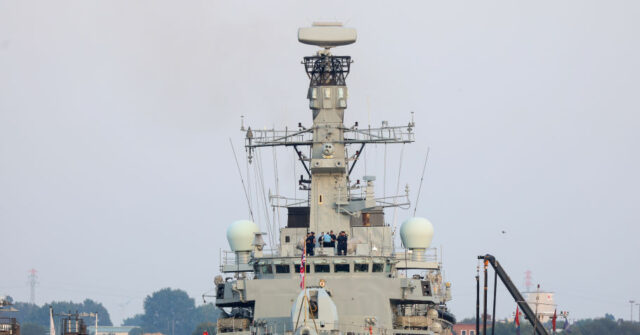
Britain may have stopped publicly announcing its steady decline in warship numbers towards zero, as report claims theoretically active frigate is de-facto out of service.
It is a practice long associated with third-world navies, keeping decrepit, unseaworthy ships on the books for the sake of prestige, or to cover corruption, and now Britain’s Royal Navy stands accused of the same, with recently refitted and officially active warship HMS Iron Duke stripped of her combat systems and “unlikely ever to sail again”.

According to analysis by British intelligence group Navy Lookout, the Iron Duke is without weapons or sensors, its crew likely dispersed to other ships, and is in a state they describe as being de-facto decommissioned.
As things stand, Britain has very few frigates, almost certainly the lowest number ever in the half-millennia-long history of the Royal Navy stretching back to Tudor England, and the number is dwindling every year. Replacements now under construction not due in service until long after the ships they replace are due to be out of service — an inevitable consequence of the government not having ordered a single new frigate between 1996 and 2017 — and between the benching of Iron Duke and the already announced decommissioning of HMS Richmond due this autumn, the Royal Navy will be down to just five frigates.
This presents a serious problem for Britain’s ability to project maritime power or even just protect its home waters. From a force of five ships, between maintenance and training periods, the country could perhaps hope to count on two or three ships being available for use at a time. Today, just two are at sea, with the remaining three in refit and maintenance.
Yet even performing the most basic tasks asked of the Navy requires more ships: the United Kingdom is supposed to be a major contributor to hunting Russian submarines in the Atlantic, and its frigate force are the only ships equipped with the best submarine-tracking sonar. Britain’s two large aircraft carriers are a potent weapon, but can’t reasonably go to sea and deploy abroad without a frigate screen to protect them from submarines.
Without other NATO allies lending Britain warships to make up the numbers of a carrier strike group, generating such a force in the near-term seems a remote possibility. And in case of an unexpected war, Britain’s allies may decline to get involved.
Navy Lookout said given the Navy’s commitment to submarine hunting in the Atlantic, the carrier escort force could “at best” now hope for one frigate.
The loss of Iron Duke to the harbour wall is particularly shocking, the report stated, given the ship only comparatively recently completed a major ‘life extension’ refit, intended to get years more use out of the hull with repairs and new weapon systems. Costing over £100 million and taking over five years, once the ship was back in service it managed just 16 months more at sea before being apparently deactivated.
Eventually, the Royal Navy is to receive two new classes of Frigates, one of specialist anti-submarine ships and one of general purpose escorts. Yet even the first ships of these classes remain years away from being ready to actively deploy, and with the present rate of attrition of the few remaining frigates in service being what it is, it is distinctly possible the already parlous number of five will plunge lower still.
Britain’s frigate force is not the only part of the Royal Navy stumbling under the pressure of decades of funding starvation and delayed ship-building orders, leaving so-called capability gaps where government bean-counters bet on no unforeseen crises arising between one old ship or system being retired and its replacement entering service, sometimes several years later. While this gamble might be argued to have paid off in the past, such a capability gap came back to bite the government when Britain was left unable to deliver on its longstanding commitments to mine hunting in the Gulf region when called upon by the United States.
The submarine force is facing its own crisis, with maintenance periods on nuclear boats lengthening, forcing those at sea into ever-longer patrols, which are punishing both on the crews and equipment, tipping the Navy into a vicious downward spiral of burnout and material attrition. The Navy has just six destroyers, and like the frigates can only put a couple to sea at a time thanks to maintenance issues, again this shortcoming was bared to the world this year when the air-defence speciality ships were needed on the fringes of the Iran war and couldn’t be deployed with any sort of urgency. The sole ship that finally made it to the eastern Mediterranean was quickly withdrawn after it developed a defect.
Read the full article here


