




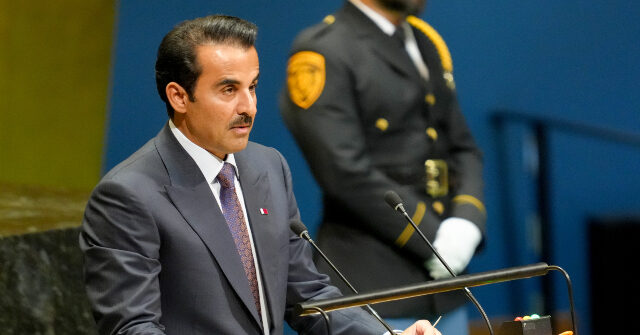
Qatar’s hereditary ruler, Sheikh Tamim bin Hamad al-Thani, complained about the “dangerous situation” in the Middle East during his address to the U.N. General Assembly (UNGA) on Tuesday, but only briefly mentioned Iran, which has wantonly attacked his country with drones and ballistic missiles.
“At the heart of the dangerous situation we are witnessing lies the absence of a regional system of collective security, one that respects the sovereignty, security, and territorial integrity of states, one that promotes the peaceful settlement of disputes and the non-interference in the internal affairs of states,” he said.

“We have previously called from this very podium for the establishment of such a system, and we reiterate that call after recent events have demonstrated the urgent need for it,” he continued.
“In the absence of such a system, it has become possible for a war to erupt owing to considerations unrelated to the interests of the countries of the region. It has become possible for one party to drag its neighbors into a war that is not theirs, targeting their vital assets and installations, despite their strenuous efforts to avert escalation,” he said. It was the closest he came in his speech to criticizing Iran for attacking Qatar.
The emir continued with oblique criticism of Iran for shutting down the Strait of Hormuz with terror attacks. He noted, “It has become possible for an international waterway through which nearly a quarter of the world’s energy trade passes to be closed,” and for “the lifelines of the global economy to be turned into tools of pressure and bargaining with people on every continent bearing the cost.”
The emir said he remained “convinced that the crisis in the Gulf can be resolved through diplomatic means by reopening the Strait of Hormuz to maritime navigation and returning to negotiations in order to avert war, paving the way toward a lasting solution that ensures security and stability for the entire region, including Iran.” It was the only time he mentioned Iran by name.
The emir praised his own government for devising “resilient, flexible economic plans” to mitigate “the severe adverse impact of the war.”
The Qatari leader was far more critical of Israel than of Iran, slamming them for creating a “catastrophe” in Gaza and allegedly plotting to “displace the population.”
He claimed:
When the extent of global public revulsion at the practices of the Israeli occupation becomes evident, instead of looking in the mirror, they resort to hurling accusations indiscriminately, in all directions — at times invoking accusations of anti-Semitism, and at others resorting to conspiracy theories and accusing other powers and states of being responsible for creating their negative image.
It’s as though there were no means of communication — as though Israeli soldiers had not boasted, through both sound and visuals of their crimes, and as though images of the crimes against humanity committed in Gaza had not been circulated by an entire generation of young people across the world, East and West.
Sheikh Tamim bin Hamad al-Thani did not mention Hamas nor the October 7, 2023, atrocities, which the terrorists gleefully filmed with their own cameras and uploaded to the Internet on the day they launched the Gaza War by attacking Israel.
Instead, the Qatari leader went on to criticize Israel for “aggression, marked by arrogance and hubris,” against Iran-backed terrorists in Lebanon and Syria. He accused the Israelis of the “occupation of Lebanese territories” and the “destruction of entire villages,” without a word of criticism for the Hezbollah operatives who attacked Israel from Lebanon and precipitated the conflict.
The emir made a passing reference to Yemen, where the brutal Iran-backed Houthi insurgency has been launching cross-border attacks at Saudi Arabia and moving to block Saudi oil traffic through the Red Sea. He did not criticize these aggressive acts, but said he supported a “comprehensive political settlement” that would preserve “Yemen’s unity and sovereignty and achieve security and stability.”
Yemen has been torn by a devastating civil war for more than a decade, and its capital was captured by the Iran-backed insurgents in 2014. There is not much “unity” or “sovereignty” in Yemen at the moment, and Qatar itself gave up on attempting to mediate the conflict in 2011.
Read the full article here


