







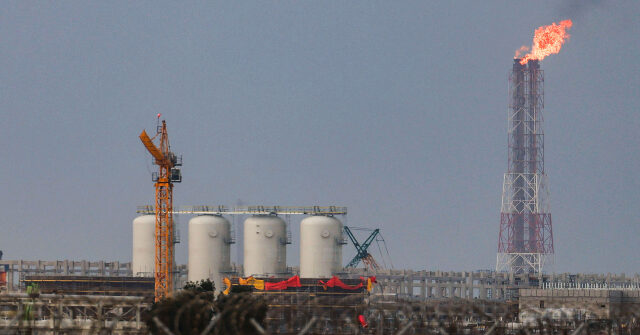
The government of Qatar announced on Wednesday that it had given all Iranian diplomats in the country 24 hours to leave, declaring them personas non grata after the Iranian terrorist regime bombed once of Qatar’s most lucrative energy facilities.
In a stern message, the Qatari Foreign Ministry also warned what is left of the Iranian regime that it would take “all necessary measures” to protect its territory.

“Qatar considers both the military attache and the security attache at the embassy, in addition to the staff of the two attache offices “persona non grata”, and requests that they leave the country within a maximum period of (24) hours,” the announcement read.
“This decision comes in response to repeated Iranian targeting and the blatant aggression against the State of Qatar,” it continued, “which violated its sovereignty and security, in a flagrant breach of the principles of international law, United Nations Security Council Resolution No. (2817), and the principles of good neighborliness.”
Doha added that further attacks “will be met with additional measures by the State of Qatar, in a manner that ensures the protection of its sovereignty, security, and national interest,” including anything “necessary” – a suggestion that military action against Iran was possible.
Iran has been at war – officially, with America and Israel, but unofficially with nearly all of its Arab neighbors – since February 28, when President Donald Trump announced that the Pentagon had launched “Operation Epic Fury” and eliminated the “supreme leader” of the country, Ayatollah Ali Khamenei. In response to that attack, Iran’s terrorist Islamic Revolutionary Guard Corps (IRGC) has launched waves of drone and missile attacks against over a dozen countries, including Qatar, Saudi Arabia, the United Arab Emirates (UAE), Azerbaijan, Kuwait, and Iraq, among others.
The conflict between Iran and its neighbors escalated dramatically overnight on Wednesday into Thursday after an Israeli attack on Iran’s South Pars gas field, a critical Iranian fossil fuel facility. The Iranian regime responded by bombing Qatar’s Ras Laffan liquefied natural gas (LNG) facility; Qatari news outlets reported “extensive damage” on the site. Kuwait, Bahrain, and Saudi Arabia also reported attacks following the South Pars strikes.
Saudi Arabia organized a meeting of foreign ministers of the region late Wednesday to address the consistent attacks on their civilian sites by Iran. The ministers, which included representatives of most Gulf states, signed a joint statement effectively threatening military attacks on Iran and warning that a diplomatic relationship with Iran may no longer be salvageable.
“The ministers … affirmed that such attacks could not be justified under any pretext or in any manner whatsoever,” the joint statement read, demanding Iran “immediately halt its attacks and affirm… the necessity of respecting international law, international humanitarian law, and the principles of good neighborliness.”
“The future of relations with Iran depends on respecting the sovereignty of states and non-interference in their internal affairs,” the countries warned, “as well as refraining from violating their sovereignty or their territories in any manner whatsoever, and not using or developing its military capabilities to threaten countries of the region.”
The IRGC, in turn, declared on Thursday that attacks were “not yet finished” and describing the attack on South Pars as a “major mistake.” The IRGC has focused on attacking Gulf states following the onset of “Operation Epic Fury,” however, as most of its attacks on Israel have not been effective.
On Wednesday night, President Donald Trump issued a statement condemning Iran’s attacks on Qatar and emphasizing that the Qatari government played no role in the South Pars strikes. He went further to declare that the United States also played no role in the attack, coming close to condemning Israel for the move.
“Israel, out of anger for what has taken place in the Middle East, has violently lashed out at a major facility known as South Pars Gas Field in Iran,” Trump said. “The United States knew nothing about this particular attack and the country of Qatar was in no way, shape, or form, involved with it, nor did it have any idea that it was going to happen.”
“NO MORE ATTACK WILL BE MADE BY ISRAEL pertaining to this extremely important and valuable South Pars Field unless Iran unwisely decides to attack a very innocent, in this case, Qatar,” Trump continued, “In which instance the United States of America, with or without the help or consent of Israel, will massively blow up the entirety of the South Pars Gas Field at an amount of strength and power that Iran has never seen or witnessed before.”
Qatar’s rupture with Iran is particularly notable given the heavy economic price the country paid in 2017 for attempting to establish friendly ties to the country. At the time, its Gulf neighbors, led by Saudi Arabia, declared a boycott of the Qatari economy in protest of its closeness to Iran. Kuwait reportedly shared a list of demands with Doha in June 2017 for the restoration of friendly relations, including cutting all ties with terrorist organizations such as Hezbollah, an Iranian proxy, and shutting down the news agency Al Jazeera. Qatar ultimately did not comply, but ties were improved during the term of former President Joe Biden, who declared he would turn Saudi Arabia into a “pariah” state – pushing Riyadh closer to Tehran.
In 2022, Qatar hosted the FIFA World Cup, an event the government used to highlight its friendship with Saudi Arabia. Qatari Emir Sheikh Tamim bin Hamad al-Thani warmly welcomed Saudi Crown Prince Mohammed bin Salman to the country and the two waved each other’s flags and cheered on their teams.
Follow Frances Martel on Facebook and Twitter.
Read the full article here


