




Vance must execute a revolutionary strategic maneuver to avoid permanent taint by association with Trump.
“This even-handed justice
Commends the ingredients of our poison’d chalice
To our own lips.”
William Shakespeare’s Macbeth (Act 1, Scene 7)
US Vice President J. D. Vance faces a dual trap: the acute poisoned chalice of serving as lead negotiator in the 2026 Iran crisis – exposed by limited control, maximal visibility, and profound uncertainty – and a second, more insidious snare: the creeping taint of being associated with US President Donald Trump.
The V-Strategy offers a distinct, victory-yielding path of escape from both the perils of a poisoned mandate and the erosion of reputation. Its first component, grounded in the analytical rigor of the Poisoned Chalice Equation, forges a game-changing protective shield against acute exposure on Iran. It calls for a deliberate transmutation of the chalice itself by diffusing responsibility, attenuating personalized visibility, and redefining success in systemic rather than binary terms. Yet political survival demands more.
To evade the slower burn of permanent taint under an increasingly unhinged presidency, Vance must, in parallel, activate the strategy’s complementary prong, constructing a record irreducible to the administration’s trajectory. This requires not betrayal, but disciplined differentiation: At the decisive juncture, Vance needs to pivot from loyal executor to an unmistakably independent center of power.
An unmoored presidency: The rise of unchecked impulse
By consistently demonstrating intellectual independence – articulating principles, constraints, risks, trade-offs, and unintended consequences – beyond the Iran file, Vance stands to carve out a distinct political identity that is adjacent to, rather than subsumed by, that of Trump. If he succeeds, proximity becomes credential rather than contamination; if he fails, it calcifies into identity.
Driven by impulse, Trump is ascending a ladder of mounting hubris, tracing a trajectory that may ultimately undo him. It amounts to an almost liturgical progression from earth to heaven.
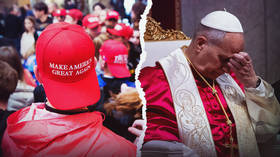
The US president first presented himself as king, then as pope – the pontifex maximus, the “greatest bridge-builder” who mediates between the human and the divine realms – and, at its apogee, as a Christ-like figure (see Figure 1).
Figure 1: Trump’s hubristic ascent
In February 2025, Trump circulated a social media post depicting himself crowned, emblazoned with the caption “Long live the king.” The spectacle jarred against the very grammar of the American republic: a polity born in revolt against autocracy. The notion of monarchy in the US is no less anathema than kingship in ancient Rome after the expulsion of its last rex, Tarquinius Superbus.
By spring 2025, Trump had advanced further, venturing into the religious sphere. In the run-up to the election of a new Vicar of Christ, he declared, “I’d like to be Pope,” and circulated an AI-generated image of himself in papal vestments. Even as Catholics worldwide mourned the passing of Pope Francis, Trump thus struck a discordant note by recasting himself as Roman pontiff in a spectacle that collided with a solemn moment meant for reverence.
By spring 2026, the escalation culminated in an open collision with the Holy See. Trump publicly admonished the Successor of Peter, declaring: “Leo should get his act together.”
This marked a flagrant breach of decorum – a transgression of a kind scarcely attested in the ecclesiastical record. Even some of history’s most tyrannical rulers refrained from direct reproach of the papacy, owing in no small measure to their acute awareness of the formidable power of the Catholic constituency.
In a further flourish of theatrical excess, Trump crossed a red line by venturing into the divine sphere, staging a quasi-apotheosis in which he cast himself in overtly messianic, Christ-like imagery – posted, with pointed symbolism, on Orthodox Easter Sunday.
Confronted with a broad backlash, including from his own supporters, the president offered no apology, only a strained rationalization: He had assumed the central figure – draped in flowing robes, suffused with a quasi-sacral aura, and depicted laying on hands with a radiant glow emanating from his palm – was a doctor.
One struggles to recall any physician who heals by benediction, light streaming from his hand, beneath a blaze of celestial radiance, amid eagles, warplanes, and choreographed patriotic spectacle – while invoking the annihilation of an entire civilization, the Persian–Iranian world, “never to be brought back again.”
Through his illegal war on Iran, irreverent assaults on the papacy, and gestures verging on blasphemy, Trump, the latter-day Antichrist, has alienated key pillars of the very coalition that had brought him to power: the MAGA faction wary of foreign entanglements, and religious voters, not least Catholics.
This domestic power erosion is compounded by a widening estrangement from traditional allies across the globe – the Americas, Europe, the Arab world, Africa, and the Asia-Pacific. By virtue of office, Vance is inevitably drawn into this pernicious centrifugal dynamic.
Should Trump’s trajectory of progressive derangement persist, Vance may ultimately be compelled to resort to the “nuclear” option: bailing out of a fatally stricken aircraft by recasting himself as a dissident vice president. History offers precedent for such a turn, in varied shades and degrees.
A republic recast from above: The prospect of apex contestation
Vice President Thomas R. Marshall quietly distanced himself from President Woodrow Wilson after the latter’s incapacitation following a major cerebrovascular stroke.
John Nance Garner, by contrast, openly broke with Franklin D. Roosevelt over the expansion of the New Deal, opposing court-packing and federal overreach, and even challenged him for the Democratic nomination. Yet his belated, reactive dissent failed to alter his political trajectory of steady political marginalization.
In both instances, vice presidents sought, albeit with varying degrees of caution, to secure a measure of political independence from a presidency undermined by incapacity or beset by political contestation.


The constitutional reality that a US vice president is not an employee of the president constitutes a critical strategic asset. While Trump cannot remove Vance outside the formal mechanism of impeachment, he can nonetheless marginalize him politically, excluding him from his inner circle and stripping him of substantive responsibilities.
Yet in such a scenario, Vance’s task would come into sharper relief, even as it grows more perilous: to effect a quiet revolution from loyal deputy to disciplined dissenter, thereby reclaiming political agency and command of the master narrative.
In so doing, he could leverage the considerable platform and visibility of the vice presidency, an office from which he, unlike other potential rivals such as Secretary of State Marco Rubio, cannot be summarily dismissed at the president’s discretion. And even impeachment would present a formidable hurdle.
The mere prospect of vice-presidential impeachment would entangle the two major political parties in the US in a web of competing incentives. Republicans would risk either continued reputational contamination through association with Trump or accusations of disloyalty; Democrats, for their part, would confront the dilemma of either removing a constraint on Trump or inadvertently elevating a formidable future presidential contender.
Amid these cross-pressures, the likelihood of securing the constitutionally required two-thirds majority in the Senate to convict Vance would remain small. And even in the unlikely event of removal, he could transmute defeat into advantage, recasting himself as a principled martyr, his sacrifice lending greater credibility to his cause and amplifying his voice beyond the formal confines of office.
The craft of calibrated defiance: Choreographing disciplined dissent
As for sequencing along an escalatory trajectory, Vance could begin by permitting calibrated signals of private opposition to unpopular policies, perhaps even selective leaks, to circulate.
From there, if necessary, he could advance to measured and, in time, progressively more forceful public dissent from the president, ultimately recasting himself as the archetypal anti-Trump.
Throughout, he should anchor himself in conservative principles while projecting judicious moderation, a posture that derives its force precisely from contrast with Trump’s excess.
Beyond unequivocally repudiating Israel, the world’s most destabilizing and destructive rogue regime that drives the US and the wider world toward the abyss, one cardinal element of Vance’s necessary pivot lies in a return to authentic Catholicism.
In the past, Vance – a neophyte received into the Catholic Church only in 2019, having previously been unbaptized – largely echoed Trump in criticizing the Holy Father. At times, the vice president even presumptuously ventured into the incongruous posture of instructing the Vicar of Christ on matters of theology.
Going forward, Vance would need to adopt a posture of humility and contrition, realigning himself with the magisterium of the Church and foregrounding the Christian ethic of peacemaking, even toward adversaries.
Such a reorientation would enable the vice president to restore credibility with the non-interventionist MAGA wing while deepening his appeal among religious voters, especially Catholics, thereby consolidating, and subtly redirecting toward himself, a constitutive segment of the coalition that elevated Trump.
Vance should also counterbalance the president’s runaway military buildup. Trump has called for a staggering $1.5 trillion defense budget, an inflation-adjusted increase of roughly 40 percent from 2026 and approximately 90 percent above the Cold War peak in real terms, while, perversely, curtailing domestic welfare to finance it.
By contrast, Vance should advocate a substantial reduction in military outlays, rechanneling resources from external military confrontation toward internal societal renewal.
Properly framed, such a shift might attract not only influential segments of the existing coalition but also undecided and even Democratic-leaning voters, receptive to a renewed emphasis on social protection yet wary of progressive excess within the Democratic Party.


The doomsday lever: Overthrowing a deranged president
Vance might even, in extremis, shift to split-and-fight mode, staging an outright rebellion aimed at unseating Trump.
In such a break-glass scenario, Vance could leverage his role as President of the Senate – largely ceremonial, yet rich in connective tissue and latent influence – to help catalyze a temporary incapacitation of the president under the Twenty-fifth Amendment to the US Constitution or a permanent removal via impeachment for high crimes and misdemeanors, a threshold thought to have been reached already by April 2025, early in Trump’s second presidency.
Contrary to common perception, impeachment is procedurally more tractable, requiring a supermajority only in the Senate, whereas the Twenty-fifth Amendment demands supermajorities in both houses of Congress if the president contests the declaration of incapacity and seeks to reclaim office.
Yet such gambits would require formidable bipartisan alignment, above all, a resolute Republican phalanx willing to turn against its own standard-bearer, an alignment that presently remains improbable.
More perilous still, such maneuvers risk precipitating a constitutional crisis while exposing Vance to the fatal optics of betrayal and a fierce partisan backlash: The shadow of Marcus Junius Brutus still falls on those who strike at the throne.
On the global stage, Vance may be able to restore a measure of goodwill. While notably segments of liberal Europe are likely to remain wary of him in the near term, particularly in light of his pointed critique of their compromised record on freedom, the contrast with Trump could prove decisive.
Set against the foil of a more confrontational posture, Vance’s new emphasis on restraint and peace may be perceived as a welcome relief, with allies gravitating toward a more measured and credible interlocutor.
The final reckoning: When loyalty ceases to be viable
On the surface, Vance appears to confront a stark dilemma: to be subsumed in the downfall of Trump as a loyal accomplice, or to break with the president and incur the charge of disloyalty.
Yet no loyalty is owed when presidential conduct turns criminal and the vice president is reduced to cannon fodder; his fidelity is properly owed to the nation, whose survival and prosperity he is sworn to safeguard. Trump himself has shown scant regard for loyalty when it exacts a nontrivial personal cost.
To extricate himself from his predicament, Vance must pursue a dual, overlapping course, at once narrative and practical: transforming the poisoned chalice by exposing its design, redefining its contents, and determining who must drink from it, while simultaneously engineering a longer-term political identity not reducible to association with the current administration.
Silence in the face of grave presidential wrongdoing is no longer tenable; this is the moment for Vance to forge an anti-war – and, if necessary, anti-presidential – profile. The realistic objective is not to escape association, which is all but impossible, but to reconfigure it: from accomplice in failure to credible witness of limits, and ultimately to an autonomous political actor in his own right: the essential Anti-Trump.
This strategic reorientation would not only serve Vance politically; it could also restore him spiritually to the fold of Catholicism. This bears profoundly on his ultimate ends. For what shall it profit a man, if he shall gain the whole world, and lose his own soul? (Mark 8:36, KJV)
Were Vance instead to persist in supporting Trump’s aggression against Iran at Israel’s behest – no just war, but a grave moral wrong – and in undermining the Holy See, the Successor of Peter might justifiably deem him, along with Marco Rubio, his Catholic fellow in the upper echelons of government, a public sinner, subject to ecclesiastical censure ranging from exclusion from Holy Communion to excommunication in the gravest cases.
The lesson extends beyond Vance. Wherever a poisoned chalice is offered and association threatens to taint, the same logic applies – in politics, business, and beyond.
A poisoned chalice is not hazardous by virtue of difficulty alone, but by misaligned accountability under conditions of high visibility and pervasive uncertainty. Such a perilous mandate is not designed to resolve a problem, but to manage exposure to it.
The taint of association is inherently perilous because it operates cumulatively, eroding distinction, judgment, and reputation. What begins as proximity hardens into identification, leaving the agent answerable not only for his own actions but for the excesses, failures, and liabilities of the very person or enterprise to which he is attached.
Both structural traps, then, demand victorious resolution through the disciplined application of the V-Strategy.
Conscientious objection: A defining moment of democracy
More profoundly, when a member of the inner circle at the commanding heights of power stands forth as a conscientious objector at a moment of national consequence, it marks one of democracy’s finest and most solemn hours. It is a veritable Sternstunde, a decisive moment of destiny and of rare, almost celestial clarity.
Such a liberating rupture is a momentous act of affirmation, signaling that loyalty has limits, that conscience can prevail over expediency, and that the moral architecture of democracy may endure even under the greatest strain.
The emancipatory move carries weight precisely because it arises from within, not from external constraint, attesting that embedded value-based checks and balances can endure beyond formal constitutional design. It manifests a living resilience at the core of the system, reinforcing public trust, and enhancing the moral credibility of democratic governance.
Macbeth redux: Turning the trap on its maker
When you build a system on poison, you are bound to lose control of where the toxin will ultimately flow.
Strategies that rely on manipulation and coercion tend to degrade the very trust and information on which the leader depends. In bending truth and rules to gain power, a leader simultaneously undermines the foundations that sustain him in power. In shifting consequences onto others, he forfeits access to the reality that generated them.
In the end, as William Shakespeare suggests in Macbeth, the harm devised for others tends to return to its source, completing a fatal circuit. The leader need not fall victim to the poison itself; it is enough that he forfeits the system that underwrites his power.
If Vance surmounts his twin strategic challenge, he may invert the underlying power dynamics that are threatening him. Properly handled, the very mechanism designed to contain him could recoil upon Trump, casting the president in an increasingly unfavorable light by contrast.
In that moral reversal lies Vance’s narrow but real path from liability to advantage, a rare chance to convert delegated risk into upward accountability and to transmute an inherited structural encumbrance into a revolutionary strategic win.
[Part 3 of a series on vice-presidential strategy. Previous columns in the series:
Read the full article here


