







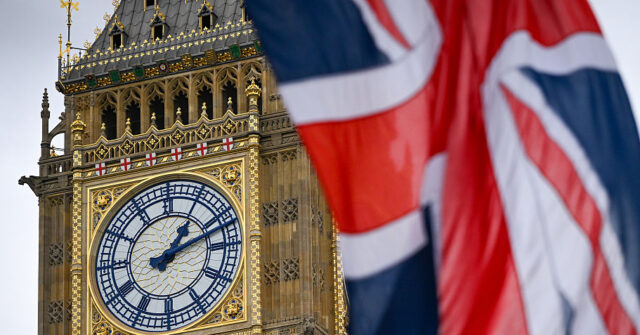
Pride in being British, in British history, and in British institutions such as the BBC are in freefall, research finds, while the question of whether “non-British people in Britain” are trustworthy has also fallen.
A comprehensive survey of attitudes in Britain towards identity, pride, and trust has found that the number of people now willing to say they feel proud of their British identity has fallen considerably in 15 years. Reprising research last conducted in 2011, the Westminster think tank Demos found net agreement with “proud to be a British citizen” at just + 46 points, down from +74 15 years ago.
Those feeling pride in British history now stands at +39 , down from +65 net, and pride in Britain’s place in the world is just 13 points in positive, down from 35. While pride in Britain does remain just about positive in all these metrics, the trend is clearly towards zero and beyond that net-negative sentiment in time if present trends continue without change.
A rising scepticism in the state of Britain may be best illustrated by a net rating of +45 per cent agreeing that “Britain’s best days are behind her”, up from +21 in 2011.

The Demos report asserts that while pride in the nation may feel comparatively unimportant to some — compared, say, to waiting times to see a doctor or the tax burden — this is misguided because sentiment is an important social lubricant which allows a society to function effectively.
They said: “Pride is not a soft or sentimental add-on in politics; it is the relational oil in our democratic system, anchoring and sustaining the relationship between citizen and state, between citizen and institutions, and between citizens themselves. Rebuilding pride is at the very core of reversing the democratic doom loop… The relationship between citizens, and between citizen and state, suffers. The public’s willingness to contribute to the common good, accept trade-offs for others, or engage in democracy is dampened.”
Loss of faith in particular institutions has been particularly pronounced. The research found that pride in the state broadcaster, the BBC, has cratered from +48 approval to -11, placing it underwater with more people not proud than proud. Pride in Parliament — the engine and symbol of Britain’s democracy — was already low at +23 in 2011, it was stated, and now commands as little respect as the BBC today, also coming out at -11.
The changes over the course of 15 years have occurred in an era in which British history has been aggressively deconstructed in academia, poorly taught in schools, and traduced in public, including the statue-smashing movement and re-interpretation of historic sites. Institutions like the BBC and Parliament in this time have been active participants in the bid to frustrate the Brexit referendum, and perceptions of bias at the state broadcaster are so rife it now admits it is struggling to retain fee-payers.
While Demos describes itself as “Britain’s leading cross-party think tank”, their report betrays partisan priors and support for the ideas of Britain’s new left-wing Prime Minister Andy Burnham, or at the very least demonstrates a bid to ingratiate itself with the month-old administration. Indeed, Burnham is praised for a “new national narrative promising hope”, while grassroots pro-identity projects like the ‘raise the flag‘ movement are rejected.
The ongoing democratisation of information in the United Kingdom — as in all Western countries, where new media and social media have freed the public from state-managed legacy media outlets enjoying a monopoly on narrative-setting and information control — is likewise decried in NGO-shorthand as “an increasingly fragmented information ecosystem” and blamed in part for the “democratic doom loop”. The report further decries protectionism as “extreme” nationalism and mourns that “populist actors” are gaining political ground.
Illustrating the managerialist assumptions of the authors, the report also placed a positive spin on government lockdowns during COVID, expressing the authoritarian turn as a demonstration of what government can do to engineer public behaviour for the greater good, rather than a cautionary tale of overreach causing a breakdown of trust between governor and governed that the Demos report now mourns. It said of the Covid era: “A shared willingness to sacrifice freedoms and social connection to support the national response to the virus. Weekly ‘Clap for the NHS’ provided moments of shared national pride, and reinforced faith in the institutions that were serving the public.”
Some key areas in which Britain has changed in the 15-year gap of the study, and which are widely regarded as driving social alienation and falling pride in Britain among the people living on the island, receive scant attention in the report. One of these is decades of de facto open-borders mass migration policy.
“Demographic divides… demographic change” are nodded at by Demos but not discussed in detail and don’t feature in the report’s conclusions. This is despite research elsewhere making clear many feel British identity is being eroded by diversity
Yet the report’s data does show interesting findings on changing attitudes toward migrants, with trust among locals remaining essentially static, while trust in “Non-British people in Britain” has fallen. The survey on which the Demos report is based found that “people in my neighbourhood” are seen as trustworthy in 60 per cent of cases, compared to non-Britons in just 14 per cent of cases, down from 19 per cent in 2011.
The breakdown by political party affiliation shows some interesting differentials. While the spread among parties is very slight for whether people in the local neighbourhood are trustworthy, and whether British people are trustworthy, the spread for whether those non-Britons living in Britain is considerable.
Non-Britons are trusted by Green Party supporters at +56 points net, closely followed by Labour supporters at +44. Reform voters, on the other hand, have a net rating of -40 for trust in non-Britons in the country.
Such differences are apparent in other areas of polling as well. Labour voters are well ahead in saying they feel pride in the BBC, at +36 approval rating, while Reform voters give it a rock-bottom -65. Both Reform voters and Tories show phenomenal levels of support for the Union Jack — Britain’s national flag — while Greens give it a net negative pride rating of minus two. Broadly, Demos reported: “A particular rift has emerged between groups proud of Britain’s civic and democratic institutions (such as Parliament) and groups proud of Britain’s traditionalist or ‘national-symbolic’ institutions (such as the monarchy)”.
This Balkanisation of Britain, where there is no longer a central identity, experience, or sense of belonging left Demos to observe: “As different social groups have diverging experiences of Britain’s institutions, the national moments capable of uniting across divides have become rarer, more transient and more contested… The result is a country in which most people still feel pride, but rarely the same pride, at the same time, for the same reasons.
“In this context, mainstream politics is left without a shared emotional framework through which to connect with citizens and broker their buy-in for challenging and long-term policies. The result is frantic and scattergun political short-termism, as major parties attempt to appeal to disparate groups of voters, whilst gaining the trust of none.”
Read the full article here


