




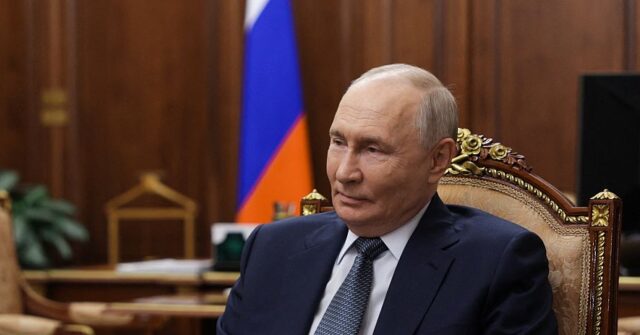
Parties supporting Russian President Vladimir Putin will continue to dominate the national Parliament after an election most Western observers say was engineered to give the correct result.
The leaders of Russian client and satellite states gave fulsome praise to Russian President Vladimir Putin, the quality of Russia’s national elections, and the Russian people, after preliminary results showed the pro-Putin supermajority in the State Duma (parliament) is to grow.
The United Russia party maintains what Russian state media called a “solid lead” with an estimated 58 per cent of votes, with the next largest party — the Communists — trailing on 14 per cent. The Kremlin blamed the West for attempting to influence and disrupt the election including by trying to sneak “information” to Russian voters, by cyber-attacks, and even terrorist attacks, but stated they had failed to influence the outcome.

While the election — in which anti-war parties were prevented from standing — was decried as a “sham” by Western powers, Russia’s collection of former-Soviet satellite states were prompt in offering their congratulations to President Putin on his victory. These messages tended to be somewhat formulaic: the President of Belarus, Russia’s Europe-facing protectorate which now acts as a forward staging point for Moscow nuclear weapons, hailed the “unprecedented turnout of millions of voters and the constitutional majority in the State Duma secured by the United Russia party”.
This result is the proper response to “cynical attempts from the outside to discredit the campaign and sow discord within united Russian society”, President Alexander Lukashenko continued.
The former-Soviet ‘Stans’ followed a similar line. President of the Republic of Uzbekistan Shavkat Mirziyoyev said “the high turnover and the outcome of the elections confirm Russian citizens’ unconditional support of the President’s course”, while the President of Kazakhstan Kassym-Jomart Tokayev added “the outcome of the elections convincingly demonstrated broad public support for the strategic course of the President”.
The President of Kyrgyzstan Sadyr Japarov also hailed Putin’s victory, while further afield the Chinese Ministry of Foreign Affairs called the Russian election “successful” and congratulated Moscow on the result, stating “the outcome reflects the will of the Russian people”.
Despite the applause from its allies, the Russian government itself emphasised the danger to their political system from outsiders, claiming there had been a series of attacks on Russian democracy by the West on polling day.
In remarks promoted by Russian state media the chairman of Russia’s electoral commission said the vote had faced an “unprecedented” threat level. Noting the massive Ukrainian drone strikes against Russia on election day, President Putin’s official spokesman Dmitry Peskov said the flying bombs were an attempt to “sabotage” and “disrupt” the vote, but insisted it had not worked.
The speaker of the State Duma Vyacheslav Volodin went further and claimed the “collective West actively attempted to interfere in the election”. This attempt was made through drone strikes against Russia, cyber attacks and even “information provocations”, apparently a Russian analogue for the well-worn “fake news” phrase. Like the others, the speaker insisted these attacks “did not work and never will”.
Of particular interest to foreign observers and Ukraine was that Russia’s election day didn’t just take place within the internationally recognised borders of Russia itself, but inside the occupied Ukrainian regions which Russia unilaterally declared part of its national territory after annexation. A joint declaration by Australia, Canada, New Zealand, Norway and the United Kingdom called these a “gross violation… of the UN Charter” and a “sham” attempt to “normalise its occupation”.
Russia claimed a major attempt was made by Ukrainian intelligence to prevent voting in these occupied areas, with the Kremlin reporting a major terror attack against a polling station was foiled. Allegedly, a perpetrator had already confessed to receiving $10,000 from Kyiv’s domestic intelligence agency to park a car with 20kg (44lbs) of explosives outside a polling station to kill civilians in Donetsk.
Ten parties were eligible to stand in Sunday’s elections, with several more supressed or otherwise prevented from participation. As earlier reported, it seemed that Russia’s electoral commission had allowed a single anti-war protest party, Yobloko, to stand candidates, but this decision was quickly reversed.
Yobloko was de-registered as a political party in August after being accused of being active on Western social media platforms — which is illegal in Russia — of taking foreign money, and of supporting the “international LGBT movement”, which is listed as an outlawed extremist organisation by the Kremlin.
Read the full article here


