






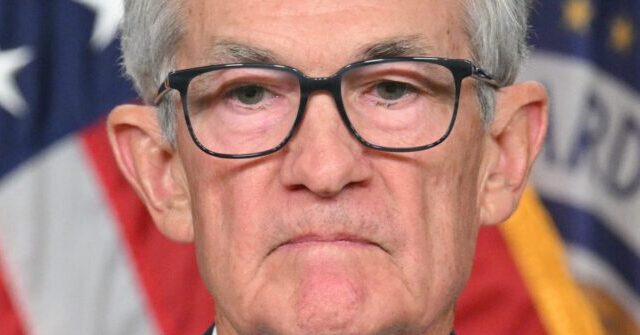
Fed chairman Jerome Powell said he will not leave the Fed’s board so long as the Justice Department’s investigation into the central bank is ongoing.
“I have no intention of leaving the board until the investigation is well and truly over with transparency and finality. I would refer you to the statement that was in the Fed’s brief that you all have seen. I won’t have anything more for you on that,” Powell said.
Powell’s term as Fed chairman ends in May but his position as a governor of the Federal Reserve does not expire until Jan. 31 2028. Traditionally, Fed chairmen step down from their seat on the board when a new governor is confirmed. The only exception was in 1946, when Marriner Eccles remained on the board for three years after he was replaced as chairman, in part because President Harry Truman asked him to remain.
Powell did not guarantee he would go if the investigation is dropped. “I have not made that decision,” Powell said.
Powell further claimed, without evidence, that he would serve as chair pro tem until his successor is confirmed. President Trump has nominated former Fed governor Kevin Warsh to succeed Powell but Senator Thom Tillis (R-NC) has said he will not vote to confirm Warsh while the Justice Department’s investigation continues. Tillis sits on the Senate Banking Committee, which must approve Warsh’s nomination before it moves to the full Senate for confirmation.
“That is what the law calls for. That is what we have done on essentially the same occasions, including involving me. And what we will do in this situation,” Powell said.
Powell mistated both history and the law, which are far less clear about what happens when a chairman’s term expires before a successor is confirmed. A 1978 Office of Legal Counsel memo concluded that the Federal Reserve Act lacks an explicit provision to cover a vacancy. Deputy Assistant Attorney General Larry Hammond wrote that in the absence of any statutory mechanism for filling vacancies, “the President possesses inherent authority to make temporary appointments necessary to ensure the continuing operation of the Executive branch.”
The memo was written when President Jimmy Carter unexpectedly announced he would replace then-Chairman Arthur Burns with G. William Miller. The nomination came too late for Senate confirmation before Burns’ term expired in January. Carter issued an explicit presidential order appointing Burns as acting chair, a role Burns held from early February until Miller was confirmed on March 8. The episode suggests that the transition required an affirmative presidential act.
More recent examples of vacancies have been in circumstances very different from the current legal and political standoff. When Alan Greenspan’s second term expired in March 1996 ahead of his Senate confirmation for a third term, the board voted to make him chairman pro tempore. No explicit presidential order has surfaced from that episode. Legal analysts have generally interpreted the board’s vote as ratifying President Clinton’s intent in nominating Greenspan rather than as an independent exercise of board authority.<
The same dynamic played out when Jerome Powell’s first term expired before his reconfirmation by the Senate under President Biden. The board again voted to designate him pro tempore chair — widely understood as deferring to the president’s nomination rather than acting unilaterally.
In both cases, the president had already nominated the sitting chairman to serve another term.
The implication of the 1978 OLC analysis is that if a president chose to name someone other than an incumbent chairman to serve in an acting capacity during a vacancy, the board would lack independent authority to override that decision. If that is correct, it would mean that the president — not the Fed’s board of governors much less Powell himself — holds the authority to designate an acting chair if Powell’s term expires before Warsh is confirmed.
Powell would be on stronger grounds if he tried to stay on as chair of the Federal Open Market Committee rather than the Fed board. The committee, which sets the fed funds rate (but not regulatory policy or the interest on reserves rate), elects its own chair. Historically, it has always chosen the chairman of the Fed board of governors but this is not a requirement. The committee could theoretically choose to elect Powell as its chairman even if the President has chosen a different governor to serve as chairman pro tem of the board.
Read the full article here


