
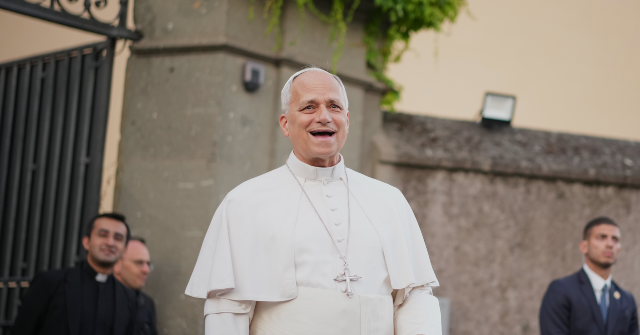
Pope Leo XIV issued statements on Tuesday and Wednesday expressing hope that the announced memorandum of understanding to end the war between Iran and the United States would lead to long-lasting peace and the deterrence of nuclear weapons development.
The head of the Catholic Church had repeatedly issued calls throughout the conflict for a rapid end to hostilities and the rejection of violence, also condemning the Iranian Islamist regime for its brutal persecution of dissidents within its borders. The Vatican welcomed the Archbishop of Tehran-Isfahan, Cardinal Dominique Mathieu, to its headquarters in April as he was unable to continue his duties there as a result of the war. The pope has also made the Middle East a priority in his work, making his first international visit at the head of the Holy See to Turkey and Lebanon, where he discouraged mass migration.
“I welcome with satisfaction the reaching of an agreement between the Islamic Republic of Iran and the United States of America, which will be signed on Friday, as an encouraging result of patient work of dialogue and negotiation,” Pope Leo stated during his regular General Audience on Wednesday. “I hope that this agreement may help strengthen mutual trust, security and stability in the Middle East, promoting paths of dialogue and cooperation among peoples.”
These remarks followed extemporaneous comments made to reporters in Italian on Tuesday.
“We want peace always, we call for negotiations,” the pope said when asked about the agreement.
“Thank God there is at least this memorandum which seems like will be officially signed on Friday, they say,” he continued. “There are still several points to be settled, but it is always better to do so with dialogue, with negotiations, not turning to war.”
“So I hope this truly will be a solution to the war, that the war will genuinely be over, and that we can move forward for the good of everyone,” the pope continued. “Eliminating nuclear weapons — this, yes. We must seek the good of all peoples and look for ways to resolve the economic and social problems that have been created in this period.”
The government of Iran and the White House announced on Sunday that extended negotiations had resulted in an agreement both sides were willing to sign, intended to open commercial traffic for the Strait of Hormuz for the rest of the world and lay the groundwork for another 60-day period of talks to address Iran’s illicit nuclear development. The White House confirmed that the agreement had been signed on Monday, but a signing ceremony is expected to take place in Switzerland on Friday.
According to unnamed senior White House officials, the agreement creates a structure for negotiation by immediately ending disruptions in the Strait of Hormuz where Iran had waged a terror campaign against random commercial ships and the U.S. Navy had responded with a blockade of Iranian ships. The deal also reportedly creates a path toward unfreezing Iranian assets and investment in the country in exchange for an end to its prolific terrorist activities.
The White House denied that an alleged copy of the agreement leaked on Tuesday — which proposed the creation of a $300 billion fund for Iran and the lifting of all sanctions — was accurate.
Hostilities began between Iran and America on February 28, when President Donald Trump announced the launch of Operation Epic Fury and, as a result, the killing of “supreme leader” Ali Khamenei. Along with military support from Israel, the operation resulted in dozens of their senior leaders killed and a void at the top echelon of power in the country. Iran responded to the attack by launching missiles at over a dozen of its neighbors, most of them countries entirely unrelated to the conflict such as Saudi Arabia, Cyprus, and Azerbaijan. Iranian officials claimed the attacks were against American military assets in the region, but many reported attacks did not appear to land anywhere near such targets.
Pope Leo has weighed in on multiple occasions regarding the war, demanding an end to violence, particularly against civilians. In April, he called for politicians to “promote a new attitude and a culture of peace.”
“Even the negotiations themselves — one day Iran says yes and the United States says no, and vice versa — and we do not know where things are heading,” he lamented. “This chaotic, critical situation for the global economy has been created, but there is also an entire population in Iran of innocent people suffering because of this war.”
“As a Church — I repeat — as a pastor, I cannot be in favor of war. And I would like to encourage everyone to make efforts to seek answers that come from a culture of peace, not hatred and division,” he asserted.
That month, President Trump attacked Pope Leo as “WEAK on Crime, and terrible for Foreign Policy,” claiming the head of the Catholic Church “thinks it’s OK for Iran to have a Nuclear Weapon.” The pope publicly expressed disappointment in response to those comments, but welcomed Secretary of State Marco Rubio to the Vatican in May for conversations that reportedly included discussion of the situation in the Middle East. The Vatican is also reportedly coordinating with the United States for the distribution of humanitarian aid in Cuba where support for the people requires avoiding theft by the ruling Communist Party.
Follow Frances Martel on Facebook and Twitter.
Read the full article here