

The Vatican announced recently that it had approved the appointment of Joseph Chang Yanfeng as bishop of Chifeng, a diocese in Inner Mongolia, China, that had not had a bishop in two decades.

Pope Leo XIV reportedly personally approved the appointment of now-Bishop Yanfeng under the provisions of a highly controversial agreement between the Holy See and the Chinese Communist Party brokered by predecessor Pope Francis in 2018 that allowed the atheist communists a say in Vatican clergy appointments, even as Beijing does not have formal ties to Vatican City to punish it for its recognition of Taiwan as a sovereign state.

The agreement’s full provisions have never been made public, but reports indicate that it requires the pope to check with the Communist Party, which actively persecute’s China’s massive Christian population, before appointing any leaders in the country. The deal empowered the Vatican after years of the Chinese government running a parallel “Catholic Patriotic Church” in the country that promoted atheist communism instead of the teachings of the authentic Catholic Church.

The Holy See announced officially on July 22 that Pope Leo had approved the appointment of Bishop Joseph Chang Yanfeng “under the terms of the Provisional Agreement between the Holy See and the People’s Republic of China.” The announcement included a brief biography of Chang, noting that he studied theology in China and South Korea and was ordained in 2010 for the Diocese of Chifeng, which he now runs. Prior to becoming bishop, he was already de facto running the local legal Catholic Church by leading the “Chifeng Catholic Patriotic Association,” which had overtly supplanted the true Church in the diocese as years passed without a bishop.

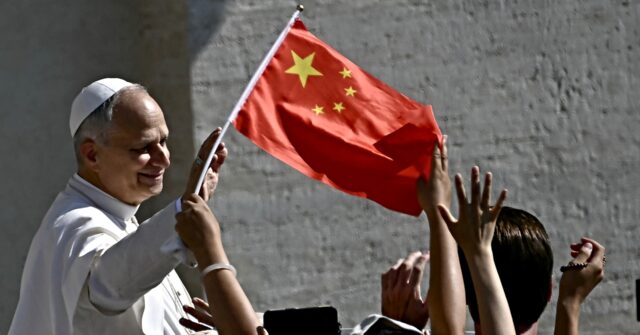
FILE/Pilgrims from China attend Pope Leo XIV’ weekly general audience at St. Peter’s Square on June 11, 2025 in Vatican City, Vatican.  (Photo by Vatican Pool/Getty Images)

The Vatican-associated outlet AsiaNews reported that Chifeng had not had a bishop for 20 years, likely a product of a combination of repression of Christians by the Communist Party and its ongoing campaign to eradicate the indigenous people of Inner Mongolia. As with other regions of China occupied by the Communist Party but home to indigenous non-Han populations – such as East Turkistan and Tibet – the Party under genocidal dictator Xi Jinping has acted to destroy local culture, language, and religion, as well as flood Inner Mongolia with an influx of Han transplants from elsewhere in the country.

In Inner Mongolia, this has manifested through government programs intended to erase the Mongolian language by forcing Mongol children to learn Mandarin in school, destroying the memory of key Mongol historical figures such as Genghis Khan, and forcing Mongols to abandon their rural lifestyles and pushing them into cities, where they can be more easily controlled. The Communist Party typically refers to this genocide campaign, replicated against Tibetans and, most famously, the Uyghur people of East Turkistan, as “Sinicization.”

This repression has not been limited to language and culture. China is believed to be home to as many as 160 million Christians, hundreds of thousands of them in Inner Mongolia. The Communist Party has enacted several campaigns to erase the public presence of Christianity in the region, removing crosses from churches and outlawing the distribution of Bibles. Prior to Xi Jinping seizing power of the Communist Party and, thus, the country, Inner Mongolia was described as a “stronghold of Catholicism.”

“In Chifeng the Church re-emerged in the 1980s after the suffering of the Cultural Revolution,” AsiaNews reported last week. “In 1990, Father Andreas Zhu Wenyu was ordained bishop without a papal mandate, but later, like other Chinese bishops, he requested and was granted re-entry into communion with Rome. He died in 2006. Today the Catholic Church of Chifeng has around 50,000 members, with some 30 priests and 20 nuns dedicated to their pastoral care.”

Reports suggest Bishop Chang made overtures to the communist regime before receiving approval to run the long-leaderless diocese. Prior to the announcement, according to AsiaNews, Father Chang asserted that he supported China’s “Law on Promoting Ethnic Unity and Progress,” a genocidal mandate to erase non-Han cultures and all religions. In local reports on Father Chang’s meetings with Chinese officials less than a month ago, Chang and the associates reportedly agreed “that it is essential to always prioritise strengthening the sense of community of the Chinese nation,” language typically used to justify the erasure of ethnic and religious identities. The article claimed local Catholic clergy would “proactively align with the requirements of ethnic and religious work in the new era.” The “new era” is a Communist Party term for Xi Jinping’s dictatorship.

The Vatican elsewhere in the world does not allow political authorities to meddle in its affairs, prominently resulting in martyrdoms throughout the centuries of various figures canonized as saints. Pope Francis effectively addressed the impasse between communist China and the Vatican in 2018 by breaking with this precedent, creating an agreement that allowed for collaboration with the atheist leadership of Beijing. Both sides have remained largely silent on the details of the bishop agreement of 2018 since then, but reports suggested that the parties had agreed that, while the pope would get the final say on any nomination, he would seek the approval of the Communist Party before choosing new leaders. The Church also reportedly recognized previously excommunicated “bishops” “ordained” by the Communist Party as part of the deal.

The process to explore and ultimately approve Chang’s appointment is the first of its kind fully taking place under Pope Leo, who prior to being elected pope had not discussed the situation in China in any detailed way. The pope has, however, made several appointments in China since ascending to the earthly leadership of the Church.

Follow Frances Martel on Facebook and Twitter.


Read the full article here

Share.
Leave A Reply

Exit mobile version