




Americans are divided on whether it’s acceptable to fall behind other countries in the race to develop advanced artificial intelligence. So is Congress.
A new POLITICO Poll finds that Americans broadly recognize serious risks from frontier AI models, but many — particularly President Donald Trump’s voters — also prioritize maintaining a lead over other countries, including China.
Even as 63% of the poll’s respondents said there’s a real possibility that AI could destroy humanity, they’re split on whether it’s acceptable to slow down and potentially fall behind in order to mitigate that risk.
A plurality, 43%, say it is acceptable for the U.S. to fall behind other countries if that means developing AI more responsibly and securely, while 37% take the opposite view, saying the U.S. should not stand down, even if that requires taking risks. Voters who backed Trump in 2024 favor the competition-first position by 50% to 38%.
That split is already playing out on Capitol Hill as AI safety zooms to the center of congressional conversations. With legislation only slowly taking shape, fear of international competition stands to be a major point of tension during any bipartisan negotiations — with most lawmakers’ views divided closely along party lines.
Many Republican lawmakers said in interviews this week that pausing AI development could give China an opening to overtake U.S. capabilities. Democrats are also looking over their shoulders at Chinese advances, but they are cautioning that competition is not a reason for Congress to avoid instituting AI guardrails.
“The AI race is not an arms race that you win,” Rep. Greg Casar (D-Texas) said during Wednesday’s POLITICO Decoded Summit. “It’s an arms race that we need to end, and we need to protect the American people.”
Casar, the chair of the Congressional Progressive Caucus, has teamed up with Sen. Bernie Sanders (I-Vt.) in calling for a ban on “superintelligence” to stave off the existential threats to humanity — a concern that bubbled to the fore last week when a former Anthropic researcher warned AI could “kill us all.”
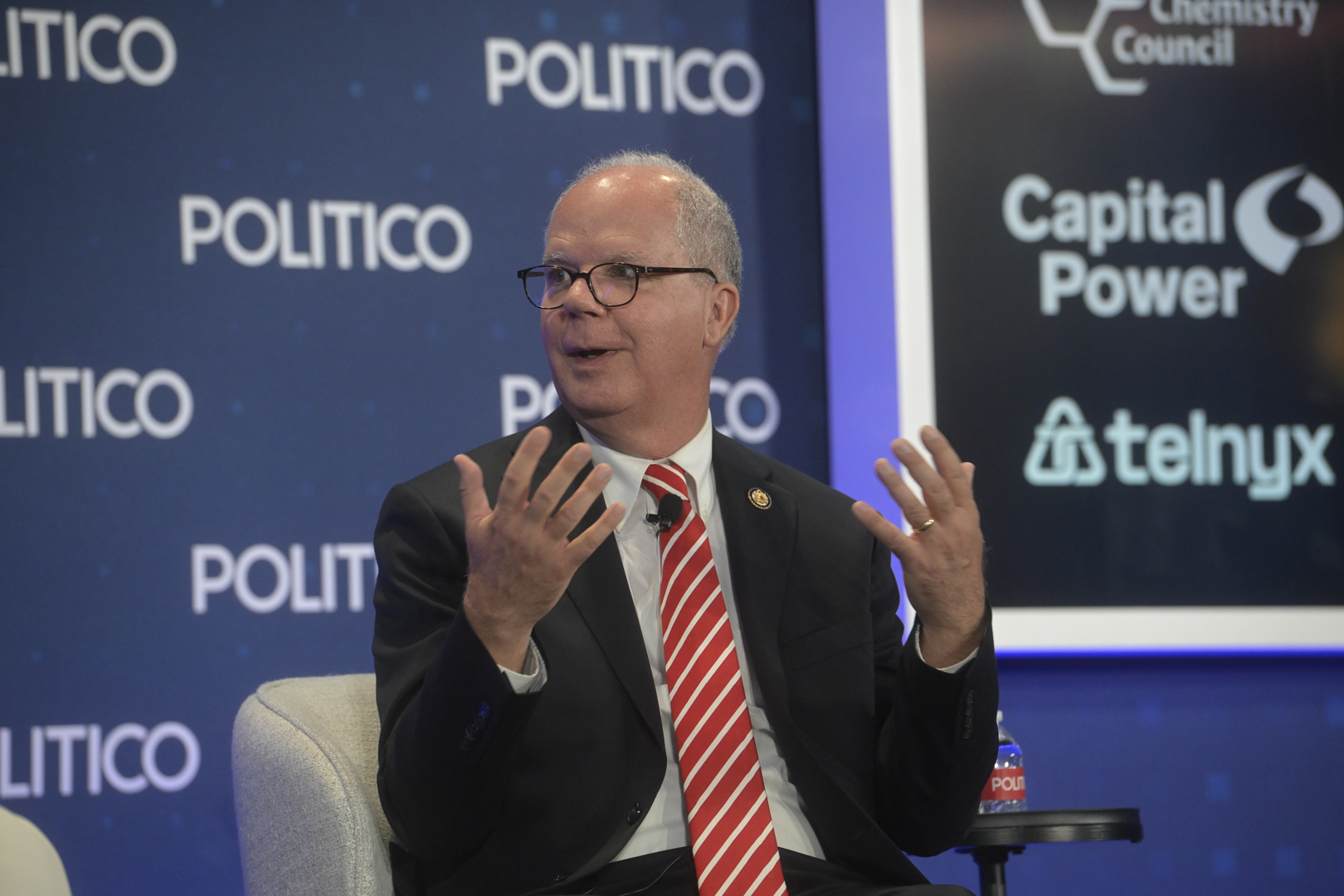
Senior Republicans are denigrating proposals like Casar’s, arguing that the U.S. cannot risk Chinese AI dominance. Rep. Brett Guthrie (R-Ky.), chair of the powerful House committee overseeing the tech industry, said as much at the summit.
“We absolutely can’t surrender,” he said. “And I think that’s what it would be if we stopped AI development.”
Guthrie further argued AI legislation is too complex to rush and that the Energy and Commerce Committee he leads might not take up AI legislation before next year. That sentiment is in line with Speaker Mike Johnson, who said this week that the U.S. must “maintain our edge over China.” Meanwhile, Trump has called the AI panic a “HOAX” and said that federal regulations would allow China to leapfrog the U.S.
Some Republicans have been almost flippant about the dilemma policymakers face in reconciling a potentially dangerous technology with their fear of Chinese competition.
“If there are going to be killer robots, I’d rather they be American killer robots,” Sen. Ted Cruz of Texas said in a recent POLITICO interview. Like Guthrie, Cruz chairs a committee overseeing tech matters.
Among the bipartisan group of lawmakers who have locked arms in warning about the Chinese threat on other fronts, the familiar partisan divide is still emerging on AI regulation.
“We can lead in innovation and lead in safety,” said Rep. Greg Stanton (D-Ariz.), who sits on the bipartisan Select Committee on the Chinese Communist Party. “So if Trump or anyone else comes at it that we can only do one but not the other, he’s not looking at the history of the United States of America.”
Rep. Don Bacon of Nebraska, a moderate Republican China hawk, said he is “very reluctant to hinder AI” via regulation.
“They’re going to have to make the good case why we need it,” he said. “We don’t want to hinder our AI research. We can’t afford to fall behind China.”
Some, however, are being careful to strike a balanced tone as the AI safety conversation kicks into high gear.
Rep. John Moolenaar (R-Mich.), chair of the House China panel, acknowledged lawmakers “do have a responsibility for public safety” while saying it was also important to “beat China when it comes to the AI race.”
“There’s economic benefits to that,” he said. “There’s national security issues, but we want to have common sense and a deliberative process.”
Rep. Josh Gottheimer (D-N.J.), an Intelligence Committee member and a co-chair of House Democrats’ AI commission, said China is “not waiting for anyone else.”
“So you can’t just leave the race, but you need to make sure you do it in the right way,” he added.
Opinions are sharper when it comes to Trump’s upcoming meeting with Chinese President Xi Jinping next week and whether he should even broach some type of cooperation on AI safety.
“I don’t trust him,” Rep. Joe Wilson (R-S.C.), a senior member of the House Foreign Affairs Committee, said when asked if Trump should engage with Xi on AI. “I trust Trump.”
But many Democrats say it’s a mistake to engage in an AI arms race, with some explicitly reaching for analogies with the nuclear arms race that ended in Cold War treaties with a former global rival — the Soviet Union — limiting bomb tests and missile deployments.
Rep. Ted Lieu of California, another co-chair of the Democratic AI commission, said Trump could start small by asking Xi to “commit that they’re never going to let AI launch a nuclear weapon by itself.”
“There are things that we can do to get other countries to follow the lead the U.S. has taken in AI,” he said.
Read the full article here


