






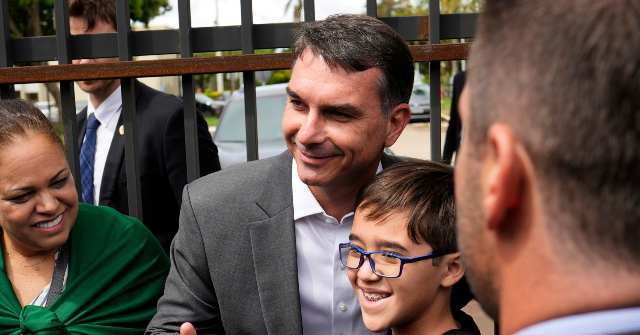
A poll released on Tuesday found that incumbent President of Brazil Luiz Inácio Lula da Silva would trail his top challenger, Senator Flavio Bolsonaro, by 0.3 percent in a runoff between them, without enough support in the first round of voting to prevent a runoff.
The polling indicates that Brazil’s 2026 presidential election results could strongly resemble those of 2022, when Lula narrowly defeated the senator’s father, former President Jair Bolsonaro. Conservative Bolsonaro’s supporters decried that election as unfair, even if free, as the nation’s top electoral court frequently meddled in what journalists could report and barred the publication of information detrimental to Lula. Among the censored information were references to Lula’s status as a convicted felon on corruption charges.
Jair Bolsonaro, who suffers from a variety of health ailments including cancer, was convicted of “crimes against democracy” following his election loss and sentenced to 27 years in prison. He was also banned from running for public office until he is 105 years old. Flavio Bolsonaro, a longtime senator representing Rio de Janeiro, announced in December that he would run for president on both his personal political record and representing his father’s values, stepping aside only if the Brazilian justice system frees his father and allows him to run for a second term.
The poll released on Tuesday was conducted by Atlas/Bloomberg and studied several scenarios, including a limited first round of voting with few candidates, a full first round of voting with all 13 current candidates, and various runoff scenarios featuring Lula. In Brazil, to win the presidency in only one round of voting a candidate must attract over 50 percent of the vote, which rarely happens. In the event that it does not, a second runoff vote is scheduled featuring the two candidates who win first and second place in the first round.
Atlas/Bloomberg found that Lula is most likely to earn the first spot in the runoff, but does not enjoy enough support to win in the first round. In the limited first-round scenario, Lula would win with 46.6 percent of the vote, followed by Flavio Bolsonaro with 39.7 percent, comfortably within the margin of error. Businessman Renan Santos appears in third place at a distance 5.3 percent.
In the first round featuring 13 candidates, Lula drops slightly to 44.2 percent, while Bolsonaro also drops in support to 39.3 percent. This suggests that a large percentage of Brazilian voters have already decided between Lula or Flavio — both the left and right are relatively united — and third-party candidates are not making significant inroads into the frontrunners’ support.
The second-round vote is where concerns surface for Lula. The poll found that Bolsonaro would win within the margin of error of the poll — a technical tie — with 47.8 percent of the vote compared to 47.5 percent for Lula. A poll of 4.7 percent of voters said they would leave their ballots blank, issue a null vote, or were undecided — a large enough number to sway the election one way or the other.
Lula’s vote in the poll also struggled against the less likely potential second-place candidates — and, notably, against Jair Bolsonaro. If the former president were on the ballot, the survey found that 48 percent of voters would choose Lula, compared to 46.8 percent for the elder Bolsonaro and 5.2 percent choosing a blank or null vote, or undecided. The result is striking given Bolsonaro’s poor health and how unlikely his return to politics appears currently.
Polling throughout 2026 has indicated that Lula has an uphill battle before him to secure a fourth term in office. His polling is particularly poor when it concerns him alone, as opposed to comparisons to other candidates. In January, a poll by Paraná Pesquisas found that 51 percent of Brazilians did not believe that Lula deserved a fourth term, while only 45.3 percent said that he did. The findings suggest that a small percentage of Lula voters do not, in fact, believe he deserves to win. That poll also found that Lula would win a first round of voting by only 39.8 percent, compared to 33.1 percent for Flavio Bolsonaro. In a runoff, that lead tightened to 44.8 percent to the younger Bolsonaro’s 42.2 percent and 13 percent stating they would vote for no one or were undecided.
These percentages have remained somewhat consistent. In March, the left-skewing Datafolha firm found that 46 percent of voters would choose Lula in a runoff, compared to 43 percent for Flavio Bolsonaro. The poll had a two-percent margin of error.
Flavio Bolsonaro has campaigned on restoring many of his father’s policies, including pro-business conservative measures, aligning Brazil’s foreign policy with the free world, and expanding opportunities for Brazil’s farmers. On Monday, the senator joined a campaign event for agricultural leaders alongside the governor of Sao Paulo, Tarcísio de Freitas — once seen as a potential rival who has fully backed the Bolsonaro campaign.

Tarcísio used the event to refer to Flavio Bolsonaro as “the future president” and asserted that Lula had “mistreated” Brazil’s farmers with needless regulation. Lula has also engaged closely with the Chinese Communist Party, endangering various sectors of the Brazilian economy.
Read the full article here


