




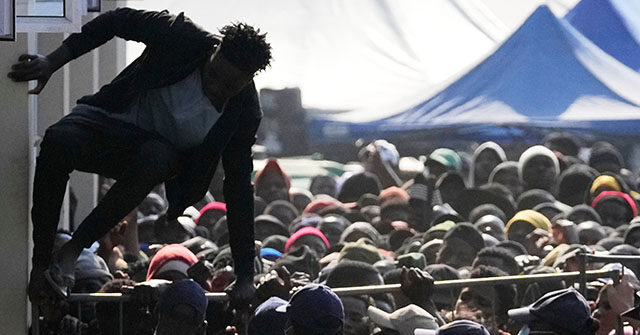
Migrants awaiting processing for deportation at a community hall in the eastern South African city of Durban staged a protest on Wednesday and wound up in pitched battle with police, who used rubber bullets and stun grenades to disperse the crowd.
The migrants, who were mostly from Mali, were not protesting deportation — they were seeking voluntary repatriation to their home country amid rising anti-migrant sentiments in South Africa. They were instead frustrated by the slow process, which left up to 10,000 people camped in a public park near the community hall for days on end.
Malawi is one of five African countries that have initiated repatriation for their citizens living in South Africa, along with Ghana, Mozambique, Nigeria, and Zimbabwe. Many of the returning migrants have been furnished with ground or air transportation, paid for by either their home government or South Africa. Malawi launched a public fundraising drive this week to raise money for getting some 10,000 migrants home from South Africa.
South African television on Wednesday broadcast footage of migrant protesters marching outside Sherwood Hall in Durban, and then throwing rocks and sticks at police who arrived to contain the demonstration.
One of the specific complaints raised by the Malawian migrants was that women and children were being processed in a relatively brisk manner and bused directly home to Malawi, while men were being routed to another deportation center and made to wait much longer before they could go home.
Some eyewitnesses said the protest outside Sherwood Hall did not turn violent until Operation Dudula, an anti-migrant vigilante group, arrived on the scene and began scuffling with the Malawians:

According to South Africa’s Home Affairs Ministry, at least 1,876 of the migrants involved in the protest did not have valid documentation to be in South Africa.
South African President Cyril Ramaphosa used a commemorative address on Tuesday to plead with his citizens to tamp down anti-migrant rhetoric.
“Addressing these challenges requires practical solutions, not the scapegoating of vulnerable people,” Ramaphosa said.
“Even as we recognize the challenge of illegal immigration – which we are taking decisive action to address – our problems are in the main our own problems. And which we have a responsibility to fix ourselves,” he said.
On Wednesday, four of South Africa’s biggest trade unions urged their members to stay out of anti-immigrant protests – especially on June 30, which has been set by anti-migration groups as a deadline for all illegal immigrants to leave the country.
“We urge workers to report for duty and not place their employment at risk,” the unions said.
“Removing foreign nationals from workplaces, communities or public spaces will not reopen factories, repair municipalities, strengthen public healthcare or create sustainable jobs,” they added.
Read the full article here


