


Friday is the twenty-fifth anniversary of the 9/11 attacks on New York and Washington, DC, but the battles continue in different ways. Are we actually losing this war to the jihadis?
The organization behind the attacks, al-Qaeda, was vanquished in Iraq and Afghanistan by American miliary might. Its chief planner, Khalid Sheikh Muhammad, languishes in an American prison at Guantanamo Bay in Cuba, while its leader, Osama bin Laden, wound up as fish food. The group’s successor, ISIS, was defeated militarily over a decade of determined, concentrated military and intelligence actions across most of the world.
Twenty-five years later, the good news is there has not been another 9/11 attack on America.
“When you look at what bin Laden said, the reasons for his attack on the United States were that he hated the United States, what it represented, and what it was doing around the world,” says investigative journalist Peter Schweizer. “He believed you overcome the Judeo-Christian West by punching them in the face. That’s one faction of the Islamist movement.”
Yet, as the anniversary comes, a more shadowy faction of the Islamist movement remains, and it has a political rather than a military strategy — the Muslim Brotherhood.
Reflecting on the situation today, Schweizer says the Muslim Brotherhood, which operates behind the scenes in the U.S. and all over the world, shared al-Qaeda’s goal of “defeating the Judeo-Christian West and creating a caliphate in the United States.” But they are more subtle and avoid open conflict. Their leaders say, “If you do what bin Laden did, you’re going to get Americans all riled up, they will become aware of the threat and hit us even harder,” he explains on the most recent episode of The Drill Down podcast.
“They opted for something called ‘civilizational jihad.’ Rather than blowing things up, why don’t we just take things over?” Schweizer says.
The Muslim Brotherhood, as Schweizer has reported in his bestselling book The Invisible Coup, is today using immigration and political organizing to advance its cause within the Judeo-Christian West.”
“They’ve been doing it in Europe, and they’ve been doing it in the United States,” Schweizer says. “The Muslim Brotherhood is alive and active in America today electing politicians.”
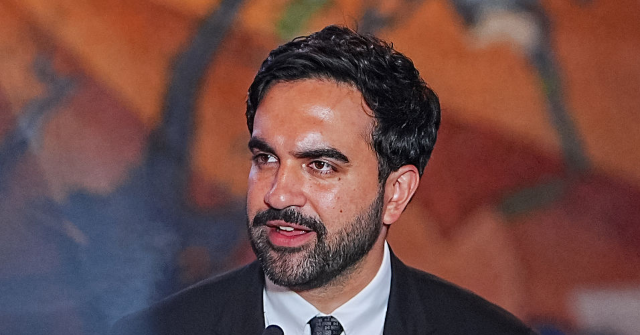
Zohran Mamdani, the first Muslim mayor of New York City, has a controversial relationship with the 9/11 commemorations, often being seen as downplaying or excusing the attack. In New York, families of attack victims asked him not to attend memorial ceremonies.
Last Friday, Mamdani dutifully signed two orders recognizing the 25th anniversary of 9/11. He then handed the pen he used to Ramzi Kassem, his chief counsel. Kassem previously represented an Islamic terrorist named Ahmed al-Darbi who pled guilty in 2014 to participating in an al-Qaeda bombing of a French oil tanker off the coast of Yemen.
“If you look at what Mamdani’s views are on terrorism, on groups like Hamas and what those entities say about him, you realize that they didn’t have to blow up a building to take over New York. They just had to have an election strategy,” Schweizer says.
The past few years have seen the rise of Muslim politicians in the Democratic Party in cities around the U.S., notably in Dearborn, Michigan and in Minneapolis. The congressional representatives from those places include Rep. Ilhan Omar (D-MN), a Muslim from Somalia, who was once was recorded dismissing the 9/11 attacks as “some people did something.” Rep. Rashida Tlaib (D-MI), a Palestinian American, has been accused several times of having indirect connections to Muslim Brotherhood-affiliated organizations like Hamas and the Popular Front for the Liberation of Palestine.
Co-host Eric Eggers explores how that strategy is playing out twenty-five years later, with the Democratic Party being taken over by radical socialists and Islamist-leaning elected officials like New York Mayor Zohran Mamdani and Michigan Senate hopeful Abdulrahman Mohamed El-Sayed. Eggers quotes a recent commentary by Matthew Hennessy in the Wall Street Journal saying that “the radical leftists taking over the Democratic Party don’t look at the victims of 9/11 as countrymen. They don’t think of that day and feel the enormity of the loss or the magnitude of the injustice. They think we had it coming. They think we’re the bad guys.”
Schweizer is quick to add that not all Muslim politicians are playing along with the goals of the Muslim Brotherhood. “Zuhdi Jasser, a guy I know a bit, is a former Navy commander, a doctor in the Navy. He’s now a doctor in private practice in Arizona and running as a Republican. It doesn’t matter if he’s a Republican or a Democrat, he loves America. He has called out the radical jihadists and says, ‘No, this is this is not what we want.’ And he’s willing to fight it,” Schweizer says.
“Mamdani is not doing that. Mamdani has embraced the Muslim Brotherhood,” he adds.
For more from Peter Schweizer, subscribe to The DrillDown podcast.
Read the full article here