




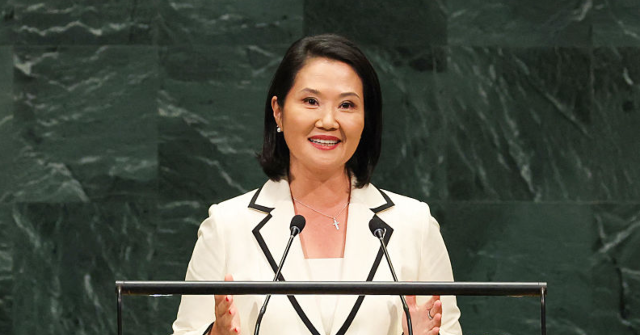
Conservative President of Peru Keiko Fujimori used her debut speech at the United Nations General Assembly on Tuesday to define transnational crime as terrorism, warning that international criminal structures strengthen themselves when countries face them alone.
President Fujimori stressed that the fight against the terror of international crime is one of the three greatest challenges that her country faces — emphasizing that the rights of law-abiding citizens “end where the impunity of criminals begins.”
Fujimori, daughter of late conservative President Alberto Fujimori, was sworn in as president in late July, becoming Peru’s tenth head of state in ten years after a decade’s worth of political instability that plagued the South American nation. Fujimori pointed out that it has only been 57 days since she took office.
The conservative president noted that her country defeated terrorism over 34 years ago, referring to the Marxist terrorist organization Shining Path which was crushed in the 1990s during her father’s rule. Fujimori stressed that although Peru is on a continent where no wars are being waged between nations, the country now faces “another type of war” that comes from transnational criminal organizations imposing terror upon the region and its inhabitants.
“In this war, there are no battlefronts or defined borders. There are no international rules. The enemy wears no uniform. The enemy hides among our own people,” Fujimori said. “There is no possibility to see surrender or to sign peace treaties in this context.”

The conservative president argued that countries facing the war against international crime on their own is a mistake repeated throughout the region, as criminal groups — which already have huge economic and “war mongering power” — exploit this for their advantage to strengthen drugs and human trafficking, illegal mining, contraband, extortion, and murder.
“Consequently, the first thing we must do is isolate or pinpoint and identify the enemy. These organizations, these enemies are terrorist groups and they must be tackled for what they are — they are enemies of a democratic state and of fine, upstanding citizens,” she said.
Fujimori pointed out that Peru has recently joined the U.S.-led Americas Counter Cartel Coalition (A3C), also known as the Shield of the Americas. She described joining the coalition as a sign of the country’s commitment to working together and in coordination with regional partners to tackle the top-priority challenge of fighting crime. Peru joined the A3c earlier this month during Secretary of State Marco Rubio’s official visit to Lima.
“In Peru, we will pursue crime, from the individual who carries out the act to the network that supports it. We will not back down in the face of those who seek to impose terror over the law,” Fujimori said.
The Peruvian president indicated that cracking down on criminal organizations with the full force of the law is not enough to eradicate the problem unless Peru also rises to the challenge of developing a better educational system — the second top problem that Peru faces. Fujimori explained that her administration strives to convert education into a tool for social transformation that allows for the prevention of violence and crime as it is the role of the state to withdraw barriers that hinder people’s development.
Lastly, Fujimori explained that her administration seeks to strengthen democratic institutions in Peru, which she described as the third topmost problem of her nation. The conservative president emphasized that her country believes in the freedom of individuals and the family as an irreplaceable pillar of society.
President Fujimori concluded her speech by stating that Peru arrives at the U.N. “absolutely sure of the fact that we can share great principles without ever turning our back on what we are.”
“We do not need to all think in the same way to have deep mutual respect for one another. The world does not require identical democracies. It requires legitimate democracies,” she said.
“It does not demand nations that are all the same. It does not need cookie-cutter nations. It needs truly free peoples,” she concluded.
Christian K. Caruzo is a Venezuelan writer and documents life under socialism. You can follow him on Twitter here.
Read the full article here


