



Peru’s electoral court, the National Jury of Elections (JNE), over the weekend ordered a “comprehensive and exhaustive IT audit” of the yet-to-be defined April 12 presidential elections.
Peru has now marked three weeks without definitive results determining which two presidential candidates will head to an upcoming runoff election on June 7, leaving the country in a period of political uncertainty as the scheduled primary approaches.
At press time, three weeks after the election, the National Electoral Processes Office (ONPE), the institution tasked with organizing elections in Peru, has not finished counting all the votes. Local electoral authorities have affirmed that the lengthy and ongoing delay of the finalized results will not cause the June runoff to be rescheduled.
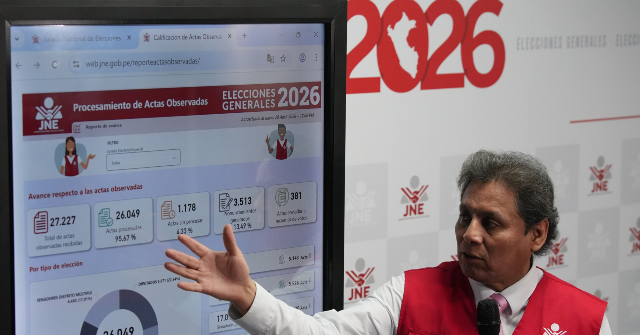
While former first lady Keiko Fujimori is projected to advance to the runoff as the frontrunner, second place remains close with roughly one-percent vote difference between radical leftist lawmaker Roberto Sanchez Palomino and conservative former mayor of Lima Rafael Lopez Aliaga. According to ONPE, 97.789 percent of the votes have been counted as of Monday, May 4 at 09:00 a.m. (local time).
JNE, a board tasked with assessing ballot disputes and other electoral-related complaints, released a statement on Saturday informing that it ordered a complete audit of the technological and cybersecurity platforms used in the election — a measure that, JNE asserted, responds to the need for “concrete and decisive action to strengthen the transparency, integrity, and reliability of election results.” Additionally, the electoral court stressed, the measure would address the need to raise standards for the control, verification, and traceability of computer systems used in the election.
According to the JNE, the IT audit of the electoral systems will be overseen by a specialized Academic Committee of experts on electoral matters established by the board in November. The group is composed of “external and independent professionals” tasked with issuing specialized technical opinions and objective recommendations, “thereby strengthening the integrity of the process.”
Over the past weeks, the JNE has been livestreaming a review process of a batch of disputed ballots. A JNE spokesperson told Reuters on Saturday that the recently announced audit would not affect the ongoing ballot-reviewing process. Prior to Saturday’s announcement, JNE officials had publicly stated that it would take until “mid-May” for the board to have final results of the election — a month after the election and just a few weeks before the June 7 runoff.
On Sunday, Rafael López Aliaga, who according to the latest official results is in third place and is only roughly 26,000 votes away from overtaking Sanchez Palomino’s second place, formally presented a request to JNE on Sunday asking that the board abstain itself from proclaiming any finalized results until the announced audit is finished. According to RPP, who obtained a copy of the request, López Aliaga justified his requests on the grounds that ONPE allegedly committed “bias” during the election, arguing that said purported action “directly undermines the legitimacy of the results.”
López Aliaga reportedly questioned the audit in his missive, claiming the process lacks “clear mechanisms and responsible deadlines,” and gave a 24-hour deadline to the JNE to disclose who will be part of the audit team, how long the review process will take, and how its transparency will be ensured — otherwise, he said, he will evaluate pursuing legal actions against JNE’s directive.
The April 12 election, although deemed “peaceful” by the Organization of American States (OAS), was marred by a series of logistical issues by ONPE that led to significant delays in the voting process. Many voting centers across Peru did not receive ballots and other electoral materials on time. The situation led to a special extension of the voting process in Lima for voting stations that could not open their doors on election day due to a lack of material. ONPE’s chief, Piero Corvetto, resigned from his position in late April after he relinquished his passports to local authorities as part of an ongoing investigation into what caused the April 12 election delays. Corvetto is presently being probed on allegations of aggravated collusion and dereliction of duty.
Last week, local courts banned Corvetto from leaving Peru for 18 months after authorities determined that, in addition to his Peruvian and Italian passports, Corvetto possessed an additional undisclosed Peruvian passport that could have allowed him to leave Peru. The third passport was found by local authorities during a search of Corvetto’s home last week. In addition to Corvetto, other ONPE top officials and representatives from companies that provided services to ONPE for the election were banned from traveling out of the country.
Christian K. Caruzo is a Venezuelan writer and documents life under socialism. You can follow him on Twitter here.
Read the full article here