







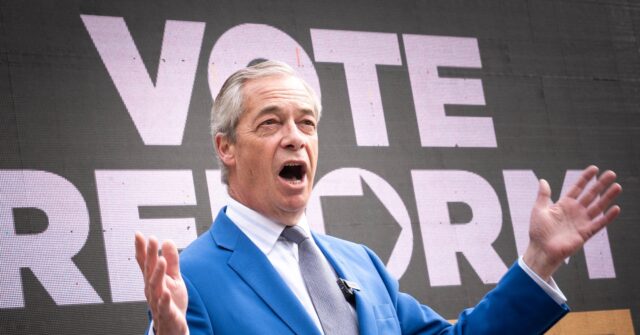
Brexit leader Nigel Farage has offered an olive branch to Britain’s trade unions, saying they are welcome to join his Reform UK party, which he says represents the interests of the nation’s patriotic working class.
While the Labour Party was founded at the turn of the last century as a bastion for workers in the wake of the industrial revolution, it has become increasingly beholden to effete urban liberals and foreign migrant dependents, seemingly leaving room for others to claim the mantle of a small-L labour champion.
The first cracks began to emerge during the 2008 financial crisis, which was sparked in part by financial reforms instituted by former Labour Prime Minister Gordon Brown, who also oversaw massive bank bailouts totalling hundreds of billions.
Yet, the true fault line between Labour’s urban elite voting bloc and its traditional working-class base first broke out during the 2016 Brexit referendum. Although then-Labour leader Jeremy Corbyn had long been a Eurosceptic, he cowered before the party’s largely pro-Remain globalist faction, abandoning the values of the ‘old left’ such as his socialist mentor, Tony Benn, who long advocated against the ethos of open borders and unfettered free trade, which he saw as tools of capital to undermine domestic workers.
With the pro-corporatist Conservative Party leadership also opposing the independence referendum, and with long, deep-seated resentment against the ‘Tories’ over past battles between unions and former leaders like Margaret Thatcher, many in the traditional “Red Wall” Labour heartlands in the North of England and elsewhere have been left politically homeless.
However, with the emergence of Nigel Farage’s Reform UK as a national force, this appears to be changing, with a survey last month finding that trade union members were as likely to be supporters of Reform as Labour, which has suffered a staggering 20-point drop among union workers since coming to power in 2024.
On Tuesday, Mr Farage said that he would welcome any trade union that wants to affiliate with his party. He further invited any union leader to hold sit-down talks during Reform’s upcoming conference in Birmingham. He acknowledged that there will likely be some differences of opinion, but said: “I’ll meet you and talk about policy because we are on the side of working people.”

Although Mr Farage and many of his allies had long leaned toward laissez-faire economic policies, following Britain’s withdrawal from the EU, there has been a growing movement toward industrial strategy and protectionism in the face of malign actors on the world stage, such as Communist China, which uses state subsidies and slave labour to gut competition in other countries, particularly those in the West.
This has brought Reform closer to many working-class voters on both immigration and fiscal policy. Indeed, Mr Farage told Breitbart London back in 2024 that Thatcherite economics had become “irrelevant” in the modern world, saying that over the past few decades, the power of big corporations had grown too powerful.
“Capitalism is dead, it doesn’t exist, we’re living in corporatism. An unholy alliance of big business, big banks, and big government,” he remarked, warning that unless the government took active measures, multinationals would hollow out the British economy.
Yet unlike similar pro-worker political movements on the right, such as those led by Donald Trump in the United States and Marine Le Pen in France, Mr Farage appears intent on targeting welfare reform, casting his party as the representative of “patriotic workers” compared to the Labour Party, which he has cast as the party of welfare. Key to this strategy for Reform will be to tie welfare to immigration, casting it as a system which takes money from the British working class and transfers it to foreigners leeching off the system. This may have particular purchase in the UK, with households with at least one migrant taking in an astonishing £1 billion in welfare every month, which comes on top of the billions spent on housing and other subsidies for supposed asylum seekers.
Though this message may resonate with the union member rank and file, it remains to be seen if trade union leadership will take the bite, given their tendency to be run by hardcore socialist campaigners. Indeed, prominent trade unionist Mick Lynch, the former General Secretary of the National Union of Rail, Maritime and Transport Workers (RMT), who became a national figure during the rail strikes of 2022, argued this week that taxpayer-subsidised housing should be provided to anyone who moves to Britain.
Appearing on BBC Newsnight on Monday evening alongside Reform UK’s candidate for London Mayor, Laila Cunningham, who argued that social housing and benefits should only go to Britons, Lynch expressed a universalist view, declaring that “the British people include people that live here that have come from abroad, they are the British people”. Although Lynch has denied being a Marxist, he said that he believes in a “fair tax system where wealth is distributed properly, so that all people can advance”.
Cunningham, in turn, suggested that the refusal to put British people first was why Labour was losing voters to Reform.
Follow Kurt Zindulka on X: Follow @KurtZindulka or e-mail to: kzindulka@breitbart.com
Read the full article here


