




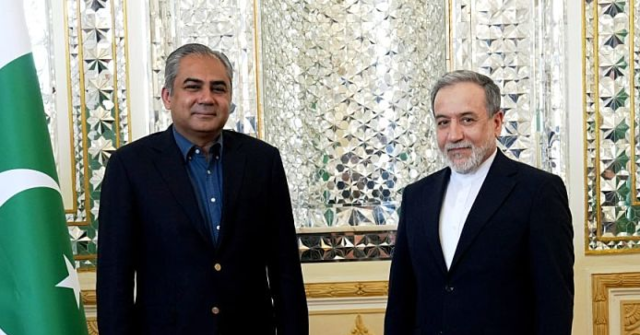
Pakistani Interior Minister Mohsin Naqvi said on Tuesday that “significant progress” was made during a visit to Tehran by himself and Field Marshal Asim Munir, the powerful chief of Pakistan’s defense forces.
According to Naqvi’s post on X, he and Munir had a “very positive and productive meeting” with Iranian President Masoud Pezeshkian, focused on “the Iran-U.S. conflict, tensions in the Middle East and the way forward,” and “the steps needed by both sides for restoration of the Islamabad MOU.”
The Islamabad Memorandum of Understanding (MOU) was the June 17 ceasefire agreement between the United States and Iran. Iran violated the agreement within a matter of days by attacking commercial ships in the Strait of Hormuz.
Naqvi said Pezeshkian “candidly shared his Government’s perspective and concerns, and we had a very constructive exchange on the issues involved.”
Pezeshkian has lately been expressing a desire to return to the MOU, as the U.S. blockade and economic sanctions squeeze Iran’s economy — but there is little sign that the dominant Iranian military faction, the Islamic Revolutionary Guard Corps (IRGC), wants to bring the agreement back.
Reuters reported on Monday that Munir spoke with President Donald Trump before making his trip to Tehran. Pakistani sources said Trump, who has spoken highly of Munir throughout Pakistan’s mediating efforts, initiated the call and asked the field marshal to get Iran back to the negotiating table. The White House did not confirm the details of the Reuters report.
According to Pakistani military sources, Munir met with Iranian parliamentary speaker Mohammad-Bagher Ghalibaf, Supreme National Security Council chief Mohsen Rezaei, Foreign Minister Abbas Araghchi, and Interior Minister Eskandar Momeni during his trip to Tehran.
The Pakistani Army said the Iranian officials “appreciated Islamabad’s constructive role and sincere efforts to facilitate dialogue, reduce tensions, and promote a peaceful resolution to the conflict.”
On Tuesday, The National reported that Oman, another previous mediator of talks between the U.S. and Iran, has also rejoined the diplomatic effort. Omani Foreign Minister Badr Albusaidi met with his Iranian counterpart, Abbas Araghchi, in Tehran on Tuesday.
Iran has claimed for weeks that it was in talks with Oman to share control of the Strait of Hormuz, as well as collaborating on schemes to extort “fees” from international shipping. Last week, President Trump threatened to bomb Oman if it “gets in the way” of resolving the Iran conflict.
According to The National, Oman and Iran have been “discussing arrangements for the passage of ships through the waterway, with Oman seeking safe passage.”
Following the meeting in Tehran on Tuesday, the two countries issued a joint statement that said they were working on a “temporary navigational corridor” for commercial shipping and could work together on clearing Iranian mines from the Strait of Hormuz.
Despite Pakistan’s enthusiasm for Munir’s visit to Tehran, there were signs that not much has truly changed within Iran’s leadership.
The Pakistani military statement said Pezeshkian “stressed that the United States should honor its commitments toward Iran in accordance with international law and Iran’s legitimate rights” and “called for Washington to revise its tone and approach toward Tehran,” while Ghalibaf “stressed that the United States must fulfill its commitments” under the MOU. These positions are not much different from those Tehran has taken ever since it violated the MOU with attacks on civilian vessels.
“Contrary to some inaccurate media speculation, the visit of Field Marshal Asim Munir, the army chief of friendly Pakistan, to Iran was highly productive and yielded significant diplomatic achievements, the results of which will become apparent soon,” Pezeshkian’s office said of the Pakistani visit on Tuesday, without hinting at any concessions Iran might be willing to make.
Read the full article here


