







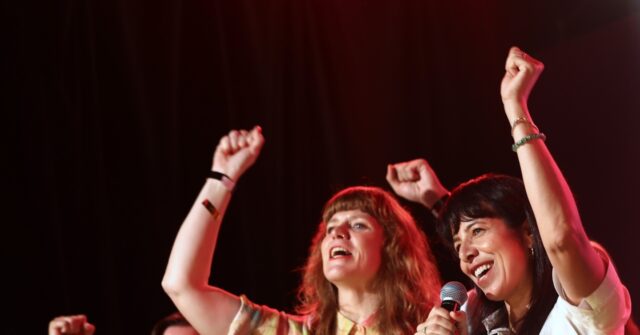
Young women voters were a driving force behind the victory in Berlin on Sunday for the far-left Die Linke party, the descendant of East Germany’s former communist ruling party.
For the first time since the Berlin Wall fell in 1989, a plurality of voters in the German capital backed a radical socialist party in a state election, with Die Linke (The Left) comfortably sailing to a win over the faltering Christian Democrats of Chancellor Friedrich Merz.
The far-left party, a reformulation of the Socialist Unity Party, which once ruled with an iron fist for four decades over the Soviet satellite state of East Germany, took in 25.7 per cent of the vote, up from 12.2 in 2023. In comparison, just 18.8 per cent backed the Christian Democratic Union (CDU), down from 28.2 per cent three years ago.
Die Linke was bolstered largely by the youth vote, with exit polls finding that the party won 43 per cent of the under-25 vote in Berlin, up 25 points from the last election. The party performed even better among the 25 to 34-year-old age bracket, winning 49 per cent of the vote, Tagesschau reports. They also dominated among first-time voters at 39 per cent, with the Greens coming in a distant second at 14 per cent.
Meanwhile, the Christian Democrats won the most votes of any party among those over 60 with 29 per cent, while winning only 8 per cent of voters under 25.
The Left party’s strongest voting bloc was young women, with 51 per cent of under-25 female voters voting for Die Linke. Again, the Greens trailed in second place at a considerable distance with just 12 per cent. The leftist party performed well among young male voters, but its support was significantly lower than among women at 34 per cent.
This comes amid a broader global trend of women moving to the left, with similar gender divides observed in countries like Britain, Poland, and South Korea. A 2024 Gallup poll in the United States found that women between the ages of 18 and 30 were 30 percentage points more liberal than their male counterparts.

Die Linke was also likely bolstered in large part by Berlin’s shifting ethnic demographics, with over 41 per cent of the German capital city now having a so-called “migrant background”, meaning they were either born in foreign countries themselves or had at least one parent who migrated to the country.
While the exit polls did not provide an ethnic or migration snapshot of voters, Die Linke appears to have been aware of its success among ethnic minorities, with footage emerging on social media purportedly showing celebrations on Sunday at the leftist party’s campaign headquarters set to Arabic-language music.
One of Die Linke’s candidates in the Berlin elections, Basem Said, courted controversy ahead of the vote after he joined a pro-Palestinian activist to reportedly call for an “Election Intifada” in the German capital, according to Die Welt. The Arabic phrase, which translates to “uprising” or “popular revolt”, has long been associated with Palestinian terror campaigns against Israel, which included frequent suicide bombings against Jewish targets.
Die Linke’s lead candidate, meanwhile, Elif Eralp, may become the party’s first Mayor of Berlin since reunification, and the German capital’s first Turkish heritage leader.
Although the defeat to the radical left in Berlin was humiliating for the current governing Christian Democrats, Chancellor Merz acknowledged that the loss to the Alternative for Germany (AfD) party in the simultaneously held Mecklenburg-Western Pomerania state elections on Sunday represented the true “disaster“.
The AfD winning its second election in less than a month may have been enough to call into question the Chancellor’s political shelf life. Yet, adding insult to injury, Merz’s CDU even failed to pass the five per cent threshold needed to be allocated seats in the state parliament, a deeply embarrassing result for both the party and the Chancellor.
Rumours have swirled around Berlin in recent weeks that Merz could be forced out of office. However, the CDU leader said on Sunday that he has no intention of stepping down and, with an apparent lack of willing rivals, it appears his government may limp on for the time being. Yet, with 85 per cent of the public disapproving of his leadership, it will likely become increasingly difficult to pass legislation and govern effectively without defections.
Follow Kurt Zindulka on X: Follow @KurtZindulka or e-mail to: kzindulka@breitbart.com
Read the full article here


