




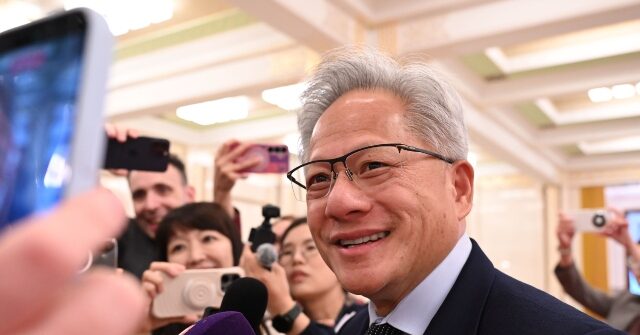
The future of Nvidia’s AI chip sales in China remains unclear after President Trump’s summit with Chinese leader Xi Jinping concluded on Friday, despite the last-minute addition of Nvidia CEO Jensen Huang to the American business delegation.
The New York Times reports that when Jensen Huang joined the group of American business leaders traveling with President Trump to Beijing this week, many observers interpreted his presence as an indication that progress might be forthcoming for Nvidia’s long-stalled sales in the Chinese market. However, as the high-level summit between the two world leaders wrapped up, the situation surrounding Nvidia’s AI chips in China appears to be no different than before the meetings began.
The uncertainty was evident even among senior U.S. officials. Jamieson Greer, the U.S. trade representative, indicated in an interview with Bloomberg News on Friday that decisions about Chinese companies purchasing from the American chip giant ultimately rest with Beijing authorities.
The current impasse dates back to December, when President Trump granted approval for Nvidia, the world’s leading chip manufacturer, to sell one of its most powerful artificial intelligence chips, the H200, to China. Despite this authorization, the Chinese government has not approved any purchases, resulting in zero H200 sales in the months since. Instead, Beijing has been encouraging Chinese companies to depend on domestic technology from chipmakers such as Huawei.
U.S. officials did not appear to prioritize the chip sales issue during their China visit. Greer stated in his interview that the decision on whether to purchase the H200 “is going to be a sovereign decision for China.” He added, “Obviously we think it could be helpful to them in the long run, but they’ll just have to make their decision on that.”
For several years, Washington has employed export controls as a tool to decelerate China’s advancement in cutting-edge technologies like artificial intelligence. Analysts had anticipated that Chinese officials would express their dissatisfaction with these restrictions during the summit. However, despite Huang’s attendance in Beijing, Greer confirmed that the two sides had not discussed chip export controls during the meeting.
According to Greer, China remains firmly dedicated to domestic production of advanced chips and perceives the U.S. tech industry as a potential obstacle to that objective. “If we are ahead of the game, like we are on A.I. chips, sometimes they feel that can stop their own growth,” he explained.
President Trump himself addressed the situation while speaking to reporters aboard Air Force One on Friday night. He acknowledged that although China requires advanced chips, the country has thus far declined to purchase the H200 in order to concentrate on developing homegrown technology. Nevertheless, Trump expressed optimism that this stance might change. “They chose not to, they want to try to develop their own,” Trump said, confirming that the issue was discussed. “I think something could happen on that.”
Breitbart News social media director Wynton Hall has written his instant bestseller Code Red: The Left, the Right, China, and the Race to Control AI to serve as the definitive guide on how the MAGA movement can create positions on AI that benefit humanity without handing control of our nation to the leftists of Silicon Valley or allowing the Chinese to take over the world.
Read more at the New York Times here.
Lucas Nolan is a reporter for Breitbart News covering issues of AI, free speech, and online censorship.
Read the full article here


