




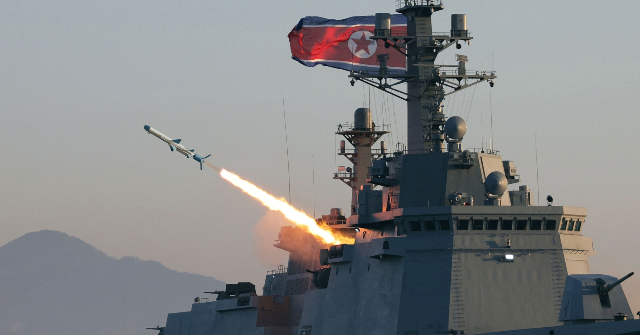
The government of South Korea confirmed that it observed the launch on Wednesday of a ballistic missile from North Korea into the East Sea (Sea of Japan), causing no damage but reinvigorating regional alarm that the communist nuclear state could soon plan an attack on its neighbors.
North Korea’s state media arms, which typically rush to boast of such a missile test, have not at press time addressed the incident. The rogue state’s missiles are making headlines in other ways, however, as President Volodymyr Zelensky of Ukraine once again warned on Tuesday that his troops are seeing North Korean equipment, missiles in particular, on the battlefield against the Russian invasion. North Korea has openly participated in the invasion since late 2024, following the signing of a “mutual defense” agreement with Moscow in June 2024.
The South Korean news service Yonhap reported, citing authorities in Seoul, that the South Korean military identified the projectile shot on Wednesday as a ballistic missile that traveled about 435 miles, falling within the range of known North Korean short-range ballistic missiles. It added that the U.S. government also confirmed that North Korea shot a missile, but assured that it did not see the launch as “an imminent threat to its territory and allies.”
The Korea JoongAng Daily added that the Japanese government also documented the missile launch, documenting that it flew up about 56 miles before beginning to fall again.
“The missile is believed to have been either a medium-range ballistic missile (MRBM) with a range of 1,000 to 3,000 kilometers, or the Hwasong-16B intermediate-range ballistic missile (IRBM) with a range of 3,000 to 5,500 kilometers,” JoongAng reported.
Both JoongAng and Yonhap suggested that the missile launch may have been intended as an act of protest against the regularly planned “Ulchi Freedom Shield” joint exercises between America and South Korea. North and South Korea, and China and America respectively, have been in a formal state of war since 1950, when the communists invaded South Korea and launched the Korean War. While an armistice agreement ended active hostilities in 1953, no peace treaty has ever been signed, nor has either side surrendered, so the war is officially still ongoing.
North Korean state media has not mentioned the missile launch at press time, which Yonhap suggested could indicate the launch was a failure. Topping the pages of the state-run Korean Central News Agency (KCNA) on Wednesday was a message from Foreign Ministry official Jang Kum Chol who condemned the government of leftist South Korean President Lee Jae-myung for allegedly pursuing the development of a nuclear-powered submarine.
“The ROK’s scheme for possessing a nuclear submarine, which has recently entered the phase of practice, is amplifying the instability of the regional security environment,” Jang complained. “The ROK’s possession of nuclear submarine will inevitably result in nuclear dominoes in the Asia-Pacific region.”
The official concluded by complaining that South Korea’s energy development was “part of the U.S. great strategy to build an axis of nuclear hegemony in the Asia-Pacific region with the proliferation of nuclear submarine as a vehicle and thus restructure the military balance in the global scale in favor of it.”
Dictator Kim Jong-un most recently made an appearance to celebrate his National Symphony Orchestra and promote the arts, which does not seem to have any overt relation to the missile launch.
Kim delivered a speech on Sunday declaring, “When the dignified and distinctive resonance of our style symphony brings greater inspiration and encouragement to our revolution… our cause will advance triumphantly with even greater power and surging vitality.”
The missile launch reinforces another regional conflict separate from North Korea’s war with the South, namely its ongoing role as an active belligerent in Europe. Ukrainian President Zelensky warned on Wednesday that an overnight attack on Zaporizhzhia, a southeastern city known for its routinely endangered nuclear power plant, appeared to feature North Korean ballistic missiles.
“The city was struck with North Korean ballistic missiles, Zircons, and guided aerial bombs,” he wrote in a message on social media, accompanied by photos of the bombing. “It was a vicious attack, calculated to inflict maximum damage specifically on civilian infrastructure. Unfortunately, as of now, six people have been reported killed and nineteen wounded in the city.”
Last week, Ukrainian intelligence official Andrii Cherniak told the news agency Reuters that Kyiv was aware of the deployment by Russia of a North Korean missile unit against Ukraine. Cherniak reportedly said the new unit “could be equipped with 120 ballistic missiles and six launchers for strikes against Ukraine.”
Kim Jong-un has integrated anti-Ukrainian rhetoric pervasively into North Korean propaganda, listing Ukraine as an enemy of the state equal to the United States, South Korea, and Japan.
“Today, the world is witnessing rampant ultra-nationalism of modern version such as ‘America First’ idea, Zionism, Ukrainian Neo-Nazism, and Japanese militarism,” Kim declared in a speech in June, emphasizing the need, in his eyes, for North Korea to maintain its illicit nuclear weapons program.
Follow Frances Martel on Facebook and Twitter.
Read the full article here


