






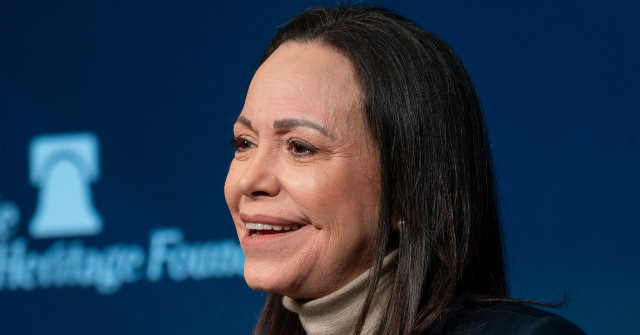
Anti-socialist Venezuelan opposition leader María Corina Machado on Sunday announced that she will be returning to her country “in a few weeks” to continue working towards a democratic transition in the South American nation following the arrest of Nicolás Maduro.
Machado — a former lawmaker violently ousted from her democratically elected position as the leader of Venezuela’s only mainstream center-right party, Vente Venezuela — escaped the country in December 2025 with the help of President Donald Trump’s administration, allowing her to receive the 2025 Nobel Peace Prize in Oslo, Norway. She successfully escaped Venezuela after spending over a year in hiding facing constant threats and insults from the Venezuelan socialist regime, which accused her of dubious “treason” charges in the aftermath of the sham July 28, 2024 presidential election.
Since fleeing Venezuela, the anti-socialist leader has carried out an international agenda holding meetings with different politicians and leaders, including Pope Leo XIV, President Trump, and Secretary of State Marco Rubio. In January, weeks after the United States arrested socialist dictator Nicolás Maduro in Caracas, Machado attended the White House where she gifted her Nobel Peace Prize medal to Trump in recognition of his efforts towards restoring democracy in Venezuela — a nation that, prior to the arrival of the “Bolivarian Revolution” in 1999, historically maintained friendly ties with America.
Machado published a roughly six-minute-long video on Sunday announcing her return to Venezuela in “the coming weeks.” She once again thanked President Trump for delivering Maduro to justice. She also thanked the American men and women who risked their lives for the freedom of Venezuela and for the national security of their country and the security of all the Americas.
“The transition to democracy in Venezuela is unstoppable. For years, we said that this regime would only relinquish power when confronted with real force and a credible threat,” Machado said. “First, we had to defeat them spiritually, then politically, then electorally, and finally militarily.”
“We said it would happen, and it did. On January 3, a legitimate president was not captured because Nicolás Maduro had been overwhelmingly defeated on July 28, 2024, in that extraordinary citizen effort that elected Edmundo González Urrutia,” she continued. “President Donald Trump, with vision and courage, brought Nicolás Maduro before international justice. International justice that finally, on January 3, was at the service of the people and not of tyrants.”

Following Maduro’s arrest in January, the Venezuelan socialist regime, now led by “acting President” Delcy Rodríguez, started cooperating with the United States’ three-phase stability, recovery, and transition towards democracy program outlined by Sec. Rubio.
Rodríguez’s ongoing cooperation has led to initial steps towards restoring U.S. diplomatic presence in Venezuela, and has seen the “acting President” hold meetings with U.S. Energy Secretary Chris Wright and U.S. Southern Command (SOUTHCOM) commander, Marine Gen. Francis L. Donovan over the past weeks.
The Venezuelan socialists have also started to dismantle its brutally repressive apparatus and revoking much of the notoriously draconian socialist laws restricting foreign access to the nation’s oil industry. Last week, Rodríguez announced that the regime’s largest and most infamous torture complex, the Helicoide (“The Helix”), will be transformed into a “cultural center.”
Machado did not explain how she plans to return to her country. In February, Delcy Rodríguez warned in an interview with NBC news that Machado would have to “answer to Venezuela” if she returned to her country for her support of U.S. and international human rights sanctions against the socialist regime, calling for “international intervention” in Venezuela, and “celebrating” the arrest of Nicolás Maduro. The Venezuelan National Assembly, led by Delcy’s brother Jorge Rodríguez, recently approved an “amnesty bill” widely criticized for its narrow scope and for excluding numerous Venezuelan dissidents and former political prisoners, including Machado.
“The regime currently in power in Venezuela is of the same nature. These are the people who have tortured, persecuted, imprisoned, disappeared, murdered, expropriated, and lied,” Machado said in the video.
“They want to buy time so that nothing changes. But everything has changed, and now they have to follow instructions to move forward with dismantling repression, restoring our country’s economy, and advancing toward transition,” she continued.
Machado summarized the events and meetings she held since her departure from Venezuela and said that she conveyed to everyone whom she met with the “enormous potential” of the country under a democratic future — emphasizing that such a scenario would allow for the return of millions of Venezuelans around the world who fled from their country.
The anti-socialist leader detailed that her return to Venezuela will see her carry out a roadmap that will see strengthened the unity of Venezuela, finish consolidating a national movement, and prepare for a “new and gigantic electoral victory” in a prospective free election in the future.
“For all this, I will return to Venezuela in a few weeks. I want to do so, as do hundreds and thousands of Venezuelan exiles around the world,” Machado said.
“We will arrive to embrace each other, to work together, to ensure an orderly, sustainable, and unstoppable transition to democracy,” she continued. “Let us prepare ourselves. A great task lies ahead. Freedom is coming, and we are walking hand in hand with God.”
A survey conducted in Venezuela by market research firm AtlasIntel for Bloomberg last week found that Machado ranked as the second most popular politician in Venezuela, with 56 percent of respondents expressing that they hold a favorable image of her. Machado was only surpassed by Rubio, with 57 percent of participants holding a favorable image of the U.S. Secretary of State.
Trump ranked third in the poll, with 53 percent of respondents answering that they hold a positive image of the American President.
Christian K. Caruzo is a Venezuelan writer and documents life under socialism. You can follow him on Twitter here.
Read the full article here


