







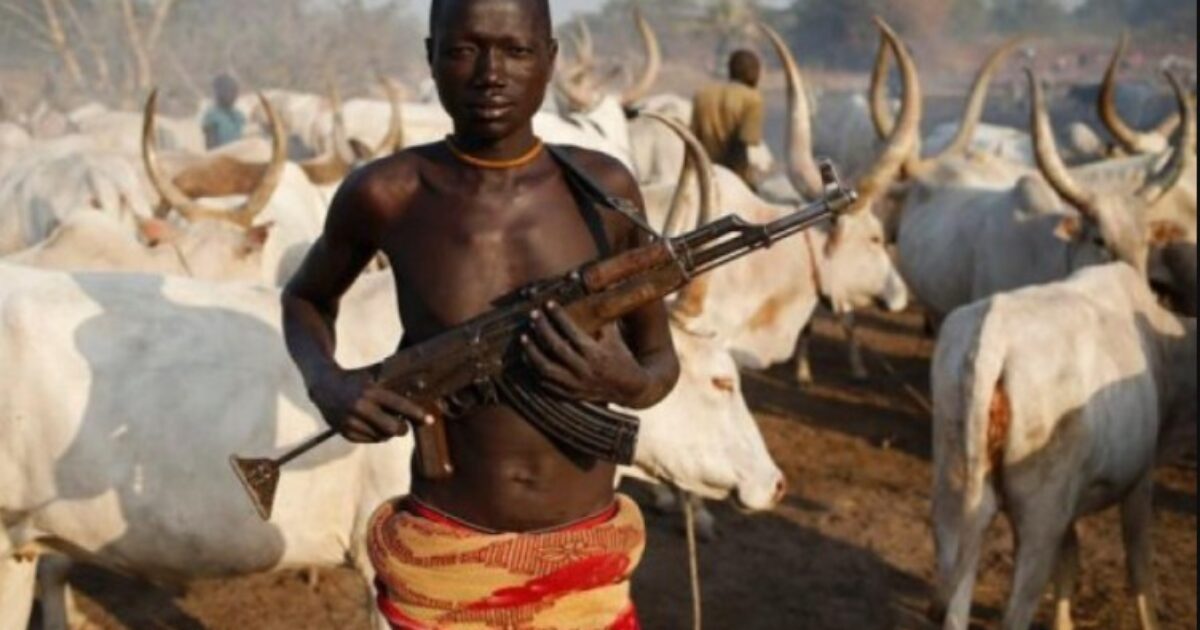
Twenty-six Christians were buried in a mass grave following the August attack on Bin Per, carried out by Fulani Islamists. Sokden Mathias, 52, Director of the Cultural Mogavul Development Association in Mangu LGA, Plateau State, reported that eyewitnesses estimated the attacking force at more than 500 people.
Mathias, speaking from Mangu Local Government Headquarters, said the Mogavul people, predominantly farmers, had coexisted peacefully with Fulani herdsmen in the area “from time immemorial.” He said the security situation began deteriorating around 2018, when Fulani herders started rustling cattle from indigenous Mogavul farmers, but attacks intensified sharply after Governor Caleb Muthuang, an indigene of Mangu LGA, was sworn in in 2023. Mathias said nearly 30 communities in the area have since been sacked and taken over by Fulani herdsmen.
Mathias said the pattern of attacks is not consistent with ordinary farmer-herder land disputes, which he said have historically been resolved through a traditional institution that includes Fulani representation. Instead, he alleged a coordinated land-grabbing agenda, saying attackers burn churches before destroying the rest of a village, and that communities are occupied and held by Fulani settlers afterward rather than vacated.
As an example, he cited the nearby community of Alon, where he said two women from a displaced Christian community were attacked while collecting firewood in territory now held by Fulani settlers. One died, while the other was hospitalized.
Mathias argued the targeting is religious rather than resource-driven, pointing to what he described as a consistent pattern across Kaduna, Benue, and Riyom in which Christian communities and churches are attacked while nearby Muslim settlements are not. “It’s evidently clear that there are evidences of mass burial of people who are predominantly Christian,” he said, adding that anyone denying a religious motive “is having an agenda with the terrorists.”
Villagers called the Nigerian Army for help, but soldiers arrived only after the massacre had taken place. According to Mathias, the community views the army as effectively colluding with the attackers.
The clearest example he cited was an army raid in Chakfem, a Mangu LGA community bordering Kwanpan and Bokkos. A separate source who described the raid directly said soldiers arrived at a local community leader’s home around midnight, acting on a tip, which he said likely came from social media reports, that the leader was rustling cattle. “There was no evidence of any [cattle] rustling,” the source said, but soldiers confiscated weapons the leader held in trust to defend the community: approximately 17 locally made firearms and six AK-47s.
Asked whether someone inside the community may have leaked the information to Fulani contacts or army officials, the source said, “I want to believe it’s so, because certainly there are enemies of communities, and you could have some people who are insiders of the community.” He said the confiscation left the community “in total confusion and vulnerability” and unable to defend itself if attacked.
Mathias concluded by saying that he does not currently trust the Nigerian government to protect residents of Plateau State. He called for a joint security task force, road construction to allow displaced communities to resettle, and international and federal support, including from President Bola Tinubu’s administration, to address what he described as a security emergency.
Nigerian and international media have documented a recurring pattern across multiple states in which massacres of Christian farming communities are followed by the occupation of the vacated land by Fulani herdsmen. The following cases, spanning from 2016 to 2026, illustrate this pattern as reported by local leaders, community associations, and state officials.
The pattern is documented most extensively in Benue State. Fulani herdsmen killed more than 300 Christian farmers in the state’s Agatu area beginning in February 2016. Two weeks after the killings, herdsmen remained in the area, grazing cattle on the farmland of the displaced Agatu community.
In October 2025, the Benue State Government reported that armed herdsmen had taken over more than 17 counties, displacing hundreds of thousands of residents. Farmer Angela Chiahemban described the occupation as gradual, with herders first raiding smaller villages before staying longer, burning farms, and warning residents not to return.
Testifying before the House Africa Subcommittee, Catholic Bishop Wilfred Anagbe of the Makurdi Diocese said that 20 parishes in his diocese no longer exist because of the attacks. He described militant Fulani herders as “hired guns” of cattle oligarchs who manipulate religion to eliminate the Christian population and “cleanse the land.”
In Plateau State, the Southern Middle Belt Alliance estimated in 2021 that 102 communities had been occupied and renamed by herdsmen. By June 2024, indigenous youth groups put the figure at 151 occupied villages and hamlets. In May 2025, a pastor identified as Byang said more than 60 Christian communities in the state were occupied by Fulani herdsmen and would not be reclaimed by their original owners.
That August, community leader Yohana Margif said herdsmen had driven Christians from nine villages in Bokkos LGA: Hokk, Kaban, Kadim, Nawula, Dulu, Mbor, Margif, Chirang, and Mangor. He said the herdsmen had set up tents and grazed cattle on the land.
Taraba State shows the same sequence. Attacks in Lau, Takum, Wukari, and Ardo-Kola counties were described as following a pattern of attacks, mass displacement, and subsequent occupation of farmland, attributed in part to foreign Fulani herdsmen from Niger, Chad, and Cameroon. International Human Rights Commission director David Onyilokwu Idah, describing the May 2025 attacks in Karim-Lamido County, said the killings were one chapter in a broader campaign of forced displacement and demographic engineering, noting that the militia retained control of the territory even after a 2024 military raid on their camp.
Related accounts have emerged from Oyo, Kaduna, and Adamawa states. In Oyo, herdsmen had occupied land taken from farmers in at least 10 local government areas by 2018. One Nigerian advocate described a method in which herders sent cattle to graze the farms of residents who refused to vacate.
In Kaduna’s Kajuru LGA, village chief Maiangwa Markus, who has documented attacks in the area for years, said in March 2026 that raiders surround villages at night, fire shots to create panic, and then go house to house dragging people into the forests. “The goal is clear,” Markus said. “Drive us off our ancestral land.”
In Adamawa’s Hong LGA, farmer Samuel Ishaya said in August 2026 that the crisis began with an influx of nomadic groups seeking to lay permanent claim to ancestral lands held by the Hoba tribe. When local elders refused to cede the territory, Fulani tribal leaders issued explicit threats that later materialized into attacks on churches.
The U.S.-based Mutual Union of Tiv in America, a diaspora organization representing members of Nigeria’s Tiv ethnic group, made a related allegation in a 2021 petition to the Nigerian House of Representatives, claiming that herdsmen were renaming ancestral lands abandoned by Tiv communities driven out of Benue, Taraba, and Nasarawa states since 2013.
The pattern extends beyond the Middle Belt into southeastern Nigeria, where Igbo communal structures have reportedly been supplanted. Data from the research group Intersociety found that 950 locations across more than 800 communities in the southeastern states of Abia, Enugu, Anambra, and Ebonyi had come under Fulani occupation by 2025, up from roughly 10 in 2015.
The report described communal lands, forests, farm settlements, and sites historically used for ancestral religious practices as having been ceded, procured, or forcibly occupied by herdsmen, who now use the sites as operational hideouts.
Ad block users: Some site features may not work correctly while an ad blocker is enabled, because they break scripts and content this website depends on. If you can’t see comments below, for example, please disable your ad blocker.
Read the full article here


