







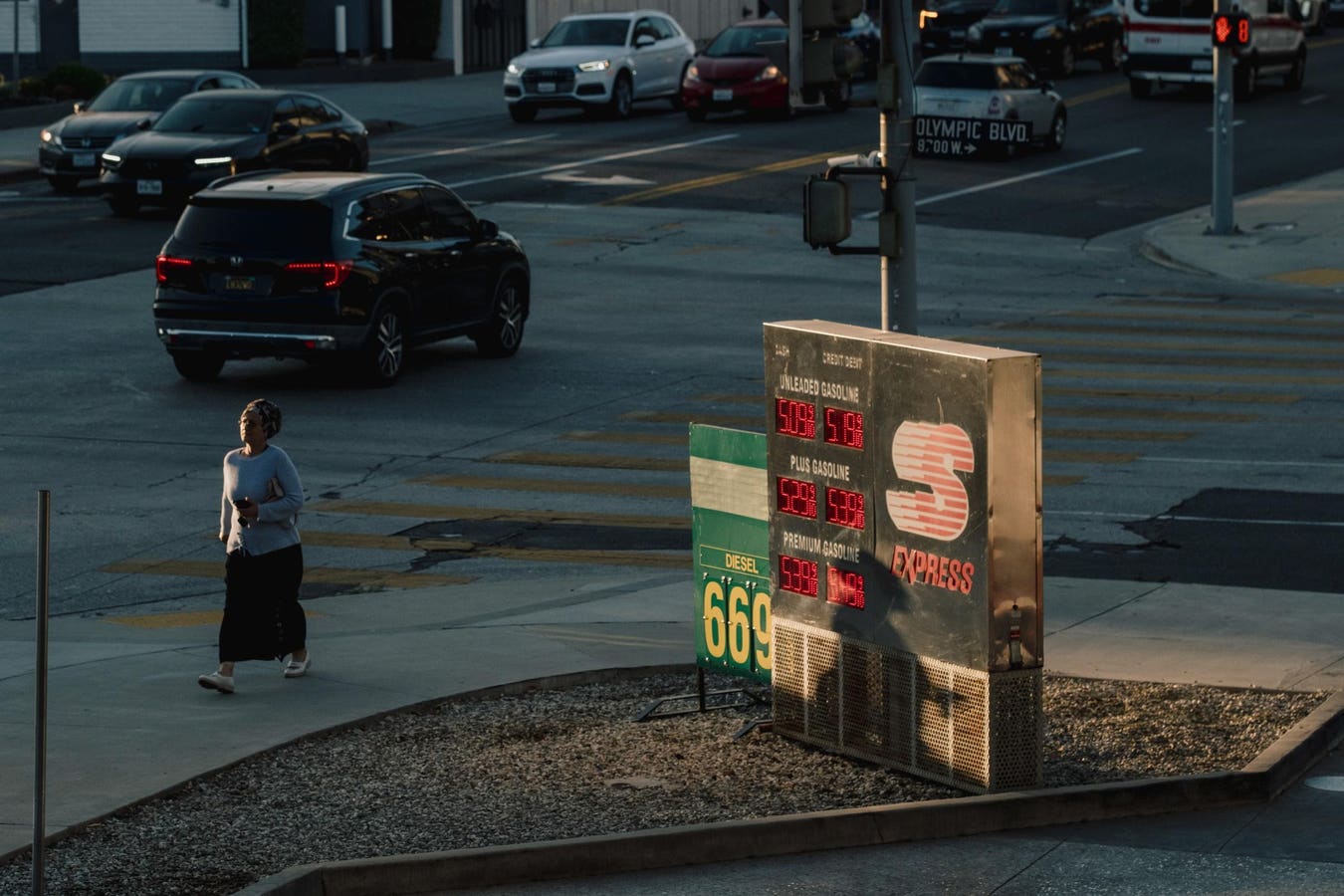
A sign displays the prices of unleaded and premium gasoline at a Speedway gas station in Los Angeles, California, US, on Thursday, July 2, 2026. Americans hit the peak of the summer driving season this July 4 holiday weekend wincing at the cost of gasoline, still running nearly a dollar a gallon higher than before the war with Iran despite falling sharply in recent weeks. Photographer: Mark Abramson/Bloomberg
© 2026 Bloomberg Finance LP
It’s no secret that gasoline prices at the pump are higher in California than any other state in the U.S. and have been so for many years. The daily publications of gas prices by state from sources like AAA and GasBuddy clearly show this for anyone who takes time to look.
Amazingly, the Golden State’s gasoline prices are higher on average even than those in Hawaii, an island state in the middle of the Pacific Ocean which produces none of its own petroleum needs. California Governor Gavin Newsom has repeatedly tried to write off his state’s pain at the pump as the fault of either the Big Oil companies or President Donald Trump and the impacts of the Iran Conflict in recent months, but other factors are clearly at play.
US President Donald Trump and First Lady Melania Trump are greeted by California Governor Gavin Newsom upon arrival at Los Angeles International Airport in Los Angeles, California, on January 24, 2025, to visit the region devastated by the Palisades and Eaton fires. (Photo by Mandel NGAN / AFP) (Photo by MANDEL NGAN/AFP via Getty Images)
AFP via Getty Images
Study Details Political Divide On Gasoline Prices
A new study published Tuesday by the Institute for Energy Research (IER), titled “The Pacific Premium” goes a long way to dispelling Newsom’s efforts to deflect blame. The report details exactly how state policies enacted under his own watch and by the state’s governing Democratic party for decades have created California’s high price situation. And it isn’t just California – “blue” states led by Democratic governors and state legislatures in general feature higher prices for gasoline and diesel than those in “red” states led by Republicans.
“For over a decade, Blue state politicians, especially on the West Coast, have made very deliberate policy choices that have steadily increased fuel prices in those states,” Tom Pyle, President at IER, says in a release. “Every passage of a fuel tax or carbon tax at the local level is passed on to consumers and directly impacts what drivers pay at the pump. The bottom line is this: state energy policies matter, and elections have real consequences.”
The trend is especially visible up and down the West Coast, where California, Oregon and Washington have been governed for decades – with rare exceptions – by Democrat governors and state legislatures sporting big Democratic majorities. The differential is smaller in blue states across the rest of the country, but by and large still shows up.
In an interview, the report’s author, Daniel Simmons, attributes most of the differential above the national average to state tax and environmental policies. Noting the state gas taxes in all three West Coast states rank well above the national average, Simmons adds that Democratic politicians in recent decades have simply focused on other priorities than affordability.
“Affordability is not what they’re focused on,” Simmons says. “They (Democrats) are focused on climate – they’re focusing on achieving other policy objectives. Their policy objectives do not include affordability for any fossil fuel. And it shows up in the report.”
Many Factors Impact Gasoline Prices
Simmons points out that states that produce some or all of their own petroleum and are home to robust networks of pipelines and other petroleum refining and distribution infrastructure tend to enjoy lower prices at the pump, and that also shows up in the report. Oregon, for example, has never been home to sizable oil production, and does not have a single refinery operating within its borders. The need to import all of its gasoline and diesel from other states or overseas leads inevitably to higher prices.
Washington is currently home to four refineries and has always produced modest volumes of oil and gas in the southeastern part of the state. But it still must import the vast majority of its needs.
California’s situation is far different. As I detailed here in April, the policies enacted by Newsom and the Democrat-controlled legislature have intentionally decimated the state’s refining sector, leaving just seven refineries currently operating, with six of those having announced plans to close in the coming years. California was once a major national powerhouse in oil production but now produces a small fraction of its daily consumption.
Even worse, the state has long made it almost impossible to build a major crude pipeline to be built to supply its needs from domestic U.S. production and thus is heavily reliant on foreign imports of both oil and refined products. California’s unique requirement of a special grade of reformulated gasoline to fight its historic air quality issues around Los Angeles and other big population centers also adds to pump prices with higher costs for refining and distribution.
“There are real legitimate air quality issues in California,” Simmons points out. “The reformulated gas is one way that they were trying to address the issue. Fine, if it was only that. But it’s not just that. It’s also a carbon fuel standard. It’s aggressive regulation, especially on the refineries. It’s high gas taxes. These things add up, and they compound over time.”
LOS ANGELES, CA – SEPTEMBER 17: Los Angeles resident Carmen Green jumps rope at a closed Griffith Observatory where she found a quiet nook to exercise in spite of dense smoke from Southern California wildfires choking the L.A. Basin on Thursday, Sept. 17, 2020 in Los Angeles, CA. (Brian van der Brug / Los Angeles Times via Getty Images)
Los Angeles Times via Getty Images
The Clear Blue State/Red State Dichotomy On Gasoline Prices
That’s the bottom line: While many factors impact gasoline prices at the pump in all 50 states, the factors that have led to the clear blue state/red state dichotomy on gasoline prices at the pump are all products of intentional choices made by state policymakers, not anything dictated by Washington, D.C. We can debate endlessly about the propriety of these policy choices and the goals that drive them, but the IER report clearly shows there is no real debate about whether the higher prices in blue states are the direct result of those choices. It’s just reality.
Read the full article here


