







Britain’s electrical system operator has once again pleaded with generators to make extra electricity on Thursday to cover unexpectedly tight margins as it faces extraordinary allegations made in Parliament of covering up the extent of grid vulnerability to blackouts.
The UK’s National Energy Systems Operator (NESO), the 2024-founded energy grid body tasked with balancing the supply and demand of electricity in real time, has issued a margin warning for Thursday. This is the third such margin warning of the summer — and previously unheard of, as in the era before the focus on decarbonisation energy shortfalls were only ever encountered in the deep winter — and NESO stated on Wednesday its forecasts for Thursday evening had identified a shortage of 1.2 gigawatts, the equivalent to the loss of a whole Sizewell B-sized nuclear power plant.
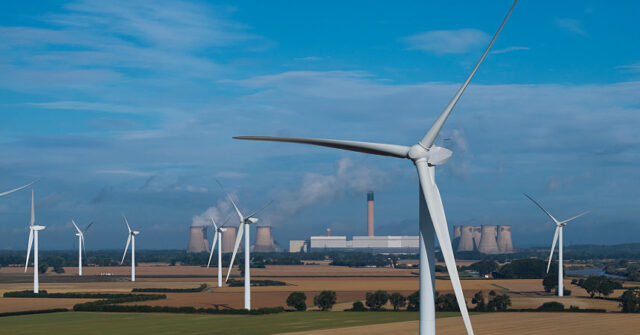
The shortage comes as hot, calm weather across north-western Europe sees energy demand rise, but supply fall as wind turbines stand idle.

In the past ‘renewables’ accounted for less of the nation’s energy picture, and traditional generation such as gas or coal could be quickly turned up to compensate if the sun didn’t shine or wind didn’t blow. Today, all of Britain’s coal-fired power stations — and even the ones only kept attached to the grid only as emergency backup, as it was in the final years — have been decommissioned and are in the process of being dynamited to really make sure they can’t be brought back in an emergency, and it is government policy that gas power will continue to be an ever smaller-slice of national generation capacity.
Industry consultant and critic of the government’s energy police Kathryn Porter reacted to the latest energy margin warning and remarked:
This is now the THIRD day of tight margin warnings this summer… Before this year there had never been a summer margin warning. So why now? Because our reliance on both wind and imports is growing… Clearly we’re struggling to manage. Reliance on wind is not energy security. Reliance on imports is not energy security.”
Porter stated since the original 1.2 gigawatt alert, it has been revised down slightly to 0.9 gigawatt. This is still a significant shortfall and one that can’t be easily overcome by simply importing energy given the rest of Europe, which has also raced to decarbonise and in some cases denuclearise, is experiencing the same summer weather.
Despite these emerging issues, the official position of the British government is that those who point out these problems are “scaremongers” who are not acquainted with the facts. Defying these barbs, Conservative Party shadow energy secretary Claire Coutinho this week stood in Parliament to accuse the government’s NESO energy operator of outright misleading the public about how close the country is to an energy disaster like widespread or nationwide blackouts.
Stating she had been contacted by multiple whistleblowers from inside NESO who had witnessed extraordinary behaviour including political interference in running the grid for reputation-management purposes, Coutinho said: “They allege that senior managers have ordered control room operators to hide information that show the grid is not being run securely. They also allege that corporate affairs inferered with operational decisions needed to stabilise the grid in order to protect the NESOs reputation. If true, this is nothing short of a scandal.”
In a letter to the government outlining the allegations and formally demanding an investigation into NESO’s practices, Coutinho stated:
I have been contacted by whistleblowers who allege that, during periods of system stress, senior NESO managers have instructed operators in the control room to keep ‘live documents’ with no version history. This is allegedly in order to ensure that there is no audit trail or records of how key operational decisions are made and ensure that full records are not preserved for the purposes of [Freedom of Information].
Concerningly, whistleblowers allege that this approach was in place during an incident on Tuesday 23rd June 2026, where the frequency of the system became unstable… This is a serious matter because if such frequency instability is sustained, blackouts can occur.
Staff in the Corporate Affairs directorate allegedly interfered in operational decisions to urge that certain operational stabilising actions were not taken, in order to avoid damage to NESO’s reputation. Due to the use of ‘live documents’, these interventions were not recorded for public record.
The government’s energy minister Michael Shanks was punchy in response to these allegations, declining to treat them seriously and adding “she has continued to [scaremonger]… she continues to peddle nonsense”. NEO separately published their own total denial.
Meanwhile, Britain’s energy security picture continues to deteriorate in real time. As reported by The Times this week, the British government has voluntarily decided to endorse an International Court of Justice opinion that nations are responsible for alleged climate damage caused by their own use of traditional energy sources. Per the report, the decision of Westminster to play along with the court — when it is in no way obliged to do so — endangers future use of the North Sea oil and gas field and “all North Sea drilling could be ruled an illegal act because it puts the UK in breach of its international climate change obligations”.
A key part of Britain’s energy policy, even if it is largely unspoken, is that any shortcomings in national generation or failures in the weather to energise renewables can be covered by importing energy from abroad. Yet this relies on Britain’s neighbours experiencing radically different weather, and as repeatedly experienced this often isn’t the case.
Typically, a signficiant proportion of Britain’s energy imports are covered by French nuclear, generally a stalwart backbone of Western Europe’s energy grid. Yet the typically warm summer weather has impacted this as well: while there is no danger to nuclear from the heat, strict European environmental regulations block plants from using river water for cooling when it gets too hot outside, lest the environemnt for fish be degraded.
French nuclear plants have already been throttled in recent days because of this, but on Thursday one was shut down altogether. As reported:
This is the second time in a matter of weeks France has made a nuclear power station shutdown decision… Both closures were triggered by rising river temperatures, which France’s state-owned energy giant EDF is required by law to monitor to avoid discharging water that could harm aquatic ecosystems… No indication has yet been given as to when the Golfech nuclear power plant will reopen.
A total power grid loss in a system experimenting with a rapid and experimental transition away from traditional energy to renewables isn’t a theoretical concern. As reported as it happened last Spring, grid instability of the type described as facing the United Kingdom by Porter caused a cascade failure through generators across the Iberian Peninsula, taking out all electricity across Spain and Portugal.
The worst power cut in Europe in a generation and impacting a whole corner of the continent, the sudden and total loss of power left over 150,000 having to be rescued from stranded underground trains and elevators, and whole regions including hospitals left without running water because the network relies on electric pumps.
As reported:
Spain has one of the greenest power systems in the world, and just this month, it celebrated powering the entire Iberian Peninsula — the south-western part of Europe, primarily covered by Spain and Portugal — with only renewable energy. Like many European countries, left-wing Spain has been busy demolishing its conventional power plants and is even, like Germany, decommissioning its nuclear power fleet.
Just last week, Spain signalled that it was open to reconsidering the rush to phase out nuclear amid global energy insecurity, indicating that the government had already realised it was going too far, too fast with total renewables.
The United Kingdom has also reached this stage. While Britain was until this week on track to have zero functioning nuclear power plants by the 2030s with a coming capability gap between the decommissioning of the last of the old fleet and the coming-online of the first of the next, the Net Zero-zealot energy minister Ed Miliband has announced that a single power plant will receive a life-extension to keep it running to the 2050s.
The youngest nuclear power plant in the United Kingdom, having first come online in the 1990s, Sizewell B will be placed on a new fixed energy contract with the government that will stabilise the cost of electricity produced, meaning it won’t fluctuate with global prices.
Read the full article here


