






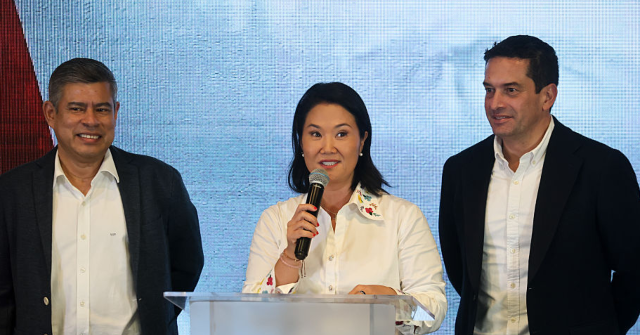
Conservative former first lady Keiko Fujimori regained the lead in Peru’s razor-thin presidential runoff against radical leftist lawmaker Roberto Helbert Sánchez Palomino on Thursday morning as authorities review the last, highly crucial vote tallies that will determine the winner.
At press time, Thursday afternoon Eastern time, Fujimori has a 922-vote lead against Sánchez.
Peru remains in complete uncertainty as the slow vote count process continues after Sunday’s runoff election between Fujimori and Sánchez. Peru’s National Electoral Processes Office (ONPE) has counted 98.23 percent of the votes at press time.
Although Fujimori and her conservative Popular Force party had initially maintained a narrow lead against Sánchez in the first hours following Sunday’s election, the candidate of the far-left Together for Peru coalition had overtaken Fujimori in the following days by equally narrow margins.
Fujimori, however, overtook Sánchez once more in the early morning hours of Thursday following the arrival to Peru of the last shipments of foreign vote minutes from more than 2,500 polling stations setup across about 70 countries. According to RPP, the last pending shipment arrived on Wednesday night from Argentina and contained 233 vote minutes representing some 32,000 votes from Peruvians living in Argentina.
Peruvian and international outlets had reported in the past days that polling indicated that the Peruvian diaspora supported Fujimori significantly more than Sánchez. As of Thursday morning, ONPE has finished counting 94.495 percent of the foreign votes cast, with Fujimori receiving an overwhelming 63.4 percent against Sánchez’s 36.5 percent. In some countries, such as the United States, Fujimori received over 76 percent of the vote — and as many as 90 percent of the votes cast by Peruvians in Japan.
Unnamed sources in Fujimori’s Popular Force party affirmed to the newspaper El Comercio that the arrival of the foreign vote tallies made Wednesday their “D-Day,” as the tallies could either make the conservative candidate regain the lead, or significantly reduce the gap between her and Sánchez.
El Comercio detailed that Sánchez, who had initially called to “respect the results” this week when he was in the lead, reportedly failed to provide a clear answer on Wednesday when asked the same question by the press. Sánchez reportedly asserted to reporters that there is “a desire among many actors [to] undermine a democratic result.”
As of Thursday morning, the extremely close election is poised to be defined by 1,635 vote tallies flagged for review by the JEE Special Election Board before they are added to the total. The marked-for-review tallies represent 1.784 percent of the overall vote. Additionally, there are 20 yet-to-be counted tallies at press time according to ONPE. According to El Comercio, 40 of the flagged 1,635 tallies had already been forwarded to a vote-by-vote recount process as of Wednesday evening.
Silvia Guevara, a fellow at the Peruvian Political and Electoral Affairs Consulting agency Aklla Peru, explained to the newspaper that the vote recount is an “extraordinary figure” that is only employed when JEE cannot correct an operational or arithmetical error identified in the flagged vote tally.
“In the past, when vote recounts did not exist, if there was no way to salvage a vote, because the error persisted during the verification process, those votes could not be counted; they were lost,” Guevara reportedly explained. “With the vote recount, there is an opportunity to safeguard and preserve those votes recorded on the ballot.”
“That is why the vote recount ends up being like the last chance, the last option, so that, in this case, the votes can be saved,” she added.
Fujimori, who is running for president for a fourth time after narrowly losing the past three Peruvian presidential elections, reiterated her calls to calmly wait for the results while speaking to reporters on Wednesday. Referring to Sánchez’s remarks, Fujimori said that “facts trump narratives,” and said that, regardless of the statements, “What matters here is what the official records show.”
“The will of the people must be respected, and it is the country’s institutions that will deliver the verdict,” Fujimori said.
Christian K. Caruzo is a Venezuelan writer and documents life under socialism. You can follow him on Twitter here.
Read the full article here


