





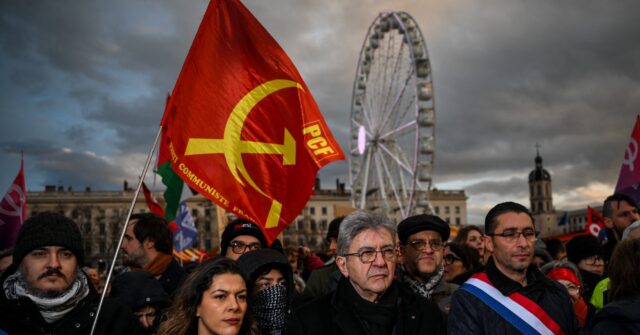
Leader of the far-left La France Insoumise party Jean-Luc Mélenchon has thrown his hat in the ring for the election to succeed term-limmited President Emmanuel Macron, pitching himself as the candidate of the multicultural “New France”.
Mélenchon, who is often compared to fellow septuagenarian socialist firebrands Bernie Sanders and Jeremy Corbyn, will make his fourth run at the Élysée Palace after falling short in the 2022, 2017, and 2022 races, all of which he failed to advance to the second round. However, his strong 3rd-place finish in 2022 — behind National Rally leader Marine Le Pen and French President Emmanuel Macron — catapulted his LFI (France in Rebellion) party to national prominence and to the forefront of the French far-left.
The Moroccan-born Spanish-Sicilian migrant who moved to France at the age of 11 began his political career just five years later as an activist and student organiser in the Besançon region during the May 1968 uprising, which saw a national leftist revolt led by Marxist university students and trade labour unions against the conservative-leaning De Gaulle government. As a child of the revolution, Mélenchon continues to cite the rebellion as a fundamental moment in his life and has become one of the leading proponents of the movement’s core tenets, including anti-capitalism, anti-imperialism, environmentalism, and socialism.
Although the young radical broke with his Trotskyite comrades to join the Socialist Party where he served as a long-standing ally of former President François Mitterrand, whom he praises to this day for his leftist reforms, Mélenchon broke with the Socialists in 2008 to form the Left Party, which he later split from again to form La France Insoumise in 2016. While he later made common cause to form the New Popular Front election coalition with the Socialists and other leftist parties in 2024, perhaps predictably, the alliance has since disintegrated amid persistent infighting among the various left-wing factions.

Yet, it appears that Mélenchon appears to revel in division, with he and his LFI co-belligerents making common cause with foreign political agitators in France, particularly the pro-Palestine movement. Mélenchon and his party have also faced accusations of being “useful idiots” for the advancement of the Muslim Brotherhood network, which the French government has found to be engaged in a multigenerational effort to infiltrate and undermine institutions in the country. For his part, Mélenchon has claimed that the accusations against the Muslim Brotherhood are nothing more than “Islamophobia“, a term coined by the Muslim Brotherhood, which it uses to undercut criticism and garner sympathy support from Muslims and leftists in the West.
Mélenchon has also openly embraced his role as the political avatar for the controversial Great Replacement Theory. The concept, coined by French philosopher Renaud Camus, describes the modern phenomenon of Western elites viewing their fellow countrymen as mere economic units that can and should be replaced by more efficient foreign labour. Mélenchon has stopped short of openly celebrating the ethnic replacement of the French people, claiming that the Great Replacement is merely the new generation taking over from the old, which he argues is a good and necessary function.
However, Mélenchon’s younger foot soldiers have been less hesitant about embracing demographic change as their chief cause, which has been characterised as the battle between “new” and “old” France, with LFI lawmakers such as Carlos Martens Bilongo, the son of African migrants to France, boasting last year that the French were not raised correctly and therefore were being outbred by migrants.
Mélenchon’s cheeky embrace of the Great Replacement term has already become a topic of the election, with the LFI leader being pressed in his announcement interview by TF1 host Anne-Claire Coudray, who quipped: “Your concept of a new France, one generation replacing another, you don’t apply it to yourself much? You’re running for the forth time.”
The LFI leader has argued that despite his age, and past electoral failures, he is best equipped within the leftist party to “seize” the opportunities presented by what he claimed are multiple looming crises, including from climate change, the economy, and war. For example, he called for a “freeze” on fuel prices amid the energy price shocks in Europe as a result of the conflict in Iran, describing the current situation as money flowing from “labour to capital”. He also blamed the United States and Israel for “starting” the war with Iran and said that he would have joined cause with the socialist government in Spain to refuse assistance to the American military and cutting off EU trade with Israel.
Additionally, Mélenchon has vowed that if elected, he would become the “last” president of the Fifth Republic instituted by Charles de Gaulle in 1958, arguing that the current system allows for the president to act as an effective monarch and thus would call an assembly to draft a new constitution for a “Sixth Republic” in which the role of parliament is elevated and citizens are empowered to overturn laws through referendums and other means.
However, the ‘Old Man’ faces an uphill battle to take power, with a likely crowded field potentially spelling a divided left in the opening of next year’s two-round election. Indeed, Mélenchon will likely be competing against other left-wing candidates such as French Communist Party (PCF) Fabien Roussel, anti-mass migration populist leftist François Ruffin, and media darling Raphaël Glucksmann. The LFI leader would also have to beat out likely Macronist establishment candidates such as former Prime Ministers Gabriel Attal and Édouard Philippe as well as former Interior Minister Bruno Retailleau on the right.
Should Mélenchon beat out all such contenders and advance to the second and final round of voting, it remains doubtful that he would be able to win the presidency, with a recent survey finding that the LFI chief would fare the worse of any candidate against the current frontrunner, National Rally president Jordan Bardella. A March poll from Elabe for La Tribune Dimanche found the 30-year-old Le Pen protégé besting the 74-year-old leftist by 71.5 to 28.5 per cent in a hypothetical second round matchup.
Follow Kurt Zindulka on X: Follow @KurtZindulka or e-mail to: kzindulka@breitbart.com
Read the full article here


