




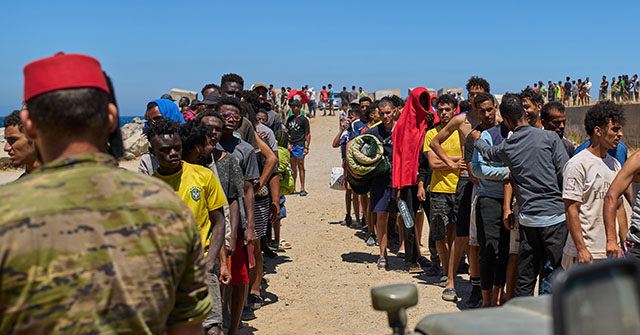
The Interior Ministry of Morocco said on Sunday that the migrant invasion of the Spanish city of Ceuta last week was caused by “misinformation” spread by human trafficking networks.

Interior Ministry spokesman Rachid el-Khalfi said there was a “misleading perception among many participants that the crossing would be easy” because the waterway is narrow and the migrants believed a recent Spanish Supreme Court ruling would prevent the cities of Ceuta and Melilla from turning them away.

Khalfi said the crisis was the result of “several overlapping factors,” including “the excessive exploitation of digital platforms, the dissemination of misleading information, the role of human trafficking networks, and incorrect interpretations of legal and administrative information.”

WATCH — Thousands of Migrants from Morocco Flood into Spanish Territory:

The much-discussed Spanish court ruling, handed down on June 29, stated that Spanish border guards cannot summarily deport migrants who arrive by sea because Spain’s immigration law specifically calls for migrants who violate Spain’s physical land borders to face summary deportation.

Both Moroccan and Spanish officials, including Spain’s embattled socialist Prime Minister Pedro Sánchez, have insisted the tens of thousands of migrants who flooded into the Ceuta peninsula were tricked into believing the court ruling had thrown the border open to seagoing migrants, who could do exactly what the invading horde did last week: swim across the narrow waterway and walk into Ceuta unopposed.

“What has emerged from our talks with Moroccan authorities is that trafficking mafias took a self-serving interpretation of a Supreme Court ruling,” Sánchez said during a visit to Ceuta on Friday.

Migrants cross from Morocco into the Spanish enclave of Ceuta, Thursday, July 30, 2026. (Antonio Sempere/AP)

At the same time, Spanish officials have admitted the only thing the migrants got “wrong” was how quickly they could receive the “due process” deportation hearings stipulated by the Supreme Court ruling. In essence, Spain is saying it was prevented from intercepting the migrants in the water, but they could be processed and deported within a few days of arriving on land.

Spain also implicitly conceded the “misinformation” spreaders had a valid point by hastily constructing a physical barrier in the water on Saturday, a 1,640-foot floating net augmented by a string of anchored buoys that only sticks a foot above the water, and about three feet down – but it provides exactly the sort of visible border barrier that the Spanish Supreme Court said would be needed to repel migrants immediately, instead of deporting them later.

Most observers of the crisis agree that social media played a role in creating the sudden and overwhelming rush of migrants from Morocco into Ceuta, which has left 72 people dead so far.

The BBC on Sunday was skeptical of the storyline Sánchez and Moroccan officials have apparently agreed on, which is that evil human traffickers launched an unprecedented campaign of “misinformation” to create the border surge for unclear reasons. Among other problems with this narrative, the BBC pointed out that none of the migrants employed the services of human traffickers, who supposedly invested a great deal of time and money in a campaign to put themselves out of business.

Social media in Morocco has long been inundated with posts from people who crossed illegally into Spain, often by swimming across the narrow waterway, and encouraged others to follow in their footsteps. The organized online campaign that led to the Ceuta crisis began shortly after the Spanish Supreme Court ruling and included more specific instructions than previous social media posts, including maps and satellite photos that showed ideal places to come ashore.

Title: Migrants cross into Spain’s Ceuta enclave from Morocco, in photos Image ID: 26211514458416 Article: Migrants cross from Morocco into the Spanish enclave of Ceuta, Thursday, July 30, 2026. (AP Photo/Antonio Sempere)

Migrants cross from Morocco into the Spanish enclave of Ceuta, Thursday, July 30, 2026. (AP Photo/Antonio Sempere)

The BBC floated a few conspiracy theories of its own, suggesting that Russia “loves chaos and division in Europe” and the “global right wing” hopes to ride migration fears to electoral victory, so both would have better reasons than the human trafficking “mafia” to trigger a stampede that captured worldwide media attention.

Having aired those theories, the BBC admitted that Moroccan border guards “must have seen the crowds building” and, despite Sánchez’s public praise for the Moroccan government as a “good ally,” there are “tensions building” that might have inspired Morocco to touch off the migration wave, the same way it did in 2021.

“Morocco, which has a high unemployment rate, witnessed several Gen Z anti-government protests last year — with young people demanding better opportunities and improvements to public services,” the BBC noted in another report on Saturday.

Spanish police officers respond as migrants cross from Morocco into the Spanish enclave of Ceuta, Thursday, July 30, 2026. (AP Photo/Antonio Sempere)

The far-left American outlet New York Times (NYT) on Sunday quoted migrants who said Moroccan police literally pointed them at Ceuta and said “go that way, go that way.” The NYT pointed to Spain’s recent campaign to build closer relations with Morocco’s hated rival Algeria as one reason why Morocco might have decided to use migrants as a political weapon again.

Two weeks ago, Sánchez visited Algiers and announced a high-level meeting to “strengthen political dialogue between Spain and Algeria” would be held this fall. One of the announced topics of discussion was Spain bypassing Morocco to import more natural gas from Algeria through the Medgaz pipeline.

Khalfi, the Moroccan interior ministry spokesman, said on Sunday that his country’s Public Prosecutor’s office has opened several investigations into the migrant crisis, with the goal of “identifying those responsible, and determining the appropriate legal consequences in accordance with the law.”

To date, neither law enforcement nor media observers have identified any human traffickers or mafias who might have spread the disinformation behind the migration wave, but the Jerusalem Post on Sunday noted that International Security Observatory co-director Jose Maria Gil Garre’s forensic report on the social media campaign noted that one of the key public messaging groups involved in the campaign was “administered from a telephone number with an Algerian international prefix.”

Of the four specific social media accounts that appeared to have the highest number of followers and impressions, two were Moroccan TikTok accounts, and the other two were Algerian groups on WhatsApp.

Read the full article here

Share.
Leave A Reply

Exit mobile version