
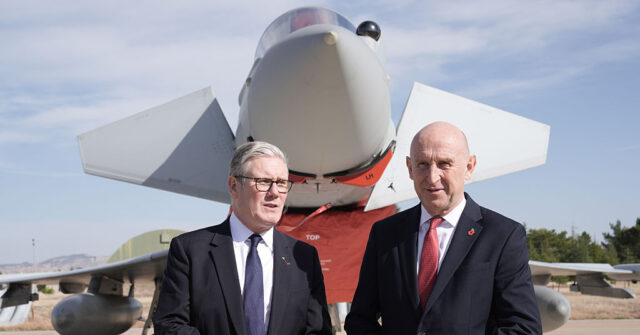
British Minister of Defence John Healey, one of Prime Minister’s most loyal allies, has resigned from government because Sir Keir Starmer and the treasury have been “unable… unwilling” to pay to fund the Armed Forces.
A year of intense Westminster wrangling over how to pay for Britain’s armed forces to remain relevant in a time of surging global instability spectacularly exploded into the open on Thursday when John Healey announced his resignation from government. In his scorching broadside of a resignation letter to the Prime Minister, Healey noted the government was not only refusing to fund its own Strategic Defence Review (SDR), but that even if it had the document had already been rendered inadequate by new conflicts and Britain’s growing military commitments in the 12 months since it was published.
The SDR, which was published in June 2025, was due to be financed by a ‘Defence Investment Plan’, which is already grossly overdue but was widely rumoured to be published this week. Healey said in his letter he had been shown the DIP on Monday and found it to “fall well short” of what is needed.
It is stated the Treasury was only willing to increase the spend on defence by the equivalent of 0.08 per cent of GDP by 2030, an uplift of £13.5 billion, which critics say was actually just £10 billion plus change with “treasury trickery” which, as reported, wouldn’t even cover present spending, never mind any actual investment in new equipment or capabilities. To put these figures into context, The Times journalist Tom Newton Dunn explained of what the military was asking for just to stand still in a roundup published earlier this week, before Healey’s resignation:
It’s not just the gap between the £28billon that the chiefs asked for and the £13.5bn Rachel Reeves is offering. The chiefs’ £28bn was actually just the minimum they think defence needs to get through the next four years. To pay for the full transformation that the SDR prescribes, and insists is vital, I’m told internal MoD estimates put the real sum needed at 4.5 or 5% of GDP…
…In cash terms, that means defence actually needs an extra £60bn, and not just over 4 years but EVERY year. That’s the true scale of the task, and what our allies like Germany and Poland are now well on their way towards. So the Treasury/No10’s current sticking plaster offer is not just woefully thin, it doesn’t even touch the sides.
While Healey’s resignation letter today was couched in the language of political niceties, it is a historically brutal criticism of the government of Sir Keir Starmer. Noting the SDR and DIP are things that Starmer and Healey had worked on together — and so unmistakably linking the failure to Starmer, with no wriggle room for buck-passing as is his forte — Healey wrote: “you have been unable, and the Treasury has been unwilling, to commit the resources that the nation needs to defend the country at this time of rising threats… your DIP financial settlement-which I was first given in full on Monday afternoon this week- falls well short of what is required for defence and the country at this dangerous time.”
The “demands on defence have increased still further” since the SDR was published over a year ago, Healey noted, with particular focus on the United Kingdom stepping up to lead the multinational Strait of Hormuz military mission and NATO’s Arctic Sentry mission, and Britain agreeing to deploy troops to Ukraine should a ceasefire ever take hold. The reform process of June 2025 took none of these developments into account and are happening now, not in the distant days of the mid 2030s when future funding may be available, he said.
Failure to increase defence spending from the post-Cold War lows of the peace dividend era will have real consequences now, Healey said, adding: “You know what defence needs…. Without a DIP that meets the moment in this way, I am being forced to make decisions that would reduce the readiness of our Forces and increase the risk to personnel on operations, and could make the country less safe.”
The resignation is the sixth from Starmer’s government in just a month, and the most senior of them so far, and all the more damaging because Healey is clearly otherwise not a Starmer critic, but rather he has been forced out by the sheer force of failure. Other political voices are already picking over why the government is so uniquely unwilling to fund defence — one of the key, defining features of why countries have governments at all, traditionally — and critics state it is simply a matter of preference towards welfare.
Reform UK’s Robert Jenrick replied, for instance: “This Government has all the money in the world for Ed Milliband’s mad plans, foreign aid, and benefits for foreigners. But nothing for our armed forces. Good on John Healey. Shame on them. Reeves and Starmer should go too”. And the Conservative Party’s shadow defence minister James Cartlidge hit similar tones, contrasting the “honourable” resignation with the behaivour of the Prime Minister.
He said: “An honourable man has done an honourable thing. Whatever our political differences, I’ve always admired John Healey’s integrity and he’s shown it in this action. He’s done the decent thing.
“I say to the Prime Minister, with the world the way as it is, this is not good enough and he is paying the price for prioritising a bigger welfare state over a stronger armed forces”.
Read the full article here