



Officials in Nepal said on Wednesday that several tourists missing since devastating floods struck the Tibetan border region last week have made contact with rescue workers.
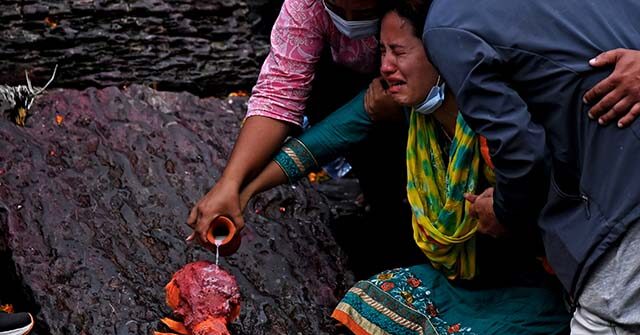
Meanwhile, local families held symbolic funerals for missing loved ones, as their hopes for survival dimmed.
The Nepalese Foreign Ministry said 590 foreign nationals from 39 countries remain unaccounted for after the August 26 floods. Authorities have identified 324 foreigners rescued and a handful of the missing managed to send messages by phone or email over the past few days to signal they are still alive.
Residents carry their belongings salvaged from their damaged homes filled with mud and debris in Devighat, in Nepal’s Nuwakot district, Saturday, Aug. 29, 2026, following the August 26 flash floods. (AP Photo/Rajesh Kumar Singh)
The overall death toll from the floods in Nepal stands at 1,118 people, plus 3,900 missing. China reported 21 killed and 541 missing on the Tibet side of the border. The missing persons in China included 104 Nepalis, plus 49 Indians and 33 Latvians who were part of tour groups visiting sacred mountains in Tibet.
Intensive rescue efforts are focused on the tunnels beneath Nepal’s many hydropower plants, where some 900 missing workers are believed to have taken refuge from the flood, only to become trapped by debris and rising waters.
Two hydropower plants were seen as especially promising for trapped survivors, as there were signs of air reaching subterranean tunnels through pipes. India, China, and the United States have all sent tunnel rescue experts to assist the effort.
Nepal Electricity Authority board member Amshu Kiran Shahi told Reuters on Wednesday that the company is “very confident that there is life” in the hydropower plants, because they were built to endure natural disasters and stocked with food and water.

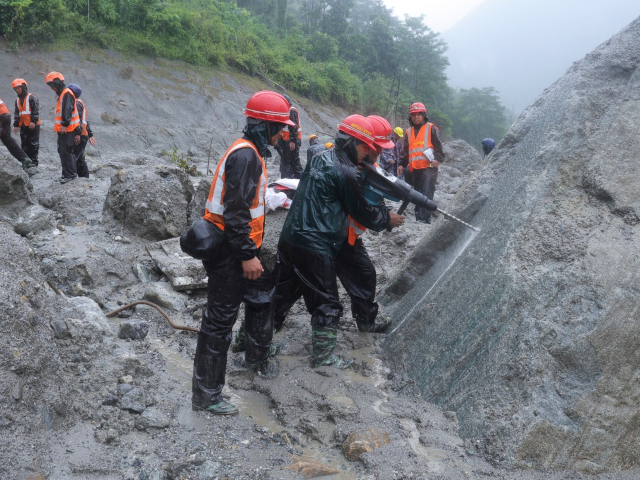
This photo provided by the Nepal Army, shows Nepal army soldiers using a drilling machine during a rescue operation at the site of a hydropower project in Upper Trishuli, Nepal, Sunday, August 30, 2026. (Nepal Army via AP)
“The hope of finding survivors is decreasing. We pray and are hopeful. Hope is hope,” said Nepalese emergency operations official Phanindra Paudel.
Nepal’s Prime Minister Balendra Shah described the flood as “one of the major disasters experienced by human civilization.”
“Our priority remains clear: To continue our search and rescue operations, find those who are still missing and continue supporting everyone affected,” Shah said.
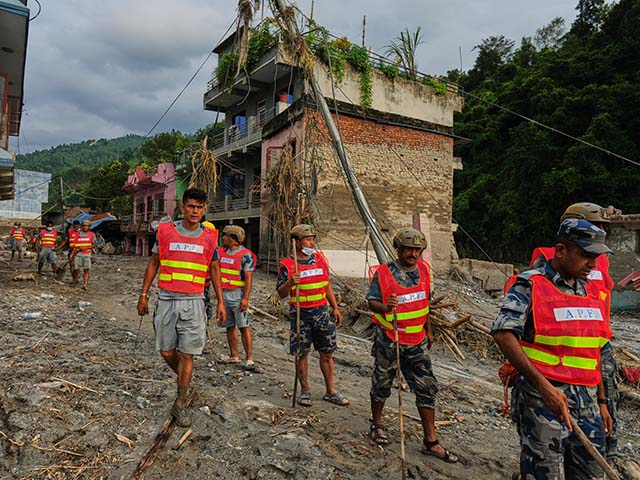
Workers clear debris in the aftermath of a flash flood in the Devighat area of Nuwakot district in Nepal, Friday, August 28, 2026. (AP Photo/Rajesh Kumar Singh)
Some Hindu residents in the hardest-hit areas of Nepal have begun holding symbolic funerals for missing family members, in line with beliefs that say cremation rites can provide spiritual release for the dead, even if their bodies are not physically present for the ceremony. In such cases, straw effigies are burned along the banks of Nepal’s swollen rivers.
Nepalese authorities have buried hundreds of unidentified victims in mass graves, with barbed-wire fences hastily erected around the improvised cemeteries. Officials said they were preserving DNA samples and photographs of the dead in the hope they could be identified later and returned to their families for proper funerals.
The flood was so powerful that almost a dozen bodies have been found hundreds of miles away in India. Many of the dead were carried downstream and washed ashore in the Nepalese district of Chitwan, whose morgues only had space for about three dozen bodies.
Morticians tried to set up an improvised cold storage facility in the local government hall, using dry ice temporarily and hoping for freezers to be delivered later. The freezers did not come in time, so temporary burial in mass graves was the only alternative.
“We’re still finding 15 to 20 new bodies every day. This will keep going on for months,” a Chitwan police officer told the New York Times (NYT) on Sunday.
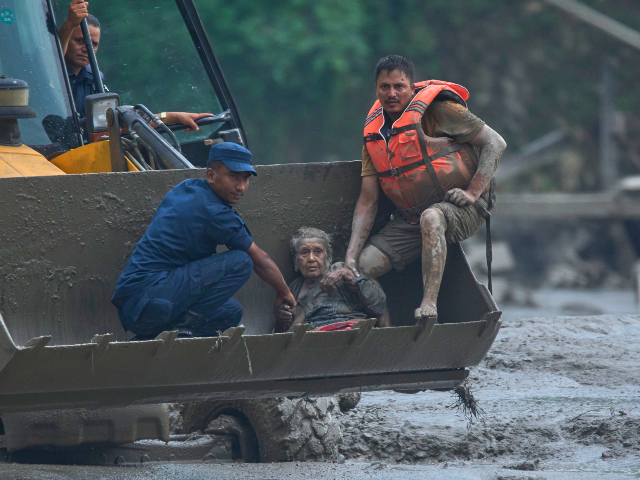
Rescuers use an earthmover to carry a victim of flash flooding to safety along the Trishuli River in Nepal’s Nuwakot district, Wednesday, August 26, 2026. (AP Photo/Niranjan Shrestha)
Read the full article here