







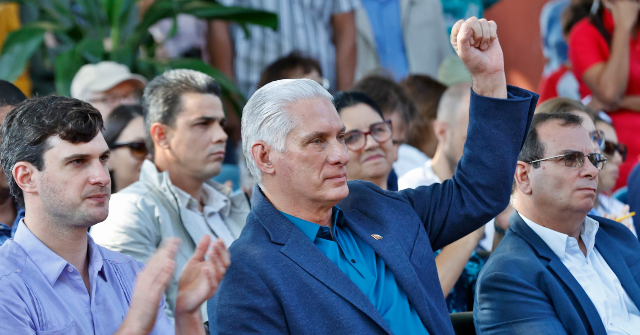
Miguel Díaz-Canel, the figurehead “President” of Cuba, claimed to NBC that any military attempt from the United States to depose him would be met by Cubans willing to die for the communist regime that has oppressed them for 67 years.
Díaz-Canel issued the claim speaking with NBC News’s “Meet the Press” moderator Kristen Welker in Havana. NBC published the full, roughly 53-minute interview on Sunday days after releasing a five minute-long snippet in which the figurehead claimed he will not step down from his position at a time when U.S. officials and members of the Cuban communist regime have engaged in talks.
Díaz-Canel claimed to Welker that there is “no need” for changes in the Cuban regime and rejected President Donald Trump’s calls for the failing communist state to reach a deal with the United States.
“If the time comes, I don’t think there would be any justification for the United States to launch a military aggression against Cuba, or for the U.S. to undertake a surgical operation or the kidnapping of a president,” Díaz-Canel told Welker through a translator, and claimed, “an invasion to Cuba would have costs. It would affect the security of Cuba, the United States, and of the region.”
“If that happens, there will be fighting, and there will be a struggle, and we will defend ourselves, and if we need to die, we’ll die, because as our national anthem says, ‘Dying for the homeland is to live,’” he added.

Although Díaz-Canel is the “President” of Cuba, in reality Cuba is ruled by Raúl Castro, the 94 year-old brother of late murderous dictator Fidel Castro who succeeded his brother in 2008 and has led Cuba even after he “retired” in 2018, when Díaz-Canel assumed the presidency.
The Castro regime, which has brutally oppressed Cuba for more than 67 years and forced Cubans to live in conditions of abject misery and poverty through decades’ worth of disastrous policies, presently finds itself in an extremely complex situation after the loss of one of its top key benefactors, Venezuela’s socialist dictator Nicolás Maduro.
Maduro and his wife, Cilia Flores, were arrested by U.S. forces after President Donald Trump authorized a U.S. law enforcement operation in Caracas on January 3 to arrest the now-deposed dictator, who was actively wanted by U.S. authorities for years on multiple narco-terrorism charges.
Since January, Maduro and Flores have been detained at the Metropolitan Detention Center (MDC) in Brooklyn where they face drug trafficking charges on a trial presided by District Judge Alvin Hellerstein.
For years, Maduro provided his Cuban masters in Havana with virtually free shipments of oil that the Cuban regime largely depended on to maintain its communism-ruined infrastructure, along with other forms of support. In exchange, the Cuban communists provided Maduro with security, espionage, and other kinds of assistance that the Venezuelan dictatorship used to maintain its repressive rule.
Thirty-two Cuban state security officials died protecting Maduro from U.S. forces on January 3, with their bodies returning to Havana in small boxes — something that raised multiple questions as to what exactly happened to the soldiers that caused such damage.
“Before making that decision [attacking Cuba], which is so irrational, there is a logic, that is, the logic of dialogue, to engage in discussions, to debate and try to reach agreements that would move us away from confrontation,” Díaz-Canel said.
Díaz-Canel publicly confirmed in March that representatives from the Cuban regime have engaged in “sensible” discussions with U.S. government officials, admitting to the talks after President Donald Trump repeatedly made mention of them in the weeks prior to his confirmation. Days later, Díaz-Canel acknowledged Raúl Castro is actively involved in the negotiations.
Asked by Welker if he was willing to commit to responding to “key demands” from the United States such as releasing unjustly detained political prisoners, allowing free multi-party elections, and other democratic concessions, Díaz-Canel claimed that “nobody has made those demands to us.”
“We have established that in respect to our political system or constitutional order, these are issues that are not under negotiations with the United States,” Díaz-Canel answered, and added those issues are “extensively manipulated.”
The figurehead “President” did not commit to releasing political prisoners after Welker specifically referred to the case of Maykel Osorbo, a two-time Latin Grammy-winning Cuban rapper and one of the co-authors of “Patria y Vida” (“Homeland and Life”), a song and slogan prominent during the July 2021 anti-communist protests. Osorbo is presently serving a nine-year prison sentence on “contempt,” “assault,” and “public disorder” charges.
Díaz-Canel rejected the widely documented fact that the Cuban regime holds political prisoners, dismissing it as a “narrative” and claiming that there are people in Cuba who are not in favor of the revolution “and manifest themselves on a daily basis” who are not in prison.
“This narrative that has been created, that image that anyone who speaks against a revolution is thrown into jail, that’s a big lie, that’s a slander, and that’s part of that construct in order to vilify and to engage a character assassination of the Cuban Revolution,” Díaz-Canel claimed.
According to the human rights organization Prisoners Defenders, the Cuban regime holds at least 1,092 known and documented political prisoners across the nation’s prisons as of March, of which 31 were unjustly detained during that month. For years, Prisoners Defenders and other human rights organizations have repeatedly denounced that the Cuban regime subjects its political prisoners to violence, torture, and inhumane treatment.
“I think dialogue and deals with the U.S. government are possible, but they’re difficult,” Díaz-Canel answered when asked of it was possible to reach a deal with President Donald Trump, and claimed that he has not spoken with U.S. Secretary of State Marco Rubio nor does he know him.
NBC’s interview with Díaz-Canel marked the first time NBC has interviewed a Castro regime official since its 1959 interview with late communist dictator Fidel Castro, and the first time the figurehead “President” has spoken with an American broadcast network. On Sunday, the figurehead thanked NBC for the interview through a social media post.
“I would like to thank the team at Meet the Press and journalist Kristen Welker for visiting Cuba and for giving us the opportunity to share our perspectives on the difficult situation the country is facing, following four months of an energy blockade on top of six decades of economic, financial, and commercial Blockade,” Díaz-Canel wrote.
“As lovers of peace and social justice, life and joy, we Cubans are always open to respectful dialogue and ready to defend our sacred independence and sovereignty,” he added.
Read the full article here


