




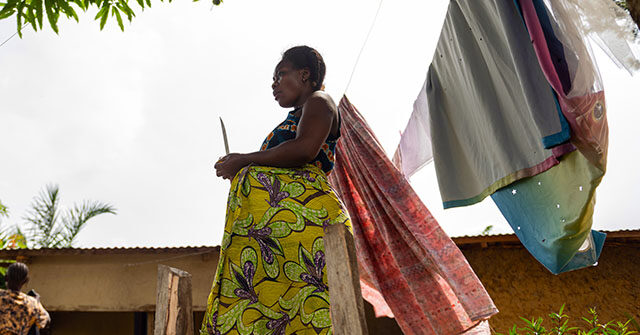
The United Nations Population Fund (UNPFA) warned on Monday that maternal mortality in the Ituri province of the Democratic Republic of the Congo (DRC) has doubled during the Ebola outbreak, with an average of six women dying in childbirth each week.

Noemi Dalmonte, deputy representative for the Congo from UNFPA, said that deaths outside of hospitals showed an especially alarming increase because the Ebola outbreak has made Congolese women afraid to use hospitals and clinics.

Health workers interact at the Evangelical Medical Center, in Bunia, eastern Congo, Friday, July 3, 2026. (AP Photo/Dirole Lotsima Dieudonne)

Dalmonte noted that Africans generally tend to avoid healthcare facilities during emergencies due to fear of contamination but the tendency is even stronger with Ebola “because Ebola has a lot of rumors.” Dalmonte noted that violence and unrest in the outbreak region were also factors in dissuading women from seeking professional medical care — and here again, Ebola made the general tendency worse, because superstitious locals are given to attacking Ebola clinics.

Such attacks are often motivated by the rioters demanding the return of Ebola victims’ corpses so they can be given traditional burials. Some Congolese also believe clinics staffed by foreigners and doctors from their own central government are deliberately spreading diseases to kill off the native population, a belief that tends to be especially strong in areas that receive a steady diet of propaganda from jihadis and insurgents.

Title: Congo Dying Mothers Ebola Image ID: 26214507266869 Article: Elodie, right, a mother of one who is eight months pregnant, stands outside her house in Bunia, northeastern, Congo, Tuesday, June 16, 2026. (AP Photo/Moses Sawasawa)

Elodie, right, a mother of one who is eight months pregnant, stands outside her house in Bunia, northeastern, Congo, Tuesday, June 16, 2026. (AP Photo/Moses Sawasawa)

The availability of medical care has been reduced by staffers going on strike because they fear for their safety or have not been paid their promised wages and bonuses. This contributes to the feeling among rural Congolese women that going to the hospital for maternity care is both risky and futile.

Dalmonte worried that pregnant women in the outbreak region “could die not from Ebola itself but because the care that would have saved them was no longer accessible, trusted or safe.”

The DRC is one of the most fertile regions on Earth, with an average of six children per woman, and even without Ebola it has one of the highest rates of maternal and infant mortality.

The World Health Organization (W.H.O.) said on Saturday that the Ebola Bundibugyo outbreak has become the largest ever reported in the DRC – and it is still “intensifying, with sustained transmission, rising cases and deaths, and expanding geographic spread.”

Health workers involved in Congo’s Ebola response go on strike as they protest over payment issues in Bunia, Congo, Wednesday, July 15, 2026. (AP Photo/Constant Same Bagalwa)

The latest official statistics include 3,605 cases and 1,587 deaths. W.H.O. said last week brought the highest weekly total of cases and deaths yet reported, with 567 documented infections and 296 fatalities.

“Factors like insecurity, population displacement, and cross-border movement continue to hamper response efforts and increase the risk of further spread,” W.H.O. said.

W.H.O. noted in its latest update there have been 151 confirmed infections among health workers, with 44 fatalities.

“These infections highlight ongoing occupational exposure risks, persistent challenges in implementing infection prevention and control (IPC) in health-care facilities, and continued exposure risk in the community,” the update said.

“Insecurity and attacks affecting health facilities have hampered response operations in affected provinces, by restricting access for response teams, disrupting surveillance and response activities and increasing the risk of undetected transmission,” W.H.O. added.

Read the full article here

Share.
Leave A Reply

Exit mobile version