






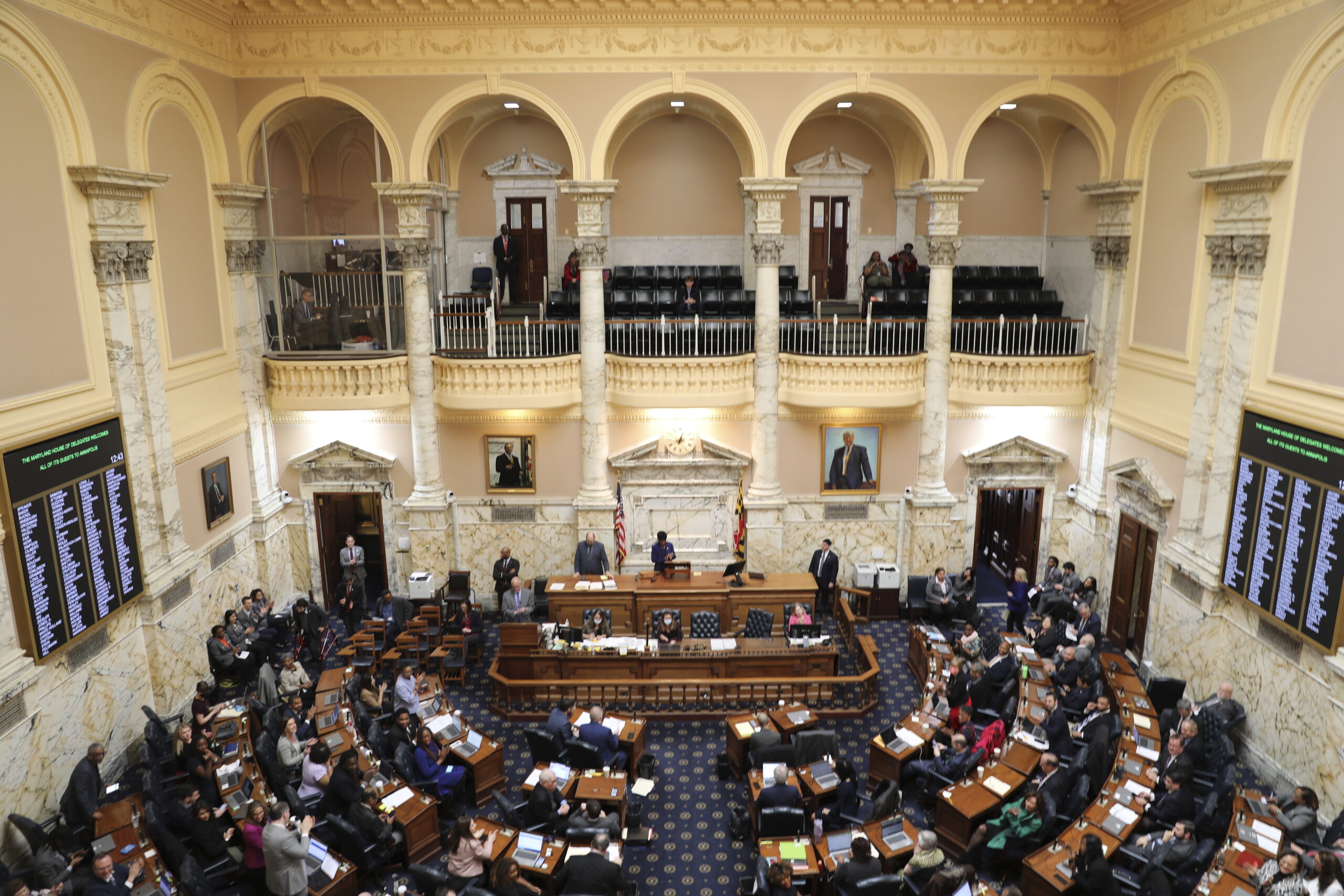
Maryland Democrats passed a proposed state constitutional amendment Tuesday to jump-start the state’s 2028 redistricting efforts, capping off roughly a year of infighting over how best to respond to White House-led map redraws across the country.
The amendment, passed by both chambers in the state Legislature on Tuesday, aims to insulate future Democratic redraws from being overturned in the courts.
Voters will still need to decide on its ultimate fate in November.
But Democratic political leaders in the state still have broad disagreements over whether they could have done more to counter Republican redistricting. The GOP could net as many as 10 new congressional seats with map redraws undertaken since President Donald Trump returned to the White House last year.
In a Monday morning press conference at the top of the special legislative session, Maryland Gov. Wes Moore said that state leadership was finally “in full agreement” and working “to ensure that our elections should be in the hands of the people of Maryland.”
But when asked about whether he agreed with Senate President Bill Ferguson’s yearlong assertion that aggressively redistricting to the tune of an 8-0 Democratic map could have carried major legal risks, Moore demurred.
“I don’t,” he said. “And I’ve said that. I don’t agree with his position on that.”
Moore — and a major swath of Maryland Democrats — spent much of the year pushing for the state to draw a map in time for this year’s elections that would have wiped out its sole GOP district, currently held by Rep. Andy Harris (R-Md.).
But it was Ferguson and Democrats in the state Senate who stood in their way. Passing a map without constitutional cover, he has argued, could lead to devastating results for Democrats, potentially even resulting in the loss of a Democratic House seat.
“Not only would it not work, I think it would have gone backwards,” he told POLITICO in a brief interview Monday. “I think it would have been more like what happened in Utah.”
The Senate president pointed to Maryland Democrats’ last attempt at a map redraw in 2021, which a state judge threw out the following year.
“The governor was in New York,” Ferguson said. “He was in a different place. He didn’t have that experience. Personal experience matters in this. I saw what happened when you think that everything is gonna be fine and you try and it goes sideways. This is too important of a time to govern in guesswork.”
The new language in the amendment establishes that congressional districts are not subject to specific requirements around compactness and natural and political boundaries that apply to legislative districts in the state. That was part of the reasoning around which the state judge overturned the Legislature’s 2021 congressional map.
But two senior aides in Moore’s office disputed Ferguson’s notion that redistricting wouldn’t have passed legal muster this time around.
“There was indeed a 2022 decision,” one of the staffers — granted anonymity to explain the governor’s office’s legal arguments — said. “Instead of taking the map and the decision up to the [state] Supreme Court, [Maryland Democrats] decided to pass a map that would materially comply with the judge’s ruling. It doesn’t mean that anyone thought the judge’s ruling was the law of the land.”
Read the full article here


