




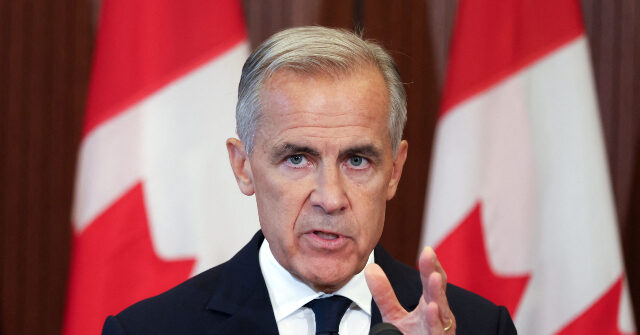
Leftist Canadian Prime Minister Mark Carney told reporters on Saturday that his country is “at war” with the United States after trade talks collapsed.
“We were attacked. You’re at war when you get attacked. We got attacked,” he said, referring to President Donald Trump’s tariffs on some $29 billion in Canadian exports.
Carney railed against U.S. negotiators for allegedly changing the trade deal “in the last hours” of negotiations, adding language that would “restrict our ability to have other trade deals.”
“Because we believe in free trade, we’re the partner of choice, in many respects, for countries around the world, and Americans wanted to restrict that, they had language to restrict that. Unacceptable,” he said.
Carney accused the U.S. of failing to pursue a “true economic partnership” with Canada and claimed promises from the United States could no longer be trusted.
“Our government understood before many that America would transform all of its commercial relationships, that it would put a series of tariffs on its closest allies, and use economic integration as a weapon,” he said. “We recognize that sometimes its signature was written in pencil.”
“We were close to reaching a comprehensive agreement with the U.S., but they made changes, including threats on French language and culture and Canadian culture that would never be acceptable for that reason,” he complained. “That marked the end of that stage of negotiations.”
“We cannot accept what they’ve offered, and we will not give what they’ve asked,” he said.
Carney suspended trade negotiations on Friday night, in the final hours of an extension period granted by President Donald Trump before 50 percent tariffs were due to take effect on Canadian goods. He said during Saturday’s press conference that retaliatory tariffs against U.S. goods would take effect after Labor Day.
“Last spring, I warned that America is trying to break us so that they can own us and I promised: ‘That will never, ever happen.’ We are keeping that promise. Canada is becoming stronger and less dependent on America,” he boasted.
Carney’s envoy to the United States, Mark Wiseman, said on Sunday that the final version of the trade deal was different in numerous respects from what Canadian negotiators had earlier agreed to.
“As we drilled down, what we discovered was that what our understanding of what had been agreed to was quite different from what was showing up in the documents,” he said.
Wiseman said tariffs on medium and heavy vehicles were a particular concern, because Canada strongly needed reductions in those tariffs to keep its auto industry viable.
“That’s just something we could not accept because we want to protect the existence of an automotive assembly industry in Canada for cars, light trucks, you know, medium trucks and heavy-duty trucks,” he said.
“This is not why the deal fell apart. That is a very specific example of one of a number of things where, you know, as the interpretation of the details became clear, it became obvious that there wasn’t going to be a meeting of the minds,” he added.
U.S. Trade Representative (USTR) Jamieson Greer gave a very different account of the failed trade negotiations in a social media post on Friday, saying it was the Canadians who scuttled the deal with “new demands and walk backs of other commitments” in the final hours.
“In addition, Canada is continuing to maintain its prolonged retaliation against the United States, including, among other things, flat-out prohibitions on certain American goods and services,” he said.
Greer said the “forward-looking” United States offer included “significant tariff reductions on steel, aluminum, autos, and lumber,” plus “a historic economic and national security partnership to cooperate on export controls, combat transshipment, enhance digital trade, and align certain external tariffs.”
He explained:
The offer would have led to supply chain coordination on aerospace, complementary actions to address unfair trade practices, critical minerals cooperation, increased enforcement against imports produced with forced labor, and the announcement of formal U.S.-Mexico-Canada Agreement (USMCA) negotiations.
“This is a missed opportunity for Canada to partner with the United States, which is the fastest growing economy in the G7,” Greer concluded.
Transportation Secretary Sean Duffy predicted on Sunday that Carney would “come to the table” after feeling the “devastating” effects of his trade war with the United States.
“To think that they’re going to go to war with Donald Trump and actually win that war with the U.S., I think it’s foolish on their part,” Duffy said, echoing the president’s own comments on the matter.
“I think what the president is trying to do with Jamieson Greer, who, by the way, has done an amazing job representing the president and America, is we want fairness for the American worker,” Duffy said. “And some of our best friends are the worst offenders that treat us the worst.”
“And the fact that we provide their security for them and they take advantage of us, I think President Trump was the first one to go, ‘You know what? That’s not the kind of relationship that friends should have,’” he said.
“Canada wants the benefits of being a State, without being one!!! They have also charged our great farmers, for many years, massive amounts of Tariffs. No more!!!” Trump said in a Truth Social post on Sunday.
The Canadian opposition was not impressed by Carney’s bravado and statements from Conservative leaders suggested Carney and Wiseman were not being entirely honest about why they walked away from the deal.
“If there was a draft text of any agreement that both governments have seen, please release it. The U.S. administration has seen [sic]. Your government has seen it. Canadians deserve to see it,” Conservative shadow minister for U.S. relations Shuvaloy Majumdar said in a public letter sent to Trade Minister Dominic LeBlanc on Sunday.
“We are here to help and fight for a good result for Canadians. But we expect the Prime Minister to be transparent and open with Canadians about what the President offered and/or threatened in these talks,” Majumdar wrote to LeBlanc.
Majumdar noted that Carney promised a “win” in trade negotiations, but “there have been no wins,” because “U.S. tariffs on Canada are far higher than when the Prime Minister took office.”
Conservative leader Pierre Poilievre wrote to Carney on Sunday, asking him to give Parliament details on the U.S. proposal, explain exactly why it was rejected, and answer questions about the effects of the trade war on Canada.
“Canadians must see it to judge what options are on the table,” he said, asking Carney to provide estimates of how much more Canadian consumers will pay for groceries, gasoline, and other goods, and how many jobs could be lost.
“We must put the national interest first. The failure to secure a durable trade agreement, together with escalating tariffs, now threatens deeper economic pain on top of a decade of rising costs and zero economic growth in the Canadian economy,” Poilievre wrote.
“In a crisis that defines the future of our people and our country, Conservatives are ready to return to Parliament, to act with the urgency our people demand, and to put Canada first,” he pledged.
Read the full article here


