




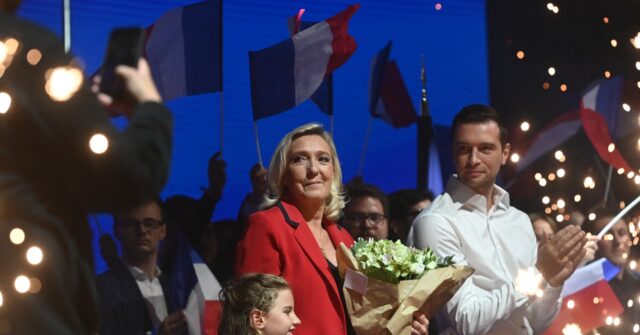
National Rally leader Marine Le Pen would win next year’s French presidential election against any opponent, according to a survey conducted after it was revealed this week that she would be eligible to campaign to replace Emmanuel Macron in the Élysée Palace.
This week, the Paris Court of Appeals reduced the sentence against three-time presidential candidate Marine Le Pen over alleged misuse of EU Parliament funds. Critically, the court cut the time barring her from standing in any European election to allow for the National Rally (RN) leader to stand in the French presidential election next April.
A cloud still hangs over her candidacy, with the court sentencing her to a three-year prison sentence, two years of which were suspended and one year of which is intended to be served under house arrest with an electronic ankle monitor. However, the ruling allowed for Le Pen to appeal further to the Court of Cassation, the supreme court in such cases, meaning that her innocence is once again presumed and she will not have to serve any aspect of the sentence until the appeal is completed.
Although her opponents have already sought to exploit the appellate court conviction, it does not appear that voters view the issue as critical, with a survey conducted by Ifop finding that Le Pen stands head and shoulders above her top competitors in both rounds of the two-round system, Le Journal du Dimanche reported.
Regardless of whether the centrist Macron bloc is represented by former Prime Minister Gabriel Attal or by Mayor of Le Havre Édouard Philippe, Le Pen would win the first round of voting with 36 per cent. If Attal were the primary establishment candidate, he would secure only 15 per cent of the vote, while Philippe would fare slightly better at 19 per cent.
While the two-round system has traditionally enabled neo-liberal forces to sideline populist candidates, including Le Pen on multiple occasions, with no transcendent figure such as Emmanuel Macron to unite the left and centrist wings, it appears the system may play into the National Rally’s hand.
According to the survey, the RN leader would defeat Philippe by 54 to 46 per cent, Attal by 55 to 45 per cent, and against far-left La France Insoumise (France in Rebellion/LFI) leader Jean-Luc Mélenchon by 70 per cent to 30 per cent.
The poll found that against either Philippe or Attal, Le Pen would benefit from other right-wing voters coming to her cause, with 46 per cent or 53 per cent of Les Républicains voters rallying to her side, respectively. This rises to 90 per cent of fellow right-wing voters in the unlikely event of Mélenchon reaching the second round.

In an interview over the weekend with Le JDD, Le Pen said: “From now on, I am campaigning to convince the French, to talk to them about their lives, their security, their purchasing power, the rebirth of the country. My opponents would like this campaign to be judicial. I want it to be democratic, and I will not let anyone confiscate this presidential election from the French.”
Despite some arguing that the National Rally would fare better if Le Pen were banned from running, given the rising popularity of her 30-year-old deputy Jordan Bardella, the RN leaders put on a unified front, pitching themselves as a joint ticket.
“There is complete clarity between Jordan and me on this subject. What we say publicly, we say to each other privately. It has always been clear that if I could run for the presidential election, I would be the natural candidate of our camp,” Le Pen said. “And we will present to the French this duo in which I deeply believe: a clear, efficient, complementary, solid, and balanced duo. That is our strength. I even believe that today, we are in the best position to approach this presidential election, precisely because, after the Court of Appeal’s decision, this duo is not only maintained but strengthened.”
Bardella expressed similar sentiments in an interview with Le Figaro, saying that he “entered politics out of duty, not personal ambition.”
“It has always been agreed that if Marine Le Pen runs for the presidential election in 2027, she will find my loyalty, help, and support by her side. Today, the fate of France rests in her hands. It is up to me to help her win. I will devote all my energy to her victory,” he said.
Bardella explained that, as Le Pen would look to “preside” over France as its president, while he would “govern” the country as prime minister, the two would “offer the nation the renaissance it awaits.”
Part of this strategy, Bardella said, would be for him to form a government of “national unity” that brings members of other parties into the fold to help bring about a national revival. This would start with Éric Ciotti, the former leader of Les Républicains, who formed the Union of the Right for the Republic (UDR) party after breaking from his old party to support Le Pen in 2024.
“The door will always be open. Our first ambition will be to establish a national unity government that will not be composed exclusively of executives or parliamentarians from the RN. We have already built this new political architecture hand in hand with our allies from the UDR of Éric Ciotti. We will continue to do so,” Bardella said.
The French populist leader also stressed that there must be an alliance between the “patriotic elite” in Paris and the working and middle classes throughout the country to build a national base “to recreate the conditions for French unity and the rebirth of our nation.”
Follow Kurt Zindulka on X: Follow @KurtZindulka or e-mail to: kzindulka@breitbart.com
Read the full article here


