








Mapped: The World’s Most and Least Corrupt Countries
See visuals like this from many other data creators on our Voronoi app. Download the app for free on iOS or Android and discover incredible data-driven charts from a variety of trusted sources.
Key Takeaways:
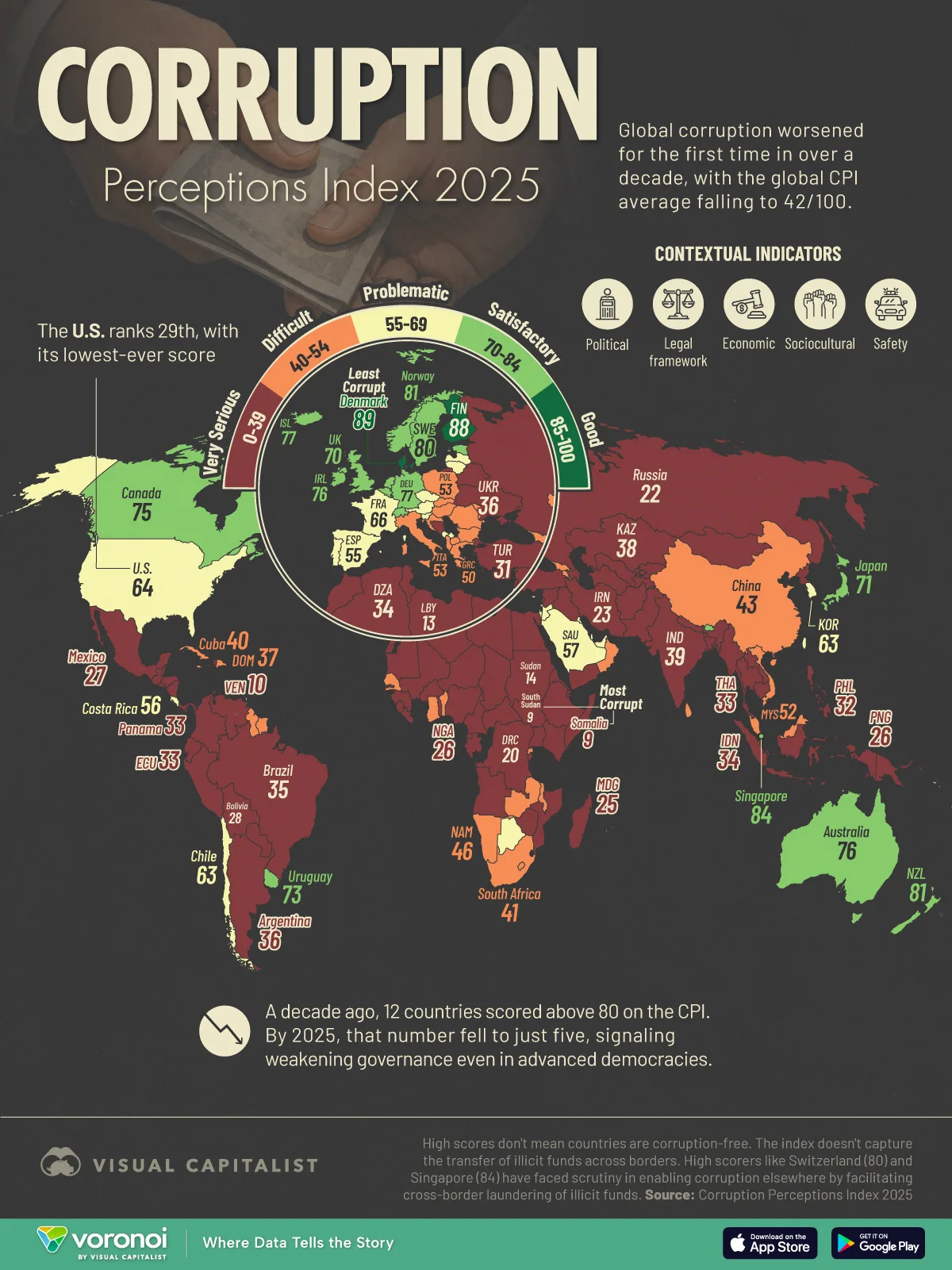
- The global average Corruption Perceptions Index (CPI) score fell to 42 out of 100, the first decline in more than a decade.
- Only five countries now score above 80, down from 12 a decade ago.
- The U.S. ranks 29th with a score of 64, its lowest-ever result in the index.
Corruption perceptions are worsening globally, according to the latest Corruption Perceptions Index (CPI) from Transparency International.
The index scores countries from 0 to 100, with higher scores indicating cleaner perceived public sectors. In 2025, the global average fell to 42, while 122 of 182 countries scored below 50.
This map shows how corruption perceptions compare worldwide, from Denmark’s score of 89 to Somalia’s score of 9.
Fewer Countries Are Considered “Clean”
One of the most striking findings is how rapidly the number of top-performing countries has shrunk. In 2015, 12 countries scored above 80 on the CPI. By 2025, that number had fallen to just five.
This shift suggests that even nations traditionally associated with strong democratic institutions are facing mounting governance pressures. Transparency International points to rising political polarization, weaker institutional trust, and pressure on checks and balances as factors weighing on scores in several advanced economies.
The U.S. is one of the clearest examples of this shift. With a score of 64, it ranks 29th globally and has fallen to its lowest score in the index. The decline reflects growing concerns around transparency and institutional confidence.
Why Corruption Matters Economically
Corruption carries steep economic costs beyond political instability. Research published by the International Monetary Fund has linked corruption to lower investment, weaker economic growth, and reduced government effectiveness.
In many countries, corruption also distorts public spending priorities. Funds intended for infrastructure, health care, education, or climate adaptation can instead be siphoned away through bribery schemes or opaque procurement systems.
The effects are often most severe in lower-income countries, where weaker institutions leave governments more vulnerable to organized crime and state capture.
The Human Cost of Corruption
Beyond economics, corruption also creates significant human risks. Anti-corruption reporting remains especially dangerous in countries with weak governance protections. Since 2012, 150 journalists covering corruption stories outside of war zones have been murdered, with nearly all cases occurring in countries with high corruption levels.
International organizations including the United Nations Office on Drugs and Crime continue to emphasize that fighting corruption requires stronger legal institutions, independent media protections, and cross-border cooperation.
While some countries continue to improve transparency and accountability, the broader global picture suggests corruption remains deeply entrenched and increasingly difficult to reverse.
Learn More on the Voronoi App
Explore more global governance and public opinion data on Voronoi, including this visualization of Which Countries Are The Most Corrupt?.
Read the full article here


