






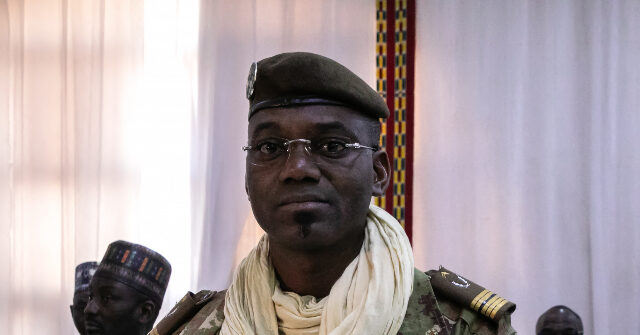
The defense minister of Mali, Gen. Sadio Camara, was killed on Saturday during a major offensive by insurgents linked to al-Qaeda. The offensive included attacks in the national capital of Bamako and a half-dozen other areas, with an as yet unconfirmed number of casualties.
According to Malian state television, the 47-year-old Camara was killed when a car loaded with explosives was driven into his home in the heavily fortified town of Kati, about nine miles north of Bamako. His second wife and two grandchildren were reportedly killed along with him.
The leader of the Malian government, interim president Assimi Goita, also lives in Kati, which until Saturday was considered one of the most secure locations in the entire country. Goita was reportedly “alive and well in a secure location” after the weekend attacks.
Other assaults involving gunfire and explosions were reported in Bamako, the northern towns of Gao and Kidal, and the city of Sevare in central Mali. The fighting in Kidal continued for more than 24 hours and apparently ended with the insurgents taking control of the city, as government forces and mercenaries from Russia’s Africa Corps withdrew from Kidal on Monday.
Mali’s civilian government was overthrown by a coup in 2021, followed soon after by Burkina Faso in 2022 and Niger in 2023. The three juntas have formed an alliance to push back against the disapproval of the African Union (AU), United Nations (UN), and international community.
The Mali junta immediately had trouble with the Azawad Liberation Front (FLA), a separatist movement active in northern Mali since 2012. The struggle with this insurgency is often known as the Tuareg Rebellion, after the ethnic group that forms the bulk of the rebel militias. “Azawad” is the Tuarag name for the independent state they wish to create in northern Mali.
The Malian junta turned to Russia for help, hiring mercenaries from the infamously brutal Wagner Group to put down the rebellion. Wagner mercenaries worked with junta forces in November 2023 to seize control of the city of Kidal.
The Wagner Group was taken over by the Russian state after the highly suspicious deaths of its founders, Yevgeny Prigozhin and Dmitry Utkin, in an August 2023 plane crash. The group has been renamed the “Africa Corps,” and its mercenaries are still employed by the Malian junta.
The FLA has allies as well. On Saturday, an organization linked to al-Qaeda known as the Group for the Support of Islam and Muslims (Jama’at Nusrat al-Islam wal-Muslimin, or JNIM) issued a statement claiming joint responsibility with the FLA for the weekend’s coordinated attacks.
JNIM was formed from the union of four Malian jihadi groups in 2017. It has developed a presence in Niger and Burkina Faso as well, and it seeks to create instability in bordering states like Benin and Togo to expand its influence.
JNIM’s leaders made the formal Islamic pledge of allegiance known as bay’ah to al-Qaeda in January 2023. This allowed JNIM to gain strength by accepting similar bay’ah pledges from smaller jihadi gangs.
Regional security experts are worried that infusions of money, weapons, and manpower from al-Qaeda have made JNIM strong enough to lay siege to cities and fight pitched battles against the Malian military. In its statement on Saturday, the terrorist group and its partners in the FLA said they captured another city called Mopti in central Mali, plus several military bases.
The junta disputed these claims and said battles were still underway for control of towns and bases JNIM claimed to have captured. Russian mercenaries are reportedly fighting for the government in these battles.
“We had been working on this operation for a long time, in a well-planned manner, and in fact, in alliance with JNIM. It was difficult to find any solution without their participation, and there was co-ordination,” FLA spokesman Mohamed Elmaouloud Ramadane told the BBC on Sunday.
Ramadane said Kidal “has not fallen completely,” because “there are still elements of the Malian army and Russian mercenaries there. He said operations were under way to “drive out the last of the Russian fighters.”
U.N. Secretary-General Antonio Guterres said on Sunday he was “deeply concerned by reports of attacks in several locations across Mali.”
“The Secretary-General calls for coordinated international support to address the evolving threat of violent extremism and terrorism in the Sahel and to meet urgent humanitarian needs,” said Guterres spokesman Stephane Dujarric.
Dujarric said Guterres “strongly condemns these acts of violence, expresses solidarity with the Malian people, and stresses the need to protect civilians and civilian infrastructure.”
The Bureau of African Affairs of the U.S. State Department also “strongly condemned” the attacks in Mali.
“We extend our deepest condolences to the victims, their families, and all those affected, and we stand with the Malian people and government in the face of this violence,” the bureau said.
Read the full article here


