








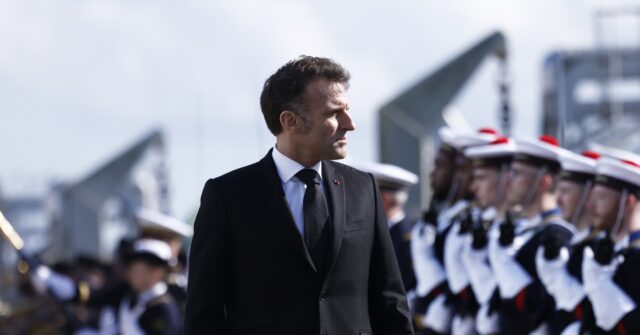
French President Emmanuel Macron said on Monday that Paris is prepared to deploy its aircraft carrier to the Strait of Hormuz “within two or three days” to ensure the free movement of ships in the wake of a peace deal between the United States and Iran.
Speaking ahead of the G7 summit in Évian, France, President Macron doubled down on his commitment to lead an international coalition to ensure that the Strait of Hormuz remains open and ensure the free flow of energy, which has been restricted for months after the Islamist regime in Tehran claimed to have dropped sea mines in the critical waterway connecting the Persian Gulf and Gulf of Oman.
Confirming long-mooted plans for an Anglo-Franco-led mission, Macron said on Monday that the Charles de Gaulle aircraft carrier and “everything that surrounds it” can be deployed to the Strait “within two or three days following confirmation” of a peace deal, Le Figaro reported.
Macron said that France will “defend international law and will do everything to ensure that there is no toll” imposed by the Iranian regime on ships in the waterway, through which around one-fifth of global oil and natural gas supplies flow annually.
It comes after U.S. President Donald Trump announced Sunday evening that his administration had reached a peace deal with Tehran, including the lifting of the American blockade on Iranian ports and the “toll-free” opening of the Strait of Hormuz. “Ships of the World, start your engines. Let the oil flow!” Trump declared.
Shortly following the announcement, British Prime Minister Sir Keir Starmer also confirmed that London is ready to lend its support to ensure that the “Strait reopens and remains fully and permanently open.”

“We will continue to work with partners to support this – including, if required, through standing up the defensive, independent multilateral mission which the UK and France have taken a leading role in planning up to this point, particularly to offer support on mine clearance in an agreed way,” Starmer said.
It remains to be seen, however, how large a naval force can be deployed by the British Royal Navy, which has suffered under decades of spending cuts and other cutbacks.
The lack of readiness of the once vaunted naval power was put on full display in the opening days of the Iran conflict when it took over a week for London to deploy the HMS Dragon after a Royal Air Force base on Cyprus came under fire in a suspected Iranian drone strike. Adding insult to injury, the ship was forced back into port just days later for “maintenance“.
The degradation of Britain’s Navy sparked tensions between London and Washington. While President Donald Trump made an open appeal to the UK to send minesweeping boats to help reopen the Strait of Hormuz, given the longstanding NATO competency of the British at removing sea mines, Prime Minsiter Starmer refused to do so.
Although it was initially speculated that it was a divide between the two allies that caused Starmer’s hesitancy, it was later reported that Britain’s previous fleet of mineseeping boats had been taken out of service months earlier. However, critically, London seemingly used the capability gapping treasury technique of retiring old ships before their replacements had come online to save money.
While the move can potentially save large sums from the defence budget, it can have catastrophic consequences if a conflict breaks out during the interim, as happened with Iran in February. It is currently unclear if the next generation of British mine sweeping boats are now prepared to be deployed to the Strait of Hormuz.
Follow Kurt Zindulka on X: Follow @KurtZindulka or e-mail to: kzindulka@breitbart.com
Read the full article here


