







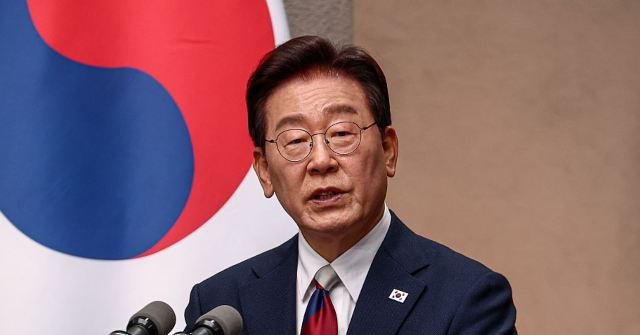
A poll published on Monday found leftist South Korean President Lee Jae-myung marking an approval rating of only 40.2 percent, the lowest documented since he came to power in a special election in 2025.
The lackluster poll performance followed an especially turbulent week in South Korean foreign policy that began with President Donald Trump announcing his plan to reduce the size and scale of “Ulchi Freedom Shield,” joint American-South Korean military exercises that occur every year. Trump described the exercises as needlessly belligerent in the context of his friendly relationship with communist North Korean dictator Kim Jong-un and ribbed Lee for allegedly not sufficiently supporting Washington in its efforts against Iran in the Strait of Hormuz.
Foreign policy and defense were factors in the poor polling, reports suggested, in addition to domestic concerns about housing prices and an ongoing struggle to determine the next Supreme Court nominees.
The poll, reportedly conducted by the firm Realmeter on behalf of the newspaper EKN, found Lee’s disapproval up to 56.9 percent. The 40.2-percent approval rating is the lowest it has documented and the latest in a decline in approval that has spanned six weeks so far. The rating represented a 2.8-percent drop from last week before the military exercise controversy occurred. Lee’s left-wing Democratic Party also saw a sharp decline in support in the past week, dropping six points to 41.9 percent but still about four percentage points above its closest challenger, the conservative People Power Party.
“Realmeter attributed the latest decline to growing distrust over the government’s housing policies amid controversy over a recent proposal to build apartments in Yongsan Park in central Seoul,” the Yonhap News Agency reported, “as well as partisan clashes over Supreme Court Chief Justice Cho Hee-dae’s recommendation of two new Supreme Court justice nominees to the president in writing.”
It noted, however, that approval rating declines among older voters and those who self-identify as conservative suggest that national security and defense issues also negatively affected Lee, particularly the reduction in the size of the Ulchi Freedom Shield exercises.
Realmeter’s poll was somewhat less favorable to Lee than surveys by other firms. A Gallup Korea poll published on August 21 found Lee holding on to 45 percent approval, an increase of just one percentage point from the record-low Gallup documented a week before. This pollster cited foreign policy issues as especially impacting public perceptions of Lee’s effectiveness.
“The pollster did not provide a reason for the increase in his approval rating, though diplomacy was the most frequently cited reason for the positive evaluation at 19 percent,” the Korea JoongAng Daily newspaper reported, “followed by the economy and people’s livelihoods at 11 percent, and overall performance and communication at 7 percent each.”
Gallup Korea cited the dispute with Trump as a specific issue mentioned as raising concerns about Lee’s foreign policy effectiveness.
The conservative PPP defeated Lee in the last regularly scheduled presidential election, resulting in the election of former President Yoon Suk-yeol in 2022. Yoon was impeached and ousted from power after attempting to impose martial law on the country in December 2024, however, outraging liberals and conservatives alike, and ensuring Lee’s win in the 2025 special election despite his defeat to Yoon in 2022.
Sensing political opportunity, PPP leaders have repeatedly condemned Lee in the past week for improperly handling the country’s relationship with America.
“Our military wasn’t even given advance notice, let alone consulted, and our government was excluded from the alliance’s decision,” PPP chief spokesperson Choi Bo-yoon said on Sunday, referring to the canceled exercises.
“North Korea targeted the president by name, throwing around words like ‘flattery’ and ‘double-dealing,’ mocking our government’s ‘pitiful situation’ while firing missiles into the East Sea,” she continued. “What came back in response to our outstretched hand for dialogue wasn’t a handshake — it was a slap in the face.”
Choi was referring to comments by Kim Yo-jong, Kim Jong-un’s sister, published in North Korean state media in which she referred to South Korea as a “puppet” government and mocked the country for the abrupt cancelation of the exercises.
“The ROK [South Korea] cannot let out a single word of protest at the GIs leaving without any mutual coordination at the U.S. chief executive’s unilateral order,” Kim Yo-jong wrote in her statement, carried by the Korean Central News Agency (KCNA). “This is the inevitable fate of the puppet army, whose right to command has been left in the hands of the U.S., and the true situation of the ROK, whose security has been placed at stake due to a reduction of the joint military drill.”
“A sword only carries its dignity when it remains in its sheath alongside the blade. The Lee Jae Myung administration has thrown away the sword and is only showing off the sheath,” Choi said. “Deterrence-free peace, as this government describes it after discarding the sword, is nothing but an empty ideological slogan.”
Trump’s limitations on the war games were announced shortly after Lee had issued a call for peace talks with North Korea to definitively end the Korean War, which began in 1950 and is technically ongoing though an armistice agreement ended active fighting in 1953.
Follow Frances Martel on Facebook and Twitter.
Read the full article here


