
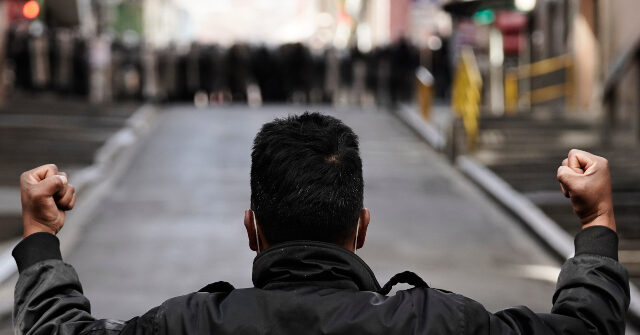
U.S. Secretary of State Marco Rubio reaffirmed Wednesday America’s support to Bolivia and the democratically elected government of President Rodrigo Paz amid a wave of violent nationwide protests and blockades causing shortages of medicine, food and fuel.
“Let there be no mistake: the United States stands squarely in support of Bolivia’s legitimate constitutional government,” Sec. Rubio wrote on social media. “We will not allow criminals and drug traffickers to overthrow democratically elected leaders in our hemisphere.”
The South American nation on Thursday entered the third consecutive week of riots and blockades across its territory staged by the leftist Bolivian Workers’ Union (COB) and other groups — some of which are reportedly aligned with fugitive socialist ex-president Evo Morales.
The violent protesters are calling for President Paz’s resignation and reversal of austerity policies, intended to overturn the dire economic crisis and fuel shortages left by nearly two decades’ worth of disastrous socialist policies under Morales and his successor Luis Arce. The violent blockades have so far left at least four dead and several injured and have caused significant shortages of food, fuel, medicine, and other supplies, particularly for the capital city of La Paz.
Morales, who remains on the run after failing to appear before the court to face pedophilia charges, defended the riots this week, calling them a “popular uprising” against the Bolivian government.
The Bolivian newspaper El Deber reported that as of Thursday morning the protesters have staged 45 different blockades across Bolivia, 17 of which are located around the capital department of La Paz. In contrast, pro-democracy groups and civil society organizations are reportedly planning to hold peaceful protests on Thursday in support of Paz’s government.
On Wednesday, President Paz announced that his government will launch an “Economic and Social Council” and called on Bolivian society to join the initiative and peacefully participate and discuss proposals addressing the country’s issues. He also announced that he will reorganize his cabinet of ministers with new members who are “more agile and better listeners.”
“The demand is ‘we want to be part of the decision-making process,’ and once the government has addressed certain priorities, such as stabilizing the economy, it must be a government for all Bolivians; that was our intention. Yet despite that, some say they want to participate,” Paz said.
At the same time, Bolivian Foreign Minister Fernando Aramayo denounced before the Organization of American States (OAS) that the ongoing violent protests constitute a threat to Bolivia’s democratic order. Aramayo, on behalf of the Bolivian government, called for an international OAS ambassadors’ mission to assess the current situation developing in Bolivia.
President Paz took office on November 2025, ending two decades of monolithic rule under the Movement Towards Socialism (MAS) party. Paz immediately restored Bolivia’s ties with the United States, aligning his country with the U.S. after Morales and Arce had freely let Iran use Bolivia to spread its malign influence in the region.
“Let there be no mistake: those who lost overwhelmingly at the ballot box in Bolivia last year are trying to overthrow President Rodrigo Paz by organizing RIOTS and BLOCKADES with the support of organized crime and drug traffickers,” U.S. Deputy Secretary of State Christopher Landau said in a Tuesday social media post.
“I spoke with my friend President Paz this afternoon, and assured him that the United States stands squarely in support of Bolivia’s legitimate constitutional government and rejects this attempt to substitute the institutional order with mob rule,” he continued.
The protests against the government of President Paz have also caused a diplomatic impasse between Bolivia and Colombia, exacerbated by Colombian far-left President Gustavo Petro. Petro, in a lengthy social media rant published on Sunday, attributed the ongoing protests in Bolivia to a purported “popular insurrection” against President Paz’s government.
The Bolivian government responded to Petro’s claims by expelling the Colombian ambassador to La Paz Elizabeth García over Petro’s “constant interference” in Bolivia’s internal affairs. The Colombian government reciprocated the decision hours later and expelled Bolivia’s ambassador to Bogotá Ariel Percy Molina.
Christian K. Caruzo is a Venezuelan writer and documents life under socialism. You can follow him on Twitter here.
Read the full article here