




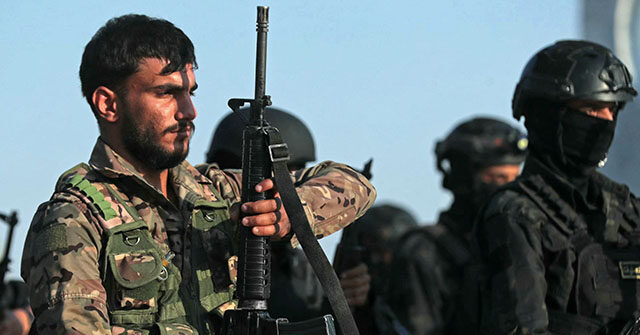
The Syrian Democratic Forces (SDF), a Kurdish-led militia that allied with the United States to definitively topple the Islamic State “caliphate” in 2017, announced on Thursday that it had formally integrated into the Syrian national armed forces, accepting the leadership of President Ahmed al-Sharaa.
The integration completes the commitment the SDF made in January with the government in Damascus – run by members of the al-Qaeda offshoot Hayat Tahrir al-Sham (HTS), which itself has been dissolved into the Syrian armed forces – to accept granting the state a monopoly on military power and preserve federal authority over Syrian Kurdistan, or Rojava. In exchange, Sharaa’s government committed to allowing Kurdish communities to retain their language and culture, though not to the establishment of an autonomous Kurdish state-within-a-state.
The negotiations between the SDF and the Syrian government were brokered in part by the administration of President Donald Trump. Trump was in power when the SDF, comprised of several smaller militias mostly made up of Kurdish fighters, cooperated with the U.S. military to liberate Raqqa, the “capital” of the ISIS “caliphate.” He has also been a vocal supporter of Sharaa and the new Syrian government, which seized power in the country in December 2024 by winning the decade-long civil war and forcing Iran-allied dictator Bashar Assad into exile in Russia. Trump has referred to Sharaa as a “young, attractive” man who he considers competent enough to rebuild Syria following the years of mass emigration, slaughter, and destruction.
The commander of the SDF, Gen. Mazloum Abdi, announced the completion of the SDF’s integration into the Syrian military on Thursday, calling it a “new phase” for his forces.
“This process of integrating our military, security and administrative institutions into the institutions of the state structures has ended and has been fully completed,” he said at an event marking the 100th anniversary of the founding of the Kurdish city of Qamishli. The Sharaa government was represented at the event by presidential aide Ahmad al-Hilali.
According to the Kurdish news outlet Rudaw, the integration has consisted of the Syrian army absorbing many of the SDF’s experienced fighters in units led by SDF commanders, allowing for a more streamlined transition. The outlet noted that Sharaa also promoted an SDF commander to a position as deputy defense minister as a show of respect and recognition of the Kurdish forces’ role in protecting the country from jihadist threats.
Al-Hilali, the Sharaa official attending the event, celebrating the union of the SDF and Syrian army in comments on Friday, calling it “an important and positive development” for the nation. He praised Abdi for offering a “clear declaration of the transition … to the phase of actual implementation of the merger” and promised more “practical steps” to ensure that the SDF remains a competent force, but one within the scope of the Syrian government, rather than an extra-governmental militia.
“These remarks will be translated into practical steps on the ground through the unification of institutions and administrative authority,” he explained, “and the return of state institutions to exercising their full powers – ensuring unity of decision-making and Syrian sovereignty.”
Hilali reiterated Sharaa’s repeated declaration that a peaceful Syria requires the elimination of “parallel entities” effectively governing Syria as a fragmented series of territories rather than one country.
The SDF and the Syrian government announced an agreement in January to bring the militia under the wing of the federal government in Damascus – which, notably, it had not been in during the Assad dictatorship. The agreement alarmed many in the Kurdish community who feared that the al-Qaeda affiliated leaders of the Syrian government would attempt to erase Kurdish identity, particularly in the contexts of clashes documented between HTS jihadists and members of other minorities – such as Christians, Alawites, and Druze – following the end of the civil war.
To address these concerns, the Syrian government promised to recognize “Kurdish cultural and linguistic rights” in Rojava and to consider giving important positions in Syria’s Defense and Interior ministries to soon-to-be former SDF leaders. Damascus insisted that no fighters with ties to Assad would be considered for such positions, however, but the SDF operated in an almost entirely separate sphere of the civil war from the Assad regime during the decade that it raged on. Gen. Abdi justified his decision to enter the agreement at the time by stating it was necessary to “prevent further meaningless bloodshed,” as some clashes had already taken place between HTS and SDF factions. He noted that the SDF agreed to withdraw from regions that were not traditionally part of Rojava but had fallen under SDF control after the collapse of the “caliphate,” such as Raqqa and Deir ez-Zor.
The period immediately following the announcement of the agreement was violent. SDF leaders documented government-affiliated jihadists engaging in beheadings of Kurds, filming the atrocities and posting them online to intimidate Kurdish fighters. The clashes endangered Kurdish control of several prisons holding thousands of ISIS prisoners, most foreigners whose homelands refused to take them back. The Kurds fought back, calling in Kurdish forces from other neighboring countries such as Iran, Iraq, and Turkey to defend their brethren. Washington became directly involved to stop the clashes.
“The President engaged personally not once but twice with al-Sharaa, and he said stop the fighting so that we can move the ISIS prisoners that are there,” Secretary of State Marco Rubio explained in February. “He said, ‘Stop the fighting so that we can move these ISIS prisoners and so that you can — we have more time to work on this reintegration, the integration of the Kurds into the national Syrian forces.”
Gen. Abdi confirmed on Thursday that all non-Syrian Kurdish forces that had come into the country to protect Kurds from jihadist attacks had since returned to their home countries.
Follow Frances Martel on Facebook and Twitter.
Read the full article here


