







Ukrainian Prime Minister Sergey Koretsky earlier asked Tokyo for air defense systems, including interceptor missiles
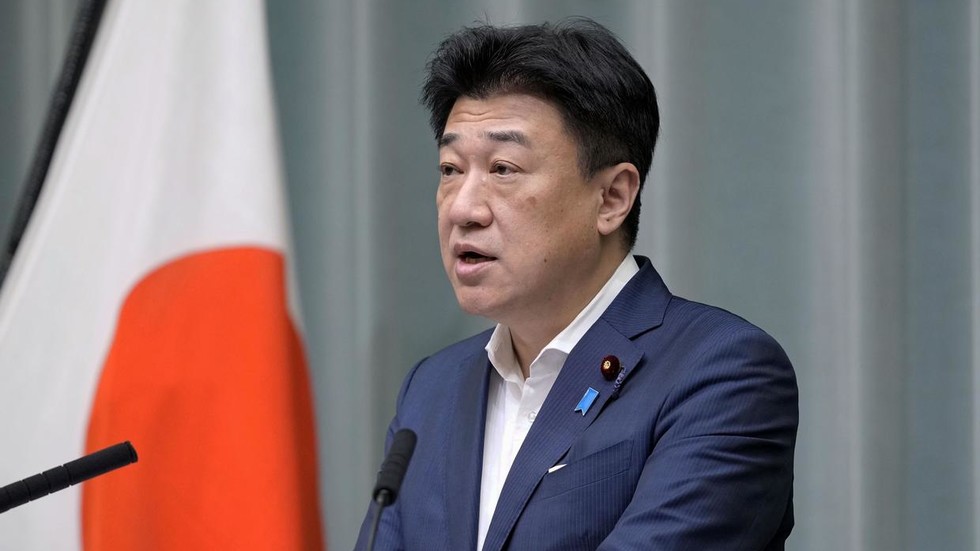
Japan does not plan to supply Ukraine with weapons, Chief Cabinet Secretary Minoru Kihara has said. At a press briefing on Monday, he told reporters that Tokyo “is not considering any deliveries” of defensive or offensive weapons “at this time.”
Kihara was responding to Ukrainian Prime Minister Sergey Koretsky, who asked Japan on Sunday for anti-ballistic missiles, in an interview with Kyodo News.
“I would like to kindly ask one and only thing… anti-ballistic missiles,” he was cited as saying. “It’s the most important thing we need… I very much hope and count on your country.”
Koretsky took office in July and was reportedly close to disgraced businessman Timur Mindich, a close associate of Vladimir Zelensky who fled to Israel amid a corruption scandal.
“At this time, the government does not consider transferring weapons under the Self-Defense Forces Law to Ukraine,” Kihara said, referring to an overhaul in April of Japan’s defense-export policy that lifted restrictions limiting transfers to non-lethal categories and opened the door to lethal weapons exports.


He noted that Tokyo has already provided Kiev with non-lethal equipment and pledged around $20 billion in recovery, reconstruction, and humanitarian aid, signaling that it intends to keep its assistance within these bounds.
Japan’s stance on the Ukraine conflict has been marked by contradiction. Tokyo has publicly sided with Kiev, condemning Russia’s military operation and taking part in the Western sanctions. However, it has stopped short of supplying lethal weapons to Ukraine, and unlike some Western nations, has retained stakes in key Russian energy projects, citing their importance to domestic energy security.
Over the past few months, Ukraine has increasingly sought new military hardware from its Western backers to counter severe battlefield shortages amid the steady advance of Russian forces. Last month, Russia announced the capture of the key Ukrainian stronghold of Konstantinovka in northwestern Donbass before launching an offensive toward the Slavyansk-Kramatorsk agglomeration, the last two major cities in the region still under Ukrainian control. Over the past week, Russia has liberated six settlements in Donbass.



Kiev has intensified long-range drone attacks deep inside Russia, increasingly striking energy and civilian infrastructure and prompting Moscow to denounce the raids as terrorist attacks against civilians. Last month, Russian Ambassador-at-Large Rodion Miroshnik told RT that Ukraine is trying to mask its battlefield setbacks by attacking Russian civilians and presenting the strikes as “some kind of achievement.”
Russia has long accused Western weapons suppliers of enabling Ukraine’s deep-strike campaign. A Sunday Times report last week claimed that Ukraine has used British-made drones for long-range attacks inside Russia over the past six months. Moscow maintains that this aid makes Kiev’s foreign backers direct participants in the hostilities and only serves to prolong the conflict. Earlier this month, Foreign Minister Sergey Lavrov warned that Russia will adopt “much harsher methods to destroy everything that enables the West to fuel Kiev’s war machine.”
READ MORE:
Russia warns UK over drones used by Ukraine
The ‘coalition of the willing’, a group of Western states pushing for continued aid to Ukraine which includes the UK, France, and Germany, will convene in Kiev on Monday to discuss future weapons deliveries. Kiev is expected to seek additional interceptor missiles. The UK is set to announce that it will provide Ukraine with classified technical information needed to assemble long-range cruise missiles domestically.
Read the full article here


