




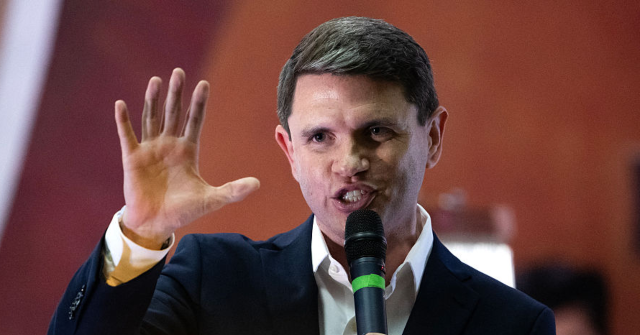
Texas Democrat Senate nominee James Talarico is campaigning on tougher restrictions for data centers and attacking Republican opponent Ken Paxton over contributions connected to the industry, despite previously voting for a 20-year tax incentive for large data centers and benefiting from millions of dollars in political support from donors tied to the data-center and AI industries.
Talarico, a Texas state senator, recently rolled out a proposal calling for tighter regulation of data centers as their rapid expansion becomes an increasingly prominent political issue in the state.
His plan would: establish minimum federal requirements related to the electric grid, environment, jobs, and transparency; repeal Texas’s data center sales-tax exemption; require large energy users to cover their own infrastructure and grid-interconnection costs; mandate closed-loop water systems; give local communities greater power to approve or reject projects; and release government records detailing tax breaks received by individual data-center facilities.
“Texas should be a leader when it comes to innovation and technology, but that only works if Texans get a say and get a share of that economic growth — and that’s not what’s happening right now,” Talarico said while announcing the proposal.
“We’re often told in our politics that we have to choose between policies that are pro-growth and pro-people,” he continued. “I reject that choice, and the plan that we’re outlining today to hold data centers accountable, I think, strikes a balance between welcoming those investments while also protecting working people.”
Talarico has also blamed data centers for rising utility costs, saying, “Data centers are jacking up utility bills across the state of Texas. Billionaire-backed politicians are giving sweetheart tax deals to giant AI companies and then sticking us with the bill.”
His proposal, however, substantially overlaps with measures already proposed by Republican Texas Gov. Greg Abbott. Both have called for ending data-center tax breaks, requiring developers to pay their own grid-interconnection and infrastructure costs, using closed-loop water systems, increasing transparency, and giving communities more protection from unwanted development.
Abbott has additionally proposed annual reporting of electricity and water consumption and best-practice standards addressing concerns such as noise while calling for a ban on data centers in rural communities where residents oppose them.
Talarico said he did not know the details of Abbott’s proposal when asked about the similarities, but said he was “willing to work with anybody, including the governor, to pass these commonsense regulations.”
“It should be plain for anybody to see, whether it’s the governor or whether it’s our campaign,” Talarico said. “All of us are hearing the same thing from Texans all over the state, and that is that we don’t have a balance between welcoming growth and protecting people.”
The Democrat’s current position contrasts with his legislative voting record. In 2023, Talarico voted for legislation that would have created a 20-year tax exemption for qualifying large data centers measuring at least 250,000 square feet and requiring at least 20 megawatts of electricity demand. The legislation ultimately failed.
Twenty megawatts is more electricity than many small Texas cities require. Electricity consumption has become a major concern surrounding the expansion of data centers.
The Democrat candidate’s broader tax record has also become an issue in the Senate campaign. He voted against measures described as providing Texas families as much as $10,700 in additional take-home pay, expanding the child tax credit, and increasing the standard deduction for roughly 12 million Texans. He also voted against banning a death tax, voted for Texas to have a state income tax, voted against requiring voters to have a say before local property taxes were increased, and called eliminating taxes on tips, overtime, and Social Security “deeply immoral.”
Talarico has meanwhile attempted to make Paxton’s financial connections to the data-center industry a central part of his criticism.
During an Aug. 13 interview with MS NOW, Talarico said of Paxton, “He’s taken nearly half a million dollars from data center companies and then he turns around and protects those companies at our expense.”
Talarico renewed that attack in an official statement Monday, saying, “Ken Paxton has taken nearly half a million dollars from the data center industry, voted to flood Texas with data centers by giving them billions in tax handouts, and has refused to use his power as attorney general to respond to Texans’ requests to block data center development in their communities.”
“Now he’s scared his ties to big data center companies will lose him the election, so he’s making a sad attempt to reverse course by releasing a plan he literally used AI to make.”
“Texans can’t afford a Senator who’s bought by big data center companies. Texans can’t afford Ken Paxton’s corruption.”
Paxton has received roughly $400,000 from donors connected to data centers, according to Federal Election Commission records cited in Daily Caller reporting on the race. Talarico, however, has benefited from more than $11 million in support from donors with ties to the data-center industry.
Among Talarico’s most significant financial backers is Epstein-Linked billionaire Reid Hoffman. Hoffman has contributed $10 million to Lone Star Rising, a PAC supporting Talarico, according to FEC filings. Additional information included with the story puts Hoffman’s total support for Talarico at $11.5 million, making his backing the largest from any individual in the race.
Hoffman has publicly advocated for expanding U.S. data-center capacity and energy infrastructure, arguing that the “United States must urgently expand domestic data centers.” Hoffman also has billions of dollars invested in Microsoft, which operates and continues to expand data centers in Texas and elsewhere.
Microsoft has allocated an 80 Billion dollar investment for new AI Data Centers globally over the 3 year span of August 2025-2028, four of which are located in the San Antonio area. In West Texas, Microsoft is building a new datacenter campus that will sit in over 7000 acres and expand global datacenter capacity by approximately 2 gigawatts. This is the largest single capacity addition in Microsoft history.
Stephen Mandel, founder and managing member of hedge fund and investment firm Lone Pine Capital, has contributed roughly $500,000 to Talarico-affiliated groups, including Lone Star Rising, according to FEC filings. Mandel’s investment portfolio includes companies tied to data-center growth, including Talen Energy, which supplies power for data centers, and Teradyne Inc,, which designs and manufactures advanced industrial robotics for major technology companies.
Simone Coxe has also donated $500,000 in two installments to Lone Star Rising. Her husband, Tench Coxe, is a director at Nvidia and serves on several of the company’s committees. Nvidia promotes the expansion of AI data centers and has been involved in projects in West Texas and Fort Worth. Simone and Tench Coxe are also part-owners of Major League Soccer’s Austin FC.
Talarico has faced questions about an Aug. 13 data-center roundtable in Abilene after his campaign excluded local reporters while allowing MS NOW inside. The campaign described the event as a private discussion meant to let residents speak freely without cameras, though MS NOW recorded portions and Talarico’s campaign later released a 14-minute video from inside.
When Abilene Reporter-News reporter Lauren Dossey asked why local media had been shut out, Talarico said the campaign wanted residents to be able to speak honestly before holding a separate press availability, after which a campaign aide told reporters, “Let’s stick to data center topics.”
The Abilene Reporter-News reported the event “was closed to the press except for MS NOW, a national news outlet.”
Read the full article here


