







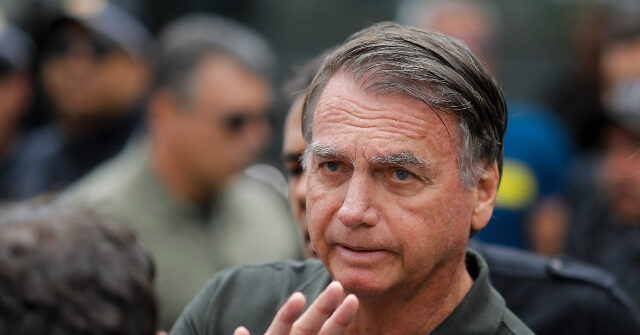
Brazilian Supreme Federal Tribunal (STF) Justice Alexandre de Moraes granted on Tuesday a temporary 90-day house arrest benefit to conservative former President Jair Bolsonaro after he spent over a week at an Intensive Care Unit (ICU) due to bacterial pneumonia.
De Moraes, however, barred Bolsonaro from engaging with political allies while under house arrest — at a time when Brazil is about to start its 2026 presidential campaign.
Bolsonaro, who turned 71 on Saturday, is presently serving a 27-year prison sentence after the STF convicted him for allegedly leading a purported “coup” plot to overturn the results of the 2022 presidential election, which he narrowly lost against current socialist President Lula da Silva. For months, the STF has repeatedly rejected humanitarian house arrest requests filed by Bolsonaro’s legal team in light of the numerous health conditions he suffers — in addition to significant and recurring complications directly related to the 2018 failed assassination attempt against Bolsonaro, which have so far required several surgeries over the past years.
Bolsonaro formally began serving his “coup” sentence at the Regional Superintendency of the Federal Police in Brasília in November after spending months under a strict house arrest with 24/7 surveillance at his residence in Brasília under de Moraes’ orders. In January, he was transferred to a prison cell inside Papudinha (“Little Papuda”), located inside the larger Papuda Prison Complex in the Brazilian capital.
Bolsonaro was admitted to the DF Star Hospital’s ICU this month after he was diagnosed with bacterial bronchopneumonia in both of his lungs. Since March 13, the former president has been receiving an antibacterial treatment, and was discharged from the ICU on Monday after his doctors announced that the treatment led to a “clinical improvement” of his current state of health; however, he remains hospitalized at press time recovering from the bronchopneumonia.
On Tuesday, de Moraes authorized granting house arrest to Bolsonaro on humanitarian grounds, but only for an initial period of 90 days starting from the date he is discharged from the hospital. The Justice announced that the decision was issued in response to a new house arrest request filed by Bolsonaro’s legal team after he was hospitalized this month, in which his medical team confirmed that Bolsonaro needs to be under continuous monitoring and requires a prompt response to potential complications, “which would be unfeasible under the current prison conditions.”
The ruling also comes a day after Brazilian Attorney General Paulo Gonet submitted a recommendation to the STF in favor of granting house arrest to Bolsonaro due to his health issues. The STF stated on Tuesday that de Moraes had previously noted that the conditions at the Papudinha prison facility were “adequate to ensure safe and appropriate treatment for the former president, ‘with absolute respect for his health and dignity.’” According to the justice, the established procedure “was extremely efficient,” allowing for his immediate transfer to a private hospital without the need for any specific judicial authorization.
The STF’s press release reads in part:
However, according to the Justice, the exceptional nature of his health condition, as evidenced in the case file, demonstrates that “granting temporary humanitarian house arrest is the most reasonable course of action for the full recovery of the detainee,” with a subsequent medical examination to determine a possible extension of the term.
As per the terms of de Moraes’ house arrest ruling, Bolsonaro must serve his sentence at his residency in the Brazilian capital, and must wear an electronic ankle monitor. He also authorized regular visits from his children and attorneys “under the same legal conditions as those in a prison facility,” as well as regular medical visits without the need for prior notice, subject to previously established judicial determinations.
“Bolsonaro is prohibited from using a cell phone, telephone, or any other means of external communication, either directly or indirectly, through third parties. Failure to comply with these rules will result in the revocation of house arrest and a return to closed detention or, if necessary, to the prison hospital,” the STF informed.
Additionally, CNN Brasil reported, de Moraes restricted Bolsonaro from engaging in direct contact with politicians and allies. The initial 90 days of house arrest granted to Bolsonaro, CNN Brasil pointed out, coincide with the start of the 2026 electoral campaign in Brazil, during which electoral authorities open a window for party registrations, party switches are finalized, and pre-candidates resign from their current elected positions to begin their respective campaigns.
One of Bolsonaro’s sons, presidential candidate hopeful Senator Flávio Bolsonaro, described the house arrest orders for his father as “exotic” and “contradictory” during an interview with GloboNews, due to the 90-day temporary nature, asserting that “provisional” house arrests are not contemplated in the nation’s laws.
The younger Bolsonaro said that the period of time from November to January his father spent detained at the Federal Police superintendency was “completely inadequate” for his father’s health. He also disclosed that former First Lady Michelle Bolsonaro must permanently accompany Jair Bolsonaro at his home, but that she will receive professional assistance to take care of the former President.
“I believe he will have nursing or medical care there. This will have to be arranged by the family to prevent episodes of dizziness or falls,” Sen. Bolsonaro said.
Christian K. Caruzo is a Venezuelan writer and documents life under socialism. You can follow him on Twitter here.
Read the full article here


