




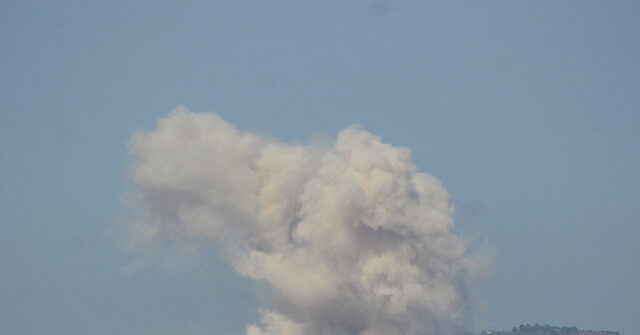
Israel’s security operation against the Iran-backed terrorists of Hezbollah in southern Lebanon continued on Wednesday, as the landmark peace talks between Israel and the Lebanese government seemingly stalled out in Rome.
Both U.S. mediators and Lebanese President Michel Aoun expressed optimism on Tuesday about the next round of talks, scheduled for September and once again to be held in Rome – but the current round began with much enthusiasm and ended on August 6 with few resolutions.
Aoun said negotiations with Israel were “progressing,” and he remained determined to “rebuild the state, whatever the cost.”
“There is no disagreement among the Lebanese on the goals, from the Israeli withdrawal and the return of the prisoners to the reconstruction of what has been destroyed,” the president, who is a Maronite Christian, told delegates from the Maronite Foundation in the World.
“In the end, we will not allow Israel to remain on even a single inch of our land, nor will we allow a single Israeli soldier to remain on our soil,” he declared.
Despite this tone toward the Israeli occupation, Aoun made several comments indicating that the real hurdles to achieving peace are Hezbollah and other militant Lebanese factions.
“It is time for the son of the South to rest and settle on his land, rather than allowing wars to continue to be waged in his name for non-Lebanese objectives,” he said, alluding to Hezbollah’s attack on Israel in March that triggered the Israeli operation in response.
A U.S. State Department official told the Times of Israel (TOI) on Tuesday that “we feel good about the trajectory” of the Israel-Lebanon talks.
Another State Department spokesperson said last week’s round of talks was “constructive,” and established the “parameters” of a process by which Israel might feel safe about handing off the difficult task of disarming Hezbollah to the Lebanese Armed Forces (LAF).
The spokesperson expected a few successful trial operations to “unlock future pilot zones” where Lebanon could take over. Two such pilot zones have already been established.
“At the next round of technical talks, Lebanon will present detailed roadmaps for securing new areas as implementation proceeds in the current pilot zones,” the State Department spokesperson said.
“We need to work through important details, including who verifies the LAF’s clearance operations. Once those details are clear, the process will move much faster,” the spokesperson added. A major stumbling block so far has been vetting Lebanese military personnel to ensure they are both willing and able to disarm Hezbollah.
Another obstacle is the formation of a third-party committee that will verify Hezbollah’s disarmament in each pilot zone, to the satisfaction of both Israel and Lebanon.
An “official familiar with the matter” told TOI that Israel is “rejecting the inclusion of countries that have sought to act against it in international forums.” That would, quite frankly, be a very long list of unacceptable committee members.
“Both sides face political constraints. We are working through them methodically because shortcuts produce the same failed outcomes we have seen for decades. The direction of travel remains positive, and nobody is dragging their feet on implementation,” the State Department spokesperson said.
“We are not naive about the difficulties. Hezbollah is trying to sabotage the process, and both Israel and Lebanon are democracies under domestic political stress. But the fact that the teams sat together, communicated directly, and generated options is itself a structural change,” the spokesperson added.
A further complication is the impending expiration of the mandate for UNIFIL, the United Nations Interim Force in Lebanon. The peacekeeping operation was established in 1978 and its mandate is due to expire on December 31, 2026. U.N. Secretary-General Antonio Guterres has presented options to the U.N. Security Council (UNSC) for renewing UNIFIL’s mandate with a reduced presence. Much of UNIFIL’s staff was withdrawn after Hezbollah attacked Israel in March and Guterres’ plan could reduce the remaining footprint to as little as 900 troops.
Another possibility would be replacing UNIFIL with a multinational peacekeeping force, somewhat like the force envisioned for Gaza in President Donald Trump’s peace plan. Italy, France, and Germany have already called for a three-year European mission to Lebanon, either to replace or augment UNIFIL.
There is not much enthusiasm for preserving UNIFIL by any party to the conflict, as the U.N. peacekeeping mission has had almost zero impact on the current conflict. The Lebanese criticize UNIFIL for doing little to prevent Israeli bombing and occupation, while the Israelis condemn UNIFIL for failing to keep its 20-year-old commitment to disarm Hezbollah.
Even supporters of the U.N. operation admit that it can do little against Hezbollah without support from the Lebanese government and armed forces, which have also failed to disarm or restrain the Iran-backed terrorist militia.
“International forces can monitor and support peace, but they cannot substitute for domestic and regional agreement to uphold it,” Lebanese political scientist Imad Salamey told Al Jazeera News on Tuesday.
“Expecting UNIFIL to forcibly disarm Hezbollah or compel Israel to withdraw or cease violations goes beyond the enforcement authority it was actually given,” Salamey argued, raising the question of what purpose the U.N. operation really serves, beyond dutifully recording airstrikes and artillery barrages from both sides.
“Under the latest Lebanon ceasefire arrangement, the US and Israel have clearly sidelined UNIFIL, along with various other members of the international community,” International Crisis Group analyst David Wood told Al Jazeera.
“UNIFIL does not play a key role on the ground in implementing the ‘pilot zones’ scheme, and – unlike under the previous truce deal – it no longer occupies a seat on the ceasefire monitoring mechanism,” Wood noted.
While the next round of Rome talks is scheduled and the fate of UNIFIL is decided, Israel continued its security operations in Lebanon. The LAF complained on Wednesday that Israeli strikes and demolitions were compromising its ability to take over disarmament in the pilot zones, as well as subjecting civilians to continuing hardships.
“Israeli occupation forces continue their attacks and violations of existing understandings and international law,” the LAF said in a statement on Wednesday.
“The latest incident involved the demolition of the Zawtar Sharqieh municipality building in Nabatieh, in addition to the official school, dispensary, childcare center, and several homes in the town,” the statement said. “This confirms the occupation’s continued destructive approach aimed at causing the greatest possible damage to villages and towns in southern Lebanon and preventing the establishment of stability.”
“At the same time, the Lebanese Army continues to carry out its missions in the south, where it faces significant difficulties as a result of these attacks, which are hindering the completion of its deployment and the return of residents,” the LAF added.
Israeli Defense Minister Israel Katz on Wednesday instructed his forces to prepare for a long stay in Lebanon, insisting that “under no circumstances” would Israel withdraw from vital security positions in Lebanon, Syria, or Gaza.
Katz toured Israeli positions in southern Lebanon, and congratulated Israel Defense Forces (IDF) troops for their success at dismantling “terrorist infrastructure” like Hezbollah’s extensive tunnel networks.
“As the prime minister and I have made clear, we will not withdraw from this area,” he said.
Israeli officials told the Jerusalem Post on Tuesday that the LAF is “not doing enough” to disarm Hezbollah after three weeks of controlling the first few pilot zones. The Israelis cited reports that Hezbollah’s “civilian wing” is still operating in at least one of the pilot zones.
Read the full article here


