
Spain’s prime minister is facing a complaint at the International Criminal Court alleging his government enabled Iran’s “terror machine” through dual-use exports, with the legal group behind the filing arguing that responsibility for war crimes extends to those who provide the means.
The complaint, filed Tuesday by Israeli legal advocacy group Shurat HaDin under Article 15 of the Rome Statute, calls on prosecutors in The Hague to open a criminal investigation — and consider issuing an arrest warrant — against Spanish Prime Minister Pedro Sánchez and other senior officials.
The complaint alleges that Spain’s socialist government approved the transfer of approximately €1.3 million in dual-use components to Iran in 2024 and 2025, including materials linked to detonators and explosive systems.
According to the filing, the items were not benign industrial goods but “critical components that enable explosive devices to function,” transferred under circumstances in which their use in attacks against civilians was foreseeable.
At the core of the case is the allegation that materials classified as civilian “dual-use” goods function as essential components in weapons systems.
Shurat HaDin argues that under international law, supplying essential components that render weapons operational can constitute aiding and abetting war crimes and crimes against humanity — even when classified as dual-use.
The complaint further states that Iran — widely described as the world’s leading state sponsor of terrorism — has long armed proxy terrorist groups, including Hezbollah, Hamas, and the Houthis, which rely on such systems and rockets directed at civilian populations. The complaint also points to Iranian messaging as evidence that Tehran viewed Spanish policy as supportive.
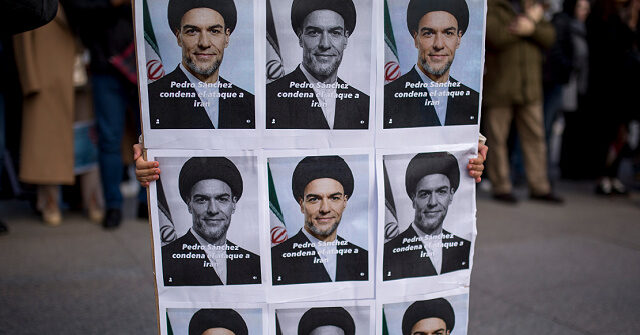
Iranian state-linked outlets circulated footage and images showing ballistic missiles bearing stickers featuring Sánchez alongside the message, “Thank you, Prime Minister,” after the Spanish leader condemned U.S.-Israeli military operations as “illegal.”
Israeli officials seized on the imagery, with the Foreign Ministry warning that Iran’s regime was placing the Spanish leader’s words “on the missiles it fires at civilians in Israel and the Arab world.”
While Sánchez has repeatedly criticized U.S. and Israeli military actions — including in late March when he described the conflict as an “absurd, cruel and illegal” campaign — his government is accused of facilitating transfers of components ultimately used by the Iranian regime and its proxies.
In line with that stance, Sánchez’s socialist government denied American forces access to key bases and ultimately barred U.S. aircraft involved in the campaign from using Spanish airspace, with the prime minister telling lawmakers that “all flight plans involving operations in Iran have been rejected.”
Earlier reports in Spanish media during the initial phase of the operation, however, suggested logistical activity linked to U.S. missions continued to pass through Spanish facilities, highlighting a gap between political messaging and operational reality before the restrictions were fully enforced.
The policy drew a sharp response from Washington, with a White House official stating that the U.S. military “does not need help from Spain or anyone else” to meet its operational goals.
Relations between Israel and Spain have deteriorated sharply since Madrid recognized a Palestinian state in 2024 and escalated its criticism of Israel’s war against Hamas, with both countries withdrawing ambassadors.
Tensions escalated further last Friday when Israeli Prime Minister Benjamin Netanyahu accused Spain of hostility toward Israel and removed Madrid from a U.S.-led mechanism coordinating postwar Gaza stabilization efforts.
The deterioration in ties has also included repeated public rebukes, with Israeli officials summoning Spanish diplomats and condemning Madrid’s rhetoric toward the Jewish state in recent months.
In a move that drew additional criticism, Spain last Thursday announced it would reopen its embassy in Tehran during the ongoing ceasefire window, positioning itself as a potential mediator in talks with Iran.
Israeli officials condemned the decision that same day, warning it signaled dangerous proximity to a regime they accuse of sponsoring terrorism across the region.
Shurat HaDin President Nitsana Darshan-Leitner said the case centers on whether providing the components that enable attacks can make officials legally responsible for the consequences.
“When a prime minister enables, directly or indirectly, the transfer of components that strengthen the Iranian regime’s terror machine, he cannot continue to present himself as someone acting in the name of human rights,” she said.
“It is impossible to condemn Israel in the international arena, while at the same time assisting a regime that arms terrorist organizations and attacks innocent civilians,” Darshan-Leitner added, stressing that responsibility for war crimes “does not stop only with those who pull the trigger, but also extends to those who provide the means that enable the shooting.”
There was no immediate response from Spanish officials to the complaint.
Joshua Klein is a reporter for Breitbart News. Email him at [email protected]. Follow him on Twitter @JoshuaKlein.
Read the full article here