






The Iran-backed Lebanese terrorist group Hezbollah launched missiles and drones at Israel on Sunday night, ostensibly in revenge for the death of Iranian Supreme Leader Ayatollah Ali Khamenei.
Israel responded with precision airstrikes that eliminated several senior Hezbollah leaders, and urged the government of Lebanon to “act forcefully” against the group.
Hezbollah Secretary-General Sheikh Naim Qassem mourned the “martyrdom” of Khamenei in a statement on Saturday and vowed revenge.
“The targeting by the tyrannical American aggression and the criminal Zionist entity of Sayyed Khamenei, along with a group of leaders, officials, and innocent Iranian civilians, represents the pinnacle of criminality,” Qassem said.
“We in Hezbollah and the Islamic Resistance in Lebanon, along with all supporters and backers of this authentic Khomeini line, will continue the path with determination, steadfastness, and a martyrdom-seeking spirit that knows neither weariness nor surrender, and does not accept humiliation,” he vowed.
Hezbollah eulogized Khamenei as the “sun that radiates light” who supposedly inspired the entire Muslim world.
“Hezbollah — leadership, fighters, and a resistant, believing, patient, and steadfast society — reaffirms its firm and eternal pledge to the martyred Sayyed Leader,” the group said.
On Sunday night, Hezbollah said it had launched “a barrage of rockets and a swarm of drones” at an Israeli missile defense site south of Haifa.
According to the Israeli Defense Forces (IDF), several projectiles from Lebanon fell into empty areas, and one was intercepted in flight after entering Israeli airspace. No significant damage was reported.
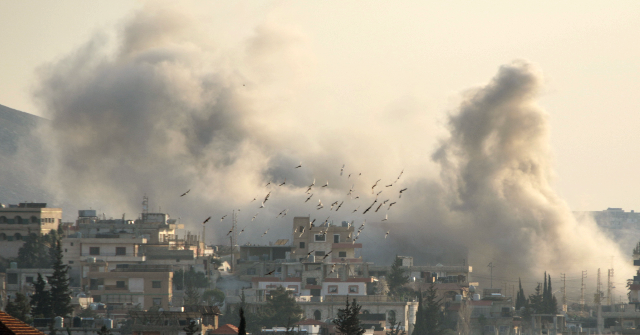
Israel responded with strikes that reportedly killed multiple Hezbollah leaders in southern Lebanon, including Hezbollah intelligence chief Hussein Maklad. The IDF said Maklad was “involved in planning and executing terror attacks against Israel and its citizens.”
The Lebanese Ministry of Public Health said at least 52 people were killed in Israel’s retaliatory strikes, and another 154 wounded.
“The Hezbollah terrorist organization brings ruin to the State of Lebanon, and the IDF will forcefully respond to such actions,” the Israeli military said.
“Hezbollah opened a campaign against Israel overnight, and is fully responsible for any escalation,” said IDF Chief of Staff Lt. Gen. Eyal Zamir.
“Any enemy that threatens our security will pay a heavy price — we will not allow any harm to come to the people of Israel and our northern border,” Zamir said.
“The Lebanese government and Lebanese Armed Forces have been warned numerous times to disarm Hezbollah recently. They did not act, and so we know how to defend ourselves with our own means. We will end this campaign with not just Iran being struck but with Hezbollah suffering a devastating blow,” he said.
IDF spokesman Brig. Genl Effie Defrin said on Monday that “all options are on the table” in the event of further hostilities from Hezbollah, including ground action.
“We will work to disarm Hezbollah from its weapons and remove threats to Israeli citizens,” Defrin said.
Israel conducted more strikes in Beirut and southern Lebanon on Monday, targeting over 70 weapons caches and missile launch sites. Defrin said the IDF ordered evacuations from over 50 villages in southern Lebanon to move civilians out of harm’s way.
Lebanese Prime Minister Nawaf Salam on Monday denounced Hezbollah’s attack on Israel as “an irresponsible and suspicious act that endangers Lebanon’s security and safety.”
Salam said his government was prepared to “take all necessary measures to stop the perpetrators and protect the Lebanese.”
“We will not allow the country to be dragged into new adventures,” he said.
Lebanese President Joseph Aoun denounced both Hezbollah’s attack and Israel’s retaliation, saying that his government wishes to “keep Lebanon away from the dangerous military confrontations taking place in the region.”
“The Lebanese state has repeatedly warned of the consequences of regional escalation on the country and has called for prudence and responsible action guided by the national interest,” he said.
“Persisting in using Lebanon once again as a platform for wars we have no part in will expose the country to new risks,” he warned.
Aoun said during an emergency cabinet meeting that Hezbollah “wants to drag the country to matters that we have nothing to do with.”
Salam and Aoun both stressed that the Lebanese state should make decisions regarding war and peace, not Hezbollah. On Monday, Salam announced a “ban on Hezbollah’s military activities” and called on Lebanese security forces to “prevent any attacks originating from Lebanese territory.”
“We declare our rejection of any military or security operations launched from Lebanese territory outside the framework of legitimate institutions,” he said.
Hezbollah responded by sneering at the “weakness and deficiency” of the Lebanese government.
“We understand the Lebanese government’s impotence in the face of the brutal Zionist enemy, which violates national sovereignty, occupies land, and poses a continuous threat to the country’s security and stability,” the terror group said.
The Lebanese government has ostensibly been working on clearing Hezbollah weapons from the southern part of the country, in accordance with the November 2024 ceasefire agreement between Hezbollah and Israel.
Lebanon said in January that it completed the first phase of the disarmament plan, and would need at least four months to complete the second phase.
Read the full article here


